
The Untapped Potential of Tea Tree Water in Modern Skincare Formulation
Here’s a number that should make any brand owner pause. Only 38% of consumers familiar with clean beauty say they trust that products labeled “clean” are truly free from harmful ingredients. Interest is high. Trust is low.
That gap is your opening.
Shoppers with oily, blemish-prone skin want something gentle that still feels like it works. They’re tired of harsh formulas that strip the skin and leave it angry. And the money is following that shift. Mordor Intelligence estimates the anti-acne cosmetics market at $5.12 billion in 2025, growing to $8.28 billion by 2031. Different research firms count things differently, so treat any single figure as a rough guide. Still, the direction is pretty clear.
Where Tea Tree Water Fits In
Most people know tea tree as an oil. Strong smell, strong reputation, and a habit of irritating skin when it’s used too heavily. Tea tree water is the quieter cousin. Also called tea tree hydrosol, it’s the water-based part collected when tea tree leaves are steam distilled. On an ingredient list, you’ll usually see it as Melaleuca Alternifolia Leaf Water.
That makes it a good fit for toners, mists, gel cleansers and light serums. Think skin that’s been through heat, sweat, masks and friction (the whole “maskne” crowd). It gives you botanical appeal without the heavy hand of an oil.
One honest note: I haven’t found clinical studies on tea tree water itself, so claims need to stay modest and be backed by testing on your finished product.
The Catch Nobody Likes to Talk About
Here’s the hard part. Hydrosols are mostly water, and “tea tree water” can mean very different things depending on who’s selling it. Some are true distillates. Some are just water with fragrance added. If you can’t trust what’s in the drum, you can’t trust what’s in your formula.
So the real challenge isn’t finding tea tree water. It’s finding a consistent, pure, lab-verified supply. We’ll start by clearing up what it actually is.
Beyond the Oil: What Exactly is Tea Tree Water (Melaleuca Alternifolia Leaf Water)?
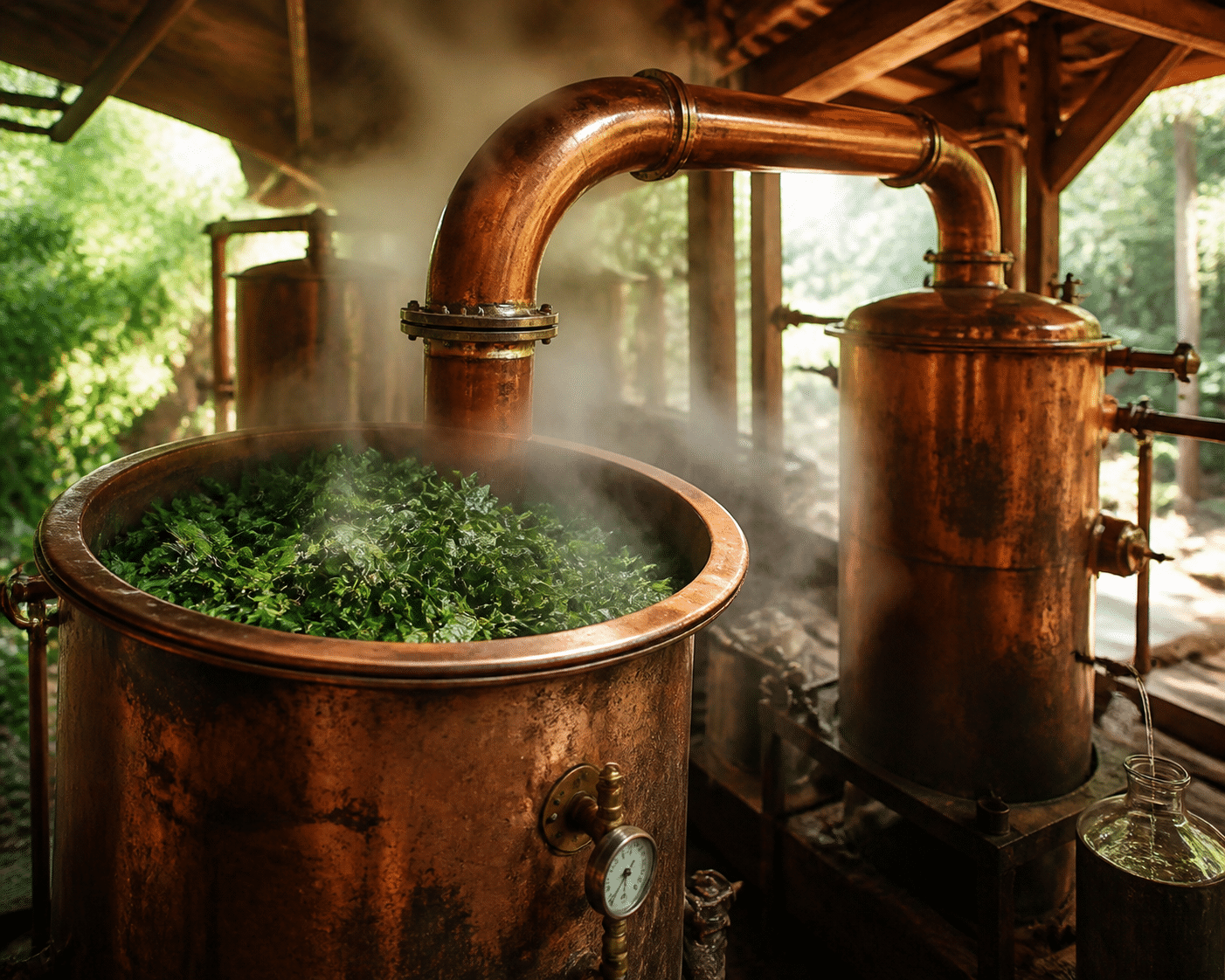
Picture a big steel pot, a pile of tea tree leaves, and a lot of hot steam. That’s basically where tea tree water starts.
How Steam Distillation Makes Two Products
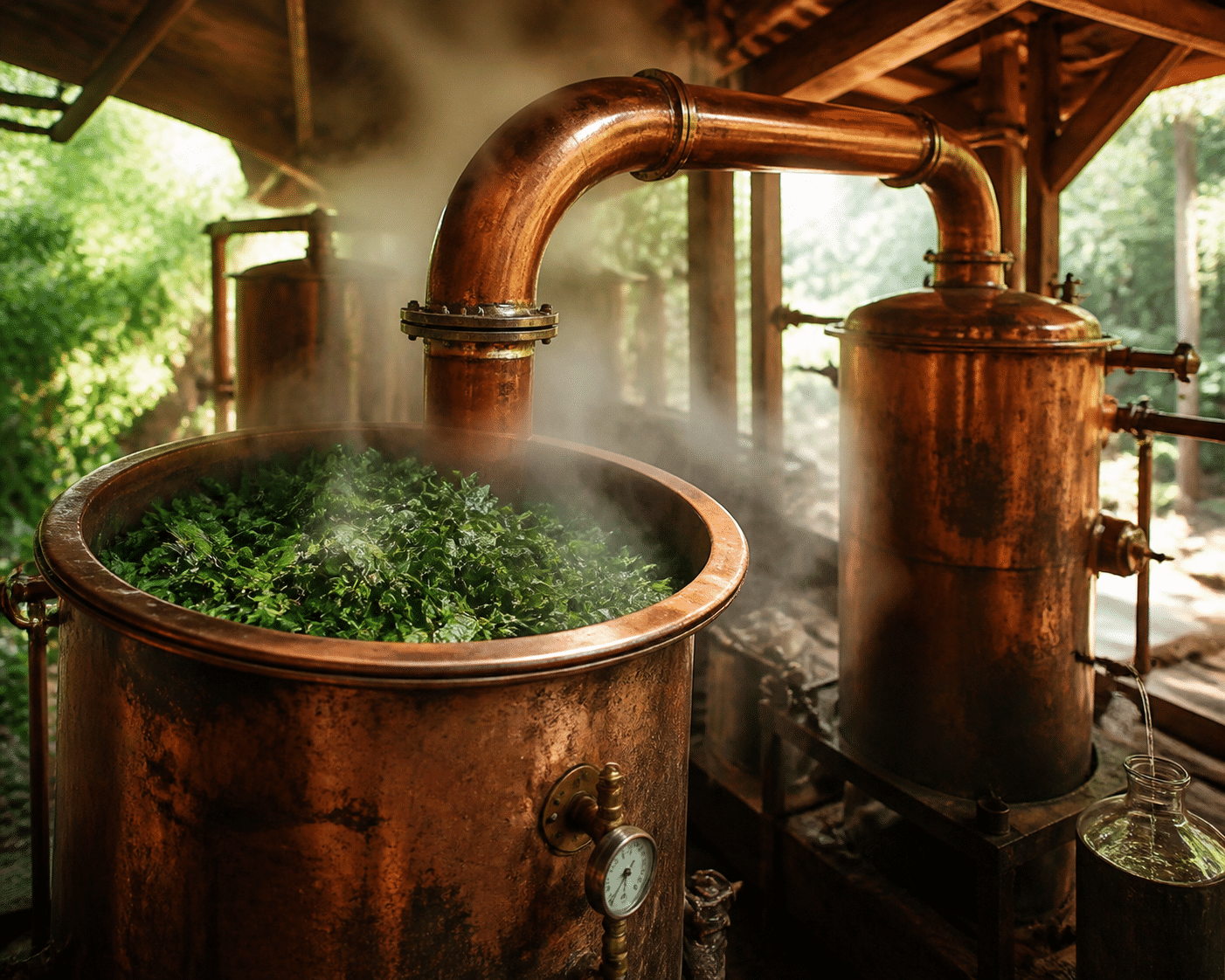
Here’s the simple version of what happens in the still:
- Steam passes through fresh Melaleuca alternifolia leaves.
- The steam picks up the plant’s volatile compounds.
- A condenser cools it back into liquid.
- The liquid settles and separates. Oil floats on top, and water sits below.
The oil is the essential oil. The water underneath is the hydrosol, the part that holds the water-loving (hydrophilic) compounds. It’s a co-product, not a leftover. You get both from the same run, but they behave very differently in a formula.
What’s Actually in the Water
The key marker in tea tree is terpinen-4-ol. In the oil, it’s big. ISO 4730:2025 sets the range at roughly 35 to 48% of the oil. In the water? Tiny. One supplier monograph puts total dissolved tea tree volatiles at around 500 to 2,000 ppm, which is only 0.05 to 0.20%.
Those numbers are rough, and they shift from batch to batch. But the point holds. Less of the strong stuff means a softer feel on skin, which is why toners and mists are such a natural home for it. (It also means you shouldn’t expect oil-level punch. Don’t promise it.)
Real Hydrosol vs. Lookalikes
Now the part that trips up a lot of buyers. Several products wear the name “tea tree water,” and they aren’t the same thing. As one bulk buyer guide points out, hydrosols and floral waters get mixed up all the time in B2B trade.
| Type | How it’s made | What to watch for |
|---|---|---|
| True hydrosol | Water collected straight from distillation | Should come with a batch COA and GC/MS data |
| Essential oil dilution | Plain water with oil added later | Not a distillate, so it can’t honestly use the same name |
| Fragrance water | Water with fragrance, solubilizer or aroma chemicals | Ingredients should be disclosed, and it shouldn’t be called pure |
This matters for your label too. Melaleuca Alternifolia Leaf Water on an INCI list should mean a real botanical distillate. If your supplier can’t explain how the material was made, that’s a red flag. Ask for the botanical name, plant part, distillation method and batch date. No paperwork? No deal.
So the identity question is settled. Next comes the harder one: what the evidence says it can actually do.
The Science-Backed Efficacy: Why Tea Tree Water is a Skincare Powerhouse
Let’s be straight about something first. “Powerhouse” is a big word, and the research doesn’t fully back it up for the water. Not yet.
What we do have is strong evidence for tea tree oil, plus good reasons to think the water is a softer, lower-dose cousin. That’s still a story worth telling. You just have to tell it carefully.
What the Research Says About Acne Bacteria
Tea tree oil has the better paper trail. A 2026 systematic review and meta-analysis pulled together seven clinical studies with 445 acne patients. Acne severity dropped compared with controls, and side effects were mostly mild and local. That’s the oil, though.
The water is a different animal. It carries far fewer of the active volatiles, so you can’t copy those results over and call it a day. And hydrosols as a group are a mixed bag. One antibacterial comparison found that lavender hydrosols had no antibacterial activity at all.
So what can you say about Cutibacterium acnes? Something like this: tea tree comes from a plant with a long record in blemish care, and the water offers a lower-intensity way to bring that botanical story into a formula. Don’t say it kills acne bacteria. Don’t say it treats infection.
Soothing, Calming and Oil Balance
Now the other two claims people love: anti-inflammatory and sebum-balancing. I couldn’t find direct clinical data on tea tree water for either one. (I looked. Twice.) A 2026 Healthline update says the same about hydrosols in general, that safety and effectiveness evidence is still limited.
Here’s what holds up. Hydrosols have lower levels of the volatile compounds linked to irritation, so they tend to feel gentler. A water-based toner or mist can also feel fresh and clarifying on oily or combination skin, without that tight, stripped feeling. That’s a sensory benefit you can test.
If you want to claim reduced redness or less shine, test the finished product. Panel studies, a sebumeter, and irritation testing will tell you more than the botanical name ever will.
Tea Tree Water vs. Tea Tree Oil
Here’s a quick side-by-side to help you decide where each one belongs.
| Factor | Tea Tree Water | Tea Tree Essential Oil |
|---|---|---|
| Potency | Low. Very dilute volatile content | High. Concentrated, strong aroma |
| Application | Toners, mists, gel cleansers, light serums | Spot treatments, small-dose boosters |
| Skin suitability | Usually gentler, but still needs patch and tolerance testing | Higher risk of irritation and sensitization, especially at higher levels |
| Formulation phase | Water phase, replaces part of the water | Oil phase or needs a solubilizer |
| Evidence base | Limited, no direct clinical data found | Stronger clinical record for acne |
| Claims you can make | Modest: refreshing, soothing feel, botanical | Broader, but still regulated by market |
| Main watch-out | Needs a solid preservation system | Dose control and oxidation |
Neither one wins outright. They do different jobs, and some brands use both.
One practical tip: ask your supplier for batch data before you build claims around the ingredient. Aroma Monk, for example, promotes lab-tested, traceable materials, which is the kind of paperwork that makes testing your finished product much easier.
Next up, let’s look at how to actually get this stuff into a formula.
3. From Concept to Shelf: Incorporating Tea Tree Water into Your Product Line
Here’s the nice part. Tea tree water doesn’t ask you to rebuild your formulas from scratch. It goes into the water phase, so most of the time you’re swapping, not starting over.
Where Tea Tree Water Fits Best
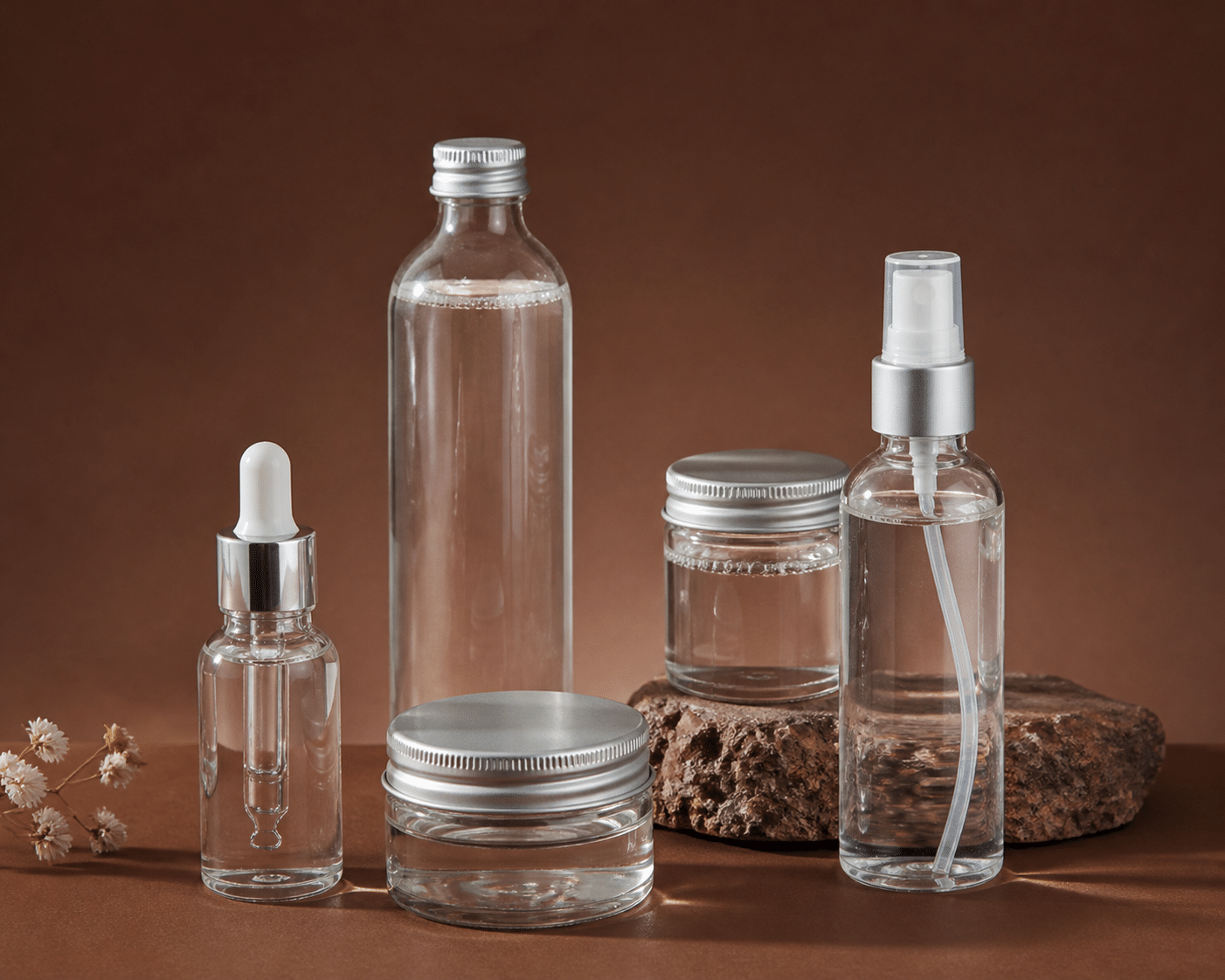
The easiest homes are the light, water-based formats. Think facial toners, purifying mists, gel cleansers and micellar waters. It also works in clay masks (mix the clay with the hydrosol instead of plain water) and in light spot gels aimed at stressed, blemish-prone skin.
There’s real proof that brands do this. The SKIN1004 Tea-Trica Purifying Toner lists tea tree leaf water at 126,900 ppm, about 12.69%, right after water. That’s a big spot on the label.
So what should you try first? There’s no official industry standard, so treat these as starting points for your own testing:
| Product type | Starting range | Notes |
|---|---|---|
| Toners, essences, mists | 5 to 20% | Some brands go higher. Check scent and stability. |
| Cleansers | 5 to 15% | Test with your surfactant system and watch skin feel. |
| Creams and lotions | 2 to 10% | Replaces part of the water phase. Can shift scent and emulsion stability. |
| Standalone toner | Up to 100% | Needs strict microbial specs and challenge testing. |
pH and Preservation: Don’t Skip This Part
Hydrosols are mostly water. Bacteria and mold love water. And “natural” doesn’t mean self-preserving, no matter how nice the tea tree aroma smells.
Two natural-leaning options come up a lot. A beginner’s guide to natural preservatives places Geogard ECT at roughly 0.5 to 1.0%, working best at pH 5 or below. Leucidal Liquid is usually used at about 2 to 4% and sits below pH 5.5, though it can be weaker on yeast. I’d screen Geogard ECT first. But honestly, neither is a magic fix.
What actually protects you:
- Keep pH in the range your preservative supplier recommends
- Use clean manufacturing and low-bioburden raw materials
- Consider a chelator like disodium EDTA if it’s compatible
- Run a preservative challenge test on the finished product
That last one matters most. Packaging, surfactants and botanical solids can all change how a preservative performs.
Ingredient Pairings That Make Sense
Tea tree water plays well with others. It’s mild, so it can be the friendly base for stronger partners.
- Witch hazel: A classic toner pairing. Check the alcohol level, because some versions can feel drying.
- Salicylic acid: Adds exfoliation. It usually needs a lower pH to work, so match your preservative and your acid.
- Hyaluronic acid: Brings hydration so oily skin doesn’t feel stripped.
- Panthenol, glycerin and allantoin: Support the skin barrier and soften the feel.
6 Product Concepts Worth Prototyping
Need ideas? Start with one clear problem and one clear customer.
- Post-Workout Blemish Control Mist: a cooling spray for sweaty, mask-wearing skin
- Gentle Reset Gel Cleanser: low-foam and non-stripping, for oily or combination skin
- Two-Step Micellar Water: tea tree water with hyaluronic acid for a quick, soft cleanse
- Clay Mask Mixing Water: a bottle of hydrosol sold alongside a dry clay powder
- Spot Soothe Gel: a light gel with panthenol for small, angry-looking areas
- Travel Toner Pad Jar: pads soaked in witch hazel and tea tree water for gym bags
A sample from a supplier like Aroma Monk, plus batch paperwork, is the cheapest way to test any of these. Start with one prototype. Document it. Scale when the data says so.
Of course, all of this depends on what’s in the drum. Next, let’s talk about how to buy it without getting burned.
Get a quote from Aroma Monk.
Essential Oil Supplier – Bulk pricing • Samples • Fast response
4. The Procurement Manager’s Checklist: Sourcing Pure, High-Quality Tea Tree Water
Picture this. A pallet of tea tree water shows up, the label looks great, and the smell is lovely. Then your lab says it’s mostly plain water with a little fragrance. Ouch.
That’s why buying hydrosol is mostly a paperwork job. The good suppliers expect you to ask. The weak ones get nervous.
The Documents You Can’t Skip
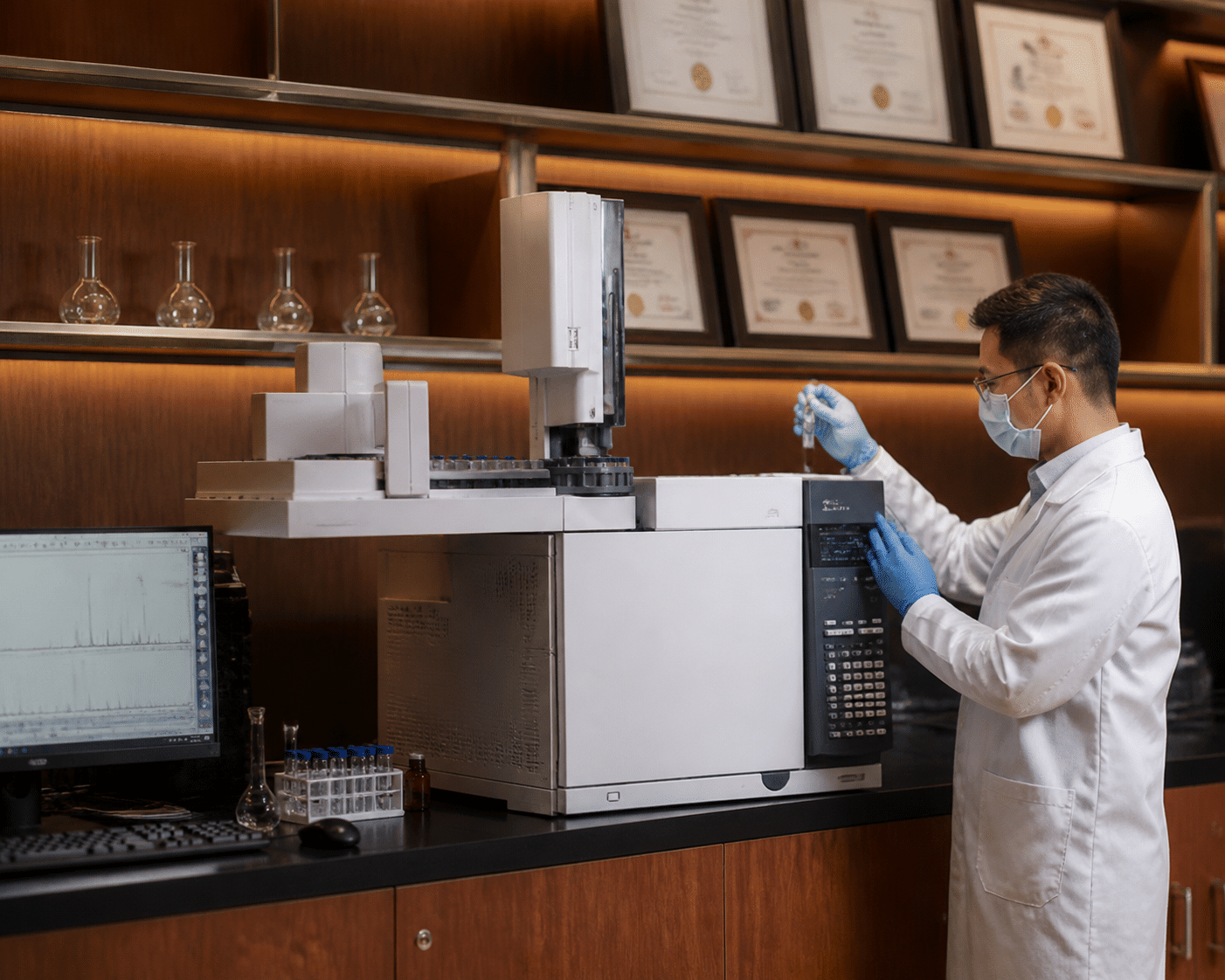
There are three papers I’d treat as non-negotiable before approving any bulk lot.
- Certificate of Analysis (CoA): It should be batch-specific, with the botanical name, batch number, distillation date and microbial results.
- GC/MS report: This is the chemical fingerprint. You want the full chromatogram and a peak table, not a one-line “pass.”
- Safety Data Sheet (SDS): Your safety and regulatory teams will ask for it, so get it early.
A GC/MS report for tea tree oil doesn’t count. I’ve seen suppliers try that swap. Also, simple tests can miss clever cheating. One tea tree oil authentication review describes a commercial sample that met the ISO composition limits but still failed the enantiomeric ratio check. So for high-value lots, ask whether the lab can run that extra test too.
One more thing. GC/MS doesn’t replace microbial testing. Hydrosols are mostly water, so ask for current yeast, mold and bacteria counts.
Who’s Behind the Drum?
Paperwork only tells you so much. The company matters too.
Ask where the leaves come from, and whether the supplier can trace a batch back to a farm or a still. Ask how the plants are harvested, and whether the people doing it are treated and paid fairly. Sustainable harvesting isn’t just a nice story for your website. Shoppers are checking.
Look for ISO 22716 Good Manufacturing Practices (GMP) too. And if you plan to say “organic,” check the certificate’s scope. Ecocert’s COSMOS standard covers finished cosmetics, but that doesn’t automatically mean your hydrosol was organically farmed. Read the fine print.
Questions to Ask Before You Place a Bulk Order
Here’s the list I’d actually send. Good suppliers answer in plain words and within a day or two.
- How is the water made? Is it collected straight from steam distillation?
- Is anything added after distillation, like fragrance, solubilizer or preservative?
- How much do batches vary, and can you share CoAs from the last three?
- What are your lead times for 200 liters? For 2,000?
- What’s the minimum order, and what packaging do you offer?
- How should it be stored, and what’s the shelf life once opened?
- Can I get a sample from the same batch I’d be buying?
Aroma Monk, for one, promotes lab-tested, traceable materials and bulk export support. That’s the kind of supplier profile worth checking against this list, so ask for sample documents and see how they respond.
Supplier Vetting Checklist
Print it, paste it into your sourcing sheet, or tape it to your monitor.
| Check | What good looks like | Pass? |
|---|---|---|
| Botanical identity | Melaleuca alternifolia leaf, with batch number and distillation date | ☐ |
| Process disclosure | Steam distilled aqueous fraction, nothing added or fully disclosed | ☐ |
| CoA | Batch-specific, with microbial limits | ☐ |
| GC/MS | Full chromatogram, terpinen-4-ol present, no odd peaks | ☐ |
| SDS and INCI sheet | Current and matched to the batch | ☐ |
| Traceability | Source farm or region named | ☐ |
| Ethical harvesting | Written sourcing policy | ☐ |
| GMP | ISO 22716 or equal, with proof | ☐ |
| Certifications | Scope covers the actual liquid | ☐ |
| Lead time and MOQ | Clear, in writing | ☐ |
| Storage guidance | Temperature, light and shelf life stated | ☐ |
A supplier who clears this table is ready to talk. Next, let’s look at where demand is heading, so you know how much to order.
5. Market Trends for 2026-2027: Capitalizing on Consumer Demand
So you know what tea tree water is, how to formulate with it, and how to buy it. Now the fun question: will anyone care?
Probably, yes. But only if you tell the right story.
Clean, Simple and Multi-Tasking
Shoppers keep asking for shorter routines and cleaner labels. That fits tea tree water nicely. One mild, water-based botanical can sit inside a toner, a mist and a gel cleanser, which is very “skinimalism.” Persistence Market Research links growth in cosmetic ingredients partly to demand for safer, multifunctional and naturally derived options. Here’s how a few estimates stack up:
| Market estimate | 2026 figure | Projection |
|---|---|---|
| Natural cosmetic ingredients (Grand View Research) | $11.5 billion | $21.7 billion by 2033, 9.5% yearly growth |
| Broader cosmetic ingredients (Persistence Market Research) | $23.2 billion | $33.8 billion by 2033, 5.5% yearly growth |
Different firms count different things, so don’t add these together. Just notice they all point up.
Educated Buyers Love a Clear Ingredient Story
Here’s where “tea tree hydrosol” earns its keep. According to GCI Magazine, 65% of consumers always or usually read ingredient labels. Those shoppers will happily read “steam-distilled aqueous fraction of Melaleuca alternifolia leaves” if you explain it simply.
But there’s a catch. Mintel’s 2026 ingredient coverage points to science-backed claims, not “natural” alone. So pair the botanical story with something you’ve actually tested, like a fresh feel or a calming sensory score.
Stress, Skin Barriers and What We Can’t Say Yet
Euromonitor expects global beauty sales of $669.8 billion in 2026, with preventive care and clinical credibility leading the themes. Skin that’s stressed by heat, pollution, masks and friction fits that picture.
I’ll be upfront, though. I didn’t find direct data linking tea tree water to “inflammaging” (the slow, age-related irritation idea). I also found no clinical proof that hydrosols are kinder to the skin microbiome than essential oils. The idea is plausible, since hydrosols carry fewer volatile compounds. Plausible isn’t proven.
So position tea tree water as a gentle, lightweight, soothing-feeling botanical for stressed, blemish-prone skin. Skip the microbiome and anti-aging promises unless your own finished-product tests back them up.
Trends tell you where to aim. Next, let’s pull it together and figure out your first move.
Partnering for Purity: Elevate Your Brand with High-Performance Tea Tree Water
So where does this leave you?
Tea tree water is a mild, water-based botanical that slips into toners, mists, gel cleansers and light serums without a full rebuild. Shoppers want gentle products that still feel like they work. Your job is to give them that, and to keep your claims honest while you do it. I’ll be straight: the evidence for the water itself is still thin, so test your finished product and let the data guide your wording.
Here’s the thing, though. A great formula can’t rescue a weak raw material. If the drum isn’t pure, nothing else matters. That’s why the supplier you pick is almost as big a decision as the recipe. Look for batch-specific paperwork, clear answers and a team that doesn’t flinch when you ask hard questions.
And you don’t have to bet the whole range on this. Start with one prototype. Document how it feels, how it holds up, and how it preserves. Scale when the numbers say so.
Ready to Test Tea Tree Water?
Next step for procurement managers and product developers
Aroma Monk offers lab-tested, traceable tea tree water for bulk and export orders. Reach out to:
- Request a sample from a representative batch
- View the technical data sheet, plus COA and SDS documents
- Ask about bulk pricing, MOQ, lead times and packaging
Send over your target product and dosage, and ask for the full paperwork up front. A good partner will be happy to share it.
Get a quote from Aroma Monk.
Essential Oil Supplier – Bulk pricing • Samples • Fast response