
Choosing the Right Tea Tree Ingredient: A Critical Decision for Product Efficacy
Picture a product developer on a Tuesday afternoon. The brief says “tea tree facial mist.” The supplier sheet says “tea tree.” Nobody has said whether that means oil or water. Sound familiar?
That mix-up happens a lot. And it’s not small. Tea tree oil is a strong, concentrated essential oil. Tea tree water, also called tea tree hydrosol, is the gentle water left over after steam distillation. They share a name, but they act very differently in a bottle.
A lot of people also think tea tree water is just oil stirred into water. It isn’t. A true hydrosol is a distillate, not a quick mix, and formulator guidance on hydrosols says the same thing about how they differ from diluted oils.
The choice shapes almost everything that follows:
- How your formula holds together over time
- How the product smells and feels on skin
- Which preservative system you need
- How safe and comfortable it is for your customer
So which one fits? It depends on what you’re making. A light daily facial mist calls for one answer. A potent spot treatment calls for another. Concentration matters too.
The next sections break down each ingredient, then compare them side by side. At Aroma Monk, we hear this question from buyers all the time, so let’s sort it out together.
Understanding the Powerhouse: What is Tea Tree Oil?
Tea tree oil is the loud one in the family. Strong smell. Strong effects. Strong opinions from anyone who’s ever spilled it.
Let’s start with where it comes from, because that explains a lot about how it behaves in your formula.
How Tea Tree Oil Is Made
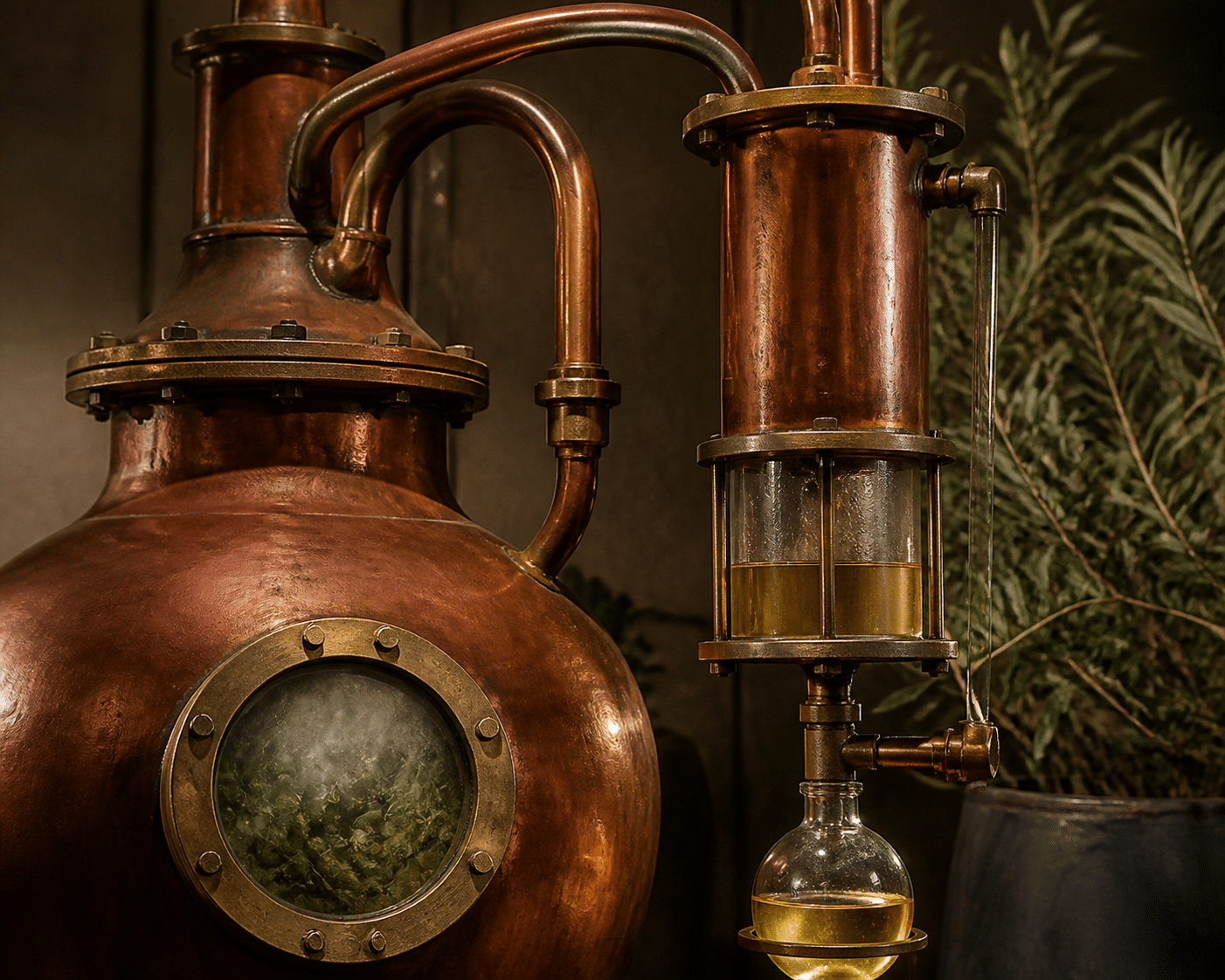
The oil comes from the leaves of Melaleuca alternifolia, a plant that grows in Australia. Producers harvest the leaves and load them into a still. Steam is pushed through the plant material, and the heat makes the tiny oil sacs in the leaves release their contents.
The steam carries those oil vapors up and into a cooling tube. There, everything turns back into liquid. Oil and water don’t mix, so they separate. The light oil floats on top and gets collected. That’s your essential oil.
And the water underneath? That’s the hydrosol. We’ll get to it in the next section.
Here’s a quick look at the steps:
| Step | What happens |
|---|---|
| 1. Harvest | Leaves and small branches are cut from the plant |
| 2. Steam | Steam passes through the leaves in a still |
| 3. Cooling | Vapor cools in a condenser and turns to liquid |
| 4. Separation | Oil floats on top and is drawn off from the water |
What Makes It So Strong

The star compound is terpinen-4-ol. Under the current ISO 4730:2025 standard, it should make up 35.0 to 48.0% of the oil, measured by gas chromatography. That’s a big share of one molecule in one bottle.
Here’s a simple view of the main parts:
| Compound | Role in the oil |
|---|---|
| Terpinen-4-ol | Main active, linked to antimicrobial and calming action |
| 1,8-Cineole | Adds a sharp, fresh note |
| p-Cymene | Often rises as the oil ages and oxidizes |
Terpinen-4-ol is why the oil gets so much attention for acne. A 2025 review in Frontiers in Medicine described tea tree oil’s skin benefits as mainly antimicrobial and anti-inflammatory. In one 12-week study of a tea tree oil gel and face wash, average acne lesions dropped from 23.7 to 10.7. Side effects were mild, like temporary peeling and dryness.
Still, I’d be careful here. That result came from a finished, formulated product. It doesn’t mean anyone should smear the straight oil on their face.
Where It Works Best (and Where It Bites)
Because it’s so concentrated, tea tree oil fits formulas built to carry an active:
- Serums and spot treatments
- Ointments and balms
- Washes and shampoos, at low levels
But strength cuts both ways. Used undiluted, it can cause burning, itching and redness. Mayo Clinic lists irritation and allergic dermatitis as possible reactions. Oxidized oil is usually harsher too, so storage and freshness matter a lot.
It also won’t mix into water on its own. You’ll need a solubilizer or emulsifier, and that brings its own trade-offs. So what’s the gentler option for water-based products? That’s where tea tree water comes in.
Introducing the Gentle Alternative: What is Tea Tree Water (Hydrosol)?
Remember that water left under the oil in the still? Here’s where it gets its moment.
What Tea Tree Water Really Is
Tea tree water, also called tea tree hydrosol or Melaleuca alternifolia water, is the aromatic water collected during steam distillation. It’s a co-product of the oil. Same leaves, same still, same steam. But what you keep is the water, not the oil.
That water isn’t plain, though. It carries water-soluble plant compounds and a few tiny droplets of oil. A 2025 study of tea tree hydrolat found terpinen-4-ol in it, the same star compound we talked about in the oil section. The amount is just far smaller. Think of it as a whisper compared to the oil’s shout.
Why It’s Not Just Oil Mixed With Water
I’ll say it again, because it trips up a lot of buyers. A true hydrosol is a distillate. A bottle labeled “tea tree floral water” might be water, tea tree oil and a solubilizer shaken together. That’s a different product, as UL Prospector explains in its guide to floral waters.
The easy check is the ingredient list. “Melaleuca alternifolia leaf water” points to a hydrosol. “Aqua, tea tree oil, solubilizer” does not.
And no, tea tree water isn’t a weaker copy of the oil. It has its own softer character, and its own place in a formula.
Benefits of Tea Tree Water in Formulas
So why would you pick it? Here’s what stands out:
- Gentler on skin. It’s much milder than the oil. Amrita launched a tea tree hydrosol in 2025 and pitched it as a softer option than the essential oil.
- Mildly antiseptic and calming. The plant compounds in the water give a light, soothing feel. I’d treat this as a gentle perk, not a strong active.
- Easy to use directly. It’s already water, so it blends into toners, facial mists, cleansers, gels and lotions with no solubilizer.
- Light, fresh scent. It smells softer than the oil, which suits daily-use products.
- Friendly to sensitive-skin positioning. A water-first formula can feel less intense on the label and on the face.
One catch. Hydrosol isn’t self-preserving. It’s mostly water, so it needs a proper preservative system and testing. Teravella’s dosage guide suggests starting around 10 to 25% of the finished product, then validating anything higher.
So you’ve met both ingredients. Next, let’s put them side by side.
Tea Tree Oil vs. Tea Tree Water: A Head-to-Head Comparison for B2B Buyers
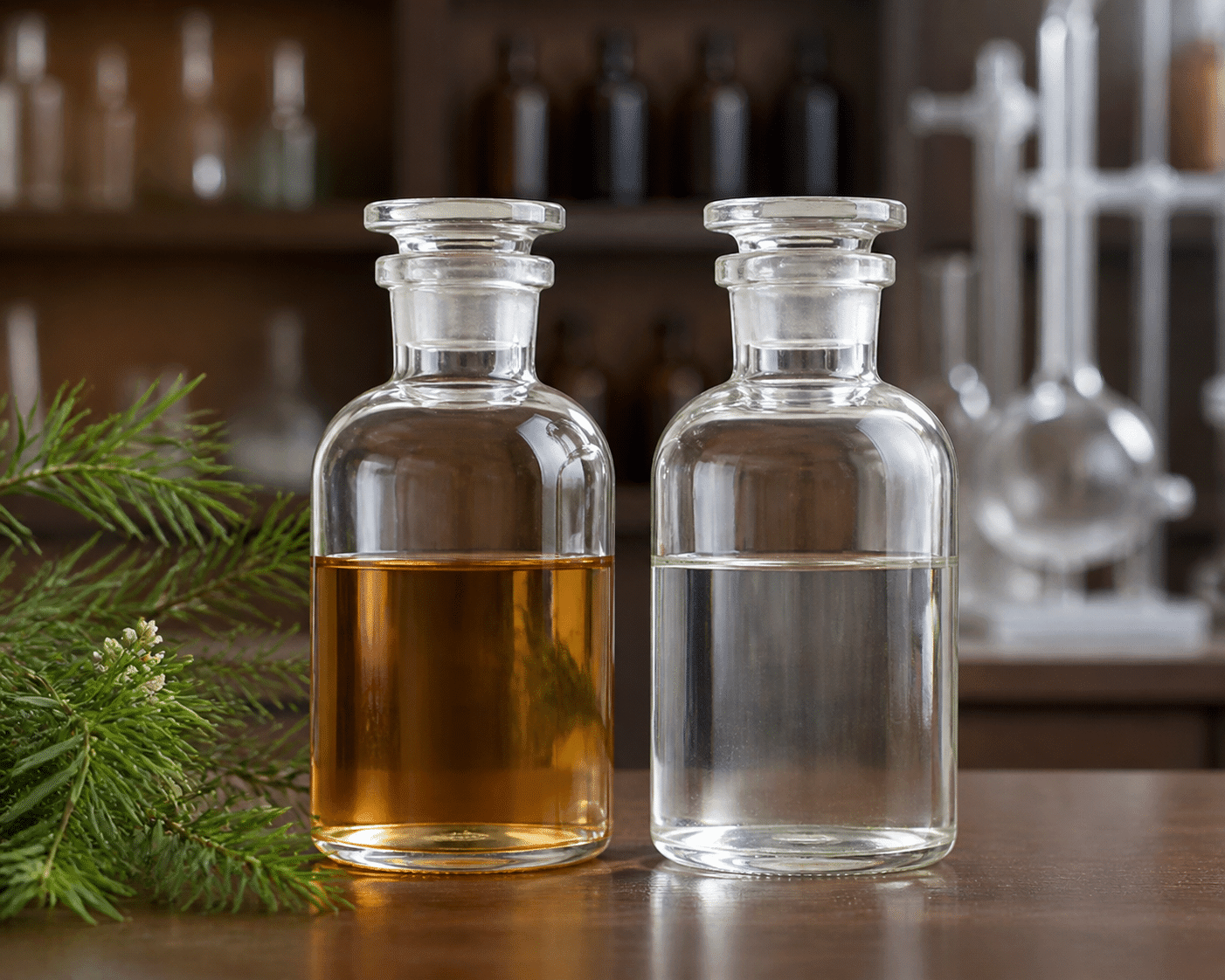
You’ve met both ingredients. Now let’s line them up and see how they really differ, because the spec sheet alone won’t tell you.
The Side-by-Side Table
Here’s the quick view first. Details follow below.
| Factor | Tea Tree Oil | Tea Tree Water (Hydrosol) |
|---|---|---|
| Production method | Steam distillation, oil separated off the top | Steam distillation, water kept from below |
| Key compounds | Terpinen-4-ol (35.0 to 48.0%), 1,8-cineole, p-cymene | Trace terpinen-4-ol and 1,8-cineole in water |
| Concentration | Very high, a true concentrate | Very low, mostly water |
| pH level | Not applicable (no water phase) | Roughly 4.5 to 7.5 on supplier specs, so check each batch |
| Skin safety | Can irritate or sensitize, strict use limits | Much gentler, but still needs preserving |
| Best for | Serums, spot treatments, washes, balms | Mists, toners, gels, lotions, cleansers |
| Aroma profile | Sharp, medicinal, camphor-like | Soft, light, lightly herbal |
| Bulk cost | About $33 to $45/kg at 25 kg | About $5.50 to $8/kg |
Safety and Use Limits
This is where the two split furthest apart. Tea tree oil comes with real caps. A 2025 opinion from the EU’s scientific committee classed it as a moderate skin sensitiser and backed only small adult uses, like 1% in face wash and 0.1% in face cream. Supplier IFRA certificates paint a similar picture. One Australian tea tree oil certificate lists 0.42% for facial leave-on products and 3.00% for body lotions.
Tea tree water doesn’t carry limits like those, because there’s so little oil in it. That makes it easier to place in a daily, leave-on product. But gentle doesn’t mean risk-free. Water-rich means microbes love it, so preservation is still a must.
One more thing on pH. I wouldn’t trust a single number. Supplier ranges for hydrosol run from about 3.3 up to 7.5, so measure each batch when it arrives.
Cost: Price Per Kilo vs. Cost Per Batch
Look at the price per kilo and oil seems like the expensive choice. Public listings show HBNO’s organic tea tree oil at roughly $45/kg in a 25 kg size, and much more for 1 kg. Meanwhile, tea tree hydrosol listings show prices as low as a few dollars per kilo. These are online prices, not firm quotes, so drum and contract volumes can land lower.
But hold on. Price per kilo isn’t the whole story. Usage rate matters more.
Say you make 1 kg of face cream with 0.1% tea tree oil. That’s 1 gram of oil, which costs about 5 cents at $45/kg. Now make 1 kg of a mist with 20% hydrosol (inside that 10 to 25% starting range we covered earlier). That’s 200 grams, which costs about $1.30 at $6.50/kg. So in this example, the “cheap” ingredient costs more per batch. Funny, right?
So the fair question isn’t “which costs less?” It’s “how much do I need to hit my product goal?” Hydrosol also needs a preservative, and oil often needs a solubilizer, so add those to your math.
Smell and Feel: What Your Customer Notices
Customers don’t read spec sheets. They sniff the bottle.
Tea tree oil is bold. Even at low levels it can steer the whole fragrance, and it may clash with delicate florals or fruity notes. It’s the smell people call “clinical.” Some love that, especially in acne or scalp products. Others hate it.
Tea tree water is the opposite. The scent is lighter and fresher, and it sits quietly in the background of a toner or facial mist. On skin, it feels like water, because it is. No oily film, no tingle. That suits daily use and sensitive-skin positioning.
One caution: hydrosol aroma can shift from batch to batch and change in storage. If scent consistency matters to your brand, ask for samples from more than one lot. Aroma Monk gets this request often from buyers, and it’s a smart one.
Next, let’s turn all this into practical steps for building each ingredient into your products.
Formulation & Application Guide: Integrating Tea Tree Into Your Product Line
Get a quote from Aroma Monk.
Essential Oil Supplier – Bulk pricing • Samples • Fast response
OK, time to get practical. You know what each ingredient does. Now, what do you actually put them in?
I’ll be upfront about one thing. The numbers below are starting points, not finished formulas. Every base behaves a little differently, so you’ll still need your own stability and preservative testing. Think of this as a first draft for your lab notebook.
Tea Tree Water Recipe Cards
Tea tree water is the easy one to work with. It’s already water, so it drops right into the water phase of most products. No solubilizer needed.
| Product idea | Starting level of tea tree water | Why it works |
|---|---|---|
| Clarifying facial toner | 10 to 25% | Light, fresh feel. Fits oily or combination skin positioning |
| After-sun spray | 10 to 25% | Cool, water-like, no oily film on warm skin |
| Scalp mist or scalp treatment | 10 to 25% | Easy to spray or dab on, and gentle for daily use |
| Gentle facial cleanser | 10 to 20% | Adds a soft herbal note without the oil’s punch |
That 10 to 25% range lines up with the starting advice we covered earlier. Go higher and you’re really building a new formula, because hydrosol can shift pH, thickness and how your emulsifier behaves.
Want a quick mask idea too? One Aroma-Zone-style recipe mixes about 1 tablespoon of tea tree hydrosol with 1 heaping tablespoon of yellow clay, left on for 5 to 10 minutes. Cute for a DIY kitchen. For a real product, though, you’d need a preservative, a pH target and challenge testing.
And one reminder, because it matters. Tea tree water is mostly water. It needs a preservative system every single time.
Tea Tree Oil Recipe Cards
Tea tree oil is the opposite. A little goes a long way, and the limits are tight.
| Product idea | Starting level of tea tree oil | Watch out for |
|---|---|---|
| Acne spot treatment (gel or serum) | 0.1 to 0.42% | Facial leave-on limits are low. Strong claims may change how it’s regulated |
| Anti-dandruff shampoo concentrate | 0.84% in the finished shampoo | Dilution changes the math, so calculate from the final product |
| Antiseptic balm | 0.84% or less | Words like “antiseptic” can push a product toward drug rules |
| Foot care cream | Up to 3.00% | Check your market’s rules for body leave-on products |
A few notes on where those numbers come from. One supplier IFRA certificate lists 0.42% for facial leave-on products and 3.40% for mostly rinse-off body and hand products. The EU’s final opinion, summarized by CIRS, backs up to 2% in shampoo, 1% in face wash and 0.1% in face cream. When two limits disagree, I’d always pick the lower one.
So what about “high potency” spot treatments? Honestly, in a regular cosmetic, the ceiling is lower than most people expect. Chasing more power with more oil usually means more irritation, not better results.
One more thing. That same EU opinion leaves out aerosol and spray formats with tea tree oil because of inhalation worries. So an oil-based after-sun spray? Skip it. That’s a job for the water.
Usage Rates by Base at a Glance
Here’s how the two ingredients line up across common bases.
| Base | Tea tree water | Tea tree oil |
|---|---|---|
| Aqueous solution (toner, mist) | 10 to 25% | Not recommended without a solubilizer, and not in sprays |
| Gel | 10 to 25% in the water phase | 0.1 to 0.42% for facial use, solubilized |
| Cream or lotion | 10 to 25% in the water phase | 0.1% (face cream) up to 3.00% (body lotion) |
| Rinse-off wash or shampoo | 10 to 20% | 0.84 to 2% depending on product type and market |
Making It Work in the Lab
Some habits save you a lot of headaches.
- Measure the pH of each hydrosol batch when it arrives, then adjust the finished formula.
- Run preservative efficacy testing on every water-rich product.
- Store tea tree oil cool, dark and tightly closed. Oxidized oil is harsher on skin.
- Test your solubilizer ratio by experiment, not by guessing.
- Use the lowest category limit if a product has more than one intended use.
If you’re still weighing which ingredient fits your next launch, Aroma Monk gets sample and spec questions like these from product developers all the time. Next up, let’s talk about how to buy both ingredients with confidence.
Sourcing Guide for Procurement Managers: How to Ensure Quality and Purity
You found the right ingredient. Now comes the part that keeps procurement teams up at night: getting the real thing, batch after batch.
Tea tree oil and tea tree water fail in different ways. So the paperwork you ask for has to be different too. Let’s walk through it.
Quality Markers Worth Checking First
For tea tree oil, start with the botanical name (Melaleuca alternifolia), the country of origin and the harvest details. Then look at the composition against the ISO range we covered earlier. Sounds simple. It isn’t always enough.
Here’s why. A 2024 study covered by HerbalGram found that some commercial samples met ISO composition limits but still failed enantiomeric-ratio tests. In plain words, a sample can look right on a basic report and still be doctored.
For tea tree water, the problem is different. Nobody enforces one global definition of “hydrosol.” So you have to ask whether it’s a true distillate, a diluted one, or water mixed with oil and a solubilizer. Get that answer in writing.
Certifications help, but they don’t prove purity on their own. ISO 22716 (cosmetic GMP) and ISO 9001 tell you how the site runs. Organic papers tell you how it was grown. Neither tells you what’s in the bottle. That’s the job of the batch test.
How to Read a CoA and GC-MS Report
A Certificate of Analysis (CoA) is a summary. A GC-MS report is the raw evidence behind it. Ask for both, and ask for the actual chromatogram, not just a pretty PDF table.
Here’s a simple guide to what to look for.
| What to check | Tea tree oil | Tea tree water |
|---|---|---|
| Batch number and date | Must match your drum or lot | Must match your lot, and be recent |
| Terpinen-4-ol | Inside the ISO range | Present in small, steady amounts |
| 1,8-Cineole | Within the spec limit | Present in trace amounts |
| p-Cymene | Low. A rise points to oxidation | Not a main marker |
| Chiral (enantiomer) data | Ask for it. It catches synthetic additions | Rarely offered |
| pH and microbial counts | Not applicable | Required. Check yeast, mold and pathogens |
| Preservative declaration | Not applicable | Must be stated clearly |
A 2024 study in the Journal of Agricultural and Food Chemistry named p-cymene as a major oxidation marker, so a high number can mean old or badly stored oil.
For hydrosol, a supplier monograph lists terpinen-4-ol and 1,8-cineole as the compounds to expect. Don’t accept an oil-style certificate as proof your water is a real hydrosol. They’re not the same document.
5 Questions to Ask Your Bulk Tea Tree Supplier
Print this one. Tape it next to your monitor.
- Is it a true steam-distillation product, and what’s the plant part, origin and harvest date?
- Can you send a batch-specific GC-MS report with the raw chromatogram?
- Which lab tests it, and is that lab ISO/IEC 17025 accredited?
- For water: what’s the pH, microbial data and preservative system? For oil: what are the oxidation markers and chiral results?
- How is each batch traced back from shipment to distillation, and do you keep sealed reference samples?
A good supplier answers these fast. A shaky one gets vague. That tells you plenty.
Why Going Direct Makes It Easier
Every middle layer between you and the still is one more place for paperwork to get lost. Brokers can simplify buying, but they often cut visibility into where a batch came from.
Working with a direct manufacturer like Aroma Monk shortens that chain. Aroma Monk manages the process from raw material sourcing to final delivery, so traceability isn’t a guess. Their essential oils are lab-tested, and they support bulk and export orders. Plus, customization of blends and packaging is on the table, which matters when your formula isn’t off the shelf.
I’d still request samples and run your own tests. Trust, then verify.
Once your sourcing is sorted, it’s time to pull everything together and pick the right ingredient for your brand.
Making the Right Choice for Your Brand: A Summary of Tea Tree Water vs. Oil
So, which one wins? Neither. They just do different jobs.
Tea tree oil is for potent, targeted work. Think spot treatments, balms and low-dose washes, where a tiny amount does the heavy lifting and the safety limits are tight. Tea tree water is for gentle, broad use in water-based formulas. Think mists, toners and lotions that people reach for every day.
Here’s the short version:
| Top 3 uses for tea tree oil | Top 3 uses for tea tree water |
|---|---|
| 1. Acne spot treatments and serums | 1. Clarifying facial toners and mists |
| 2. Anti-dandruff shampoos and washes (at low levels) | 2. Scalp mists and after-sun sprays |
| 3. Antiseptic-style balms and foot care creams | 3. Gentle cleansers, gels and lotions |
One rule sits under all of this. Your finished product is only as good as the raw material you start with. A great formula can’t fix an oxidized oil. And it can’t turn “aqua, tea tree oil, solubilizer” into a real hydrosol. So choose the right ingredient for the job, then check it with a batch-specific GC-MS report, a clear distillation declaration and proper microbial data.
I’ll be honest, nobody gets every formula right on the first try. That’s normal. The smart move is to test early, with real samples and real data in your hands.
So if you’re a product developer or brand owner weighing tea tree oil vs tea tree water for your next launch, talk to a supplier who can back up what they ship. Aroma Monk can share samples, specs and technical data for your formulation needs, so you can compare before you commit.
Get a quote from Aroma Monk.
Essential Oil Supplier – Bulk pricing • Samples • Fast response