

Beyond the Hype: What Does the Research Say About Sea Buckthorn Oil Supplements?
A plant that’s been used for more than 1,000 years doesn’t usually fade into the background. Sea buckthorn, or Hippophae rhamnoides, has shown up in Tibetan, Chinese, Ayurvedic, Greek, and Roman traditions for ages. People used it for skin trouble, burns, stomach issues, and even strength. Pretty old-school. Pretty interesting.
Now it’s back, but in a very modern way. You’ll see it in capsules, oils, and beauty products, often sold as a superfood or an omega 7 supplement. And yes, the buzz is real. But does the science actually back the hype around the sea buckthorn oil supplement?
That’s what we’re here to sort out.
This article takes a close look at sea buckthorn research studies, not marketing copy. We’ll look at what sea buckthorn benefits are supported by human trials, what still feels shaky, and where the evidence is just too thin to make big claims. The oil is known for its rare palmitoleic acid, better known as Omega-7, plus other plant compounds that may help skin, mucous membranes, and heart health. Some people use it for sea buckthorn oil for skin, others for dry eyes or vaginal dryness, and some ask if sea buckthorn oil is effective for cholesterol support.
So let’s keep it simple. What does sea buckthorn oil actually do, and what does it only seem to do? That’s the real question.
Section 1: The Nutritional Anatomy of Sea Buckthorn Oil
You know that one ingredient that sounds simple, then turns out to have a lot going on? Sea buckthorn oil is kind of like that. On the surface, it’s just an oil from a bright orange berry. But inside, it’s packed with a mix that makes people keep asking if sea buckthorn oil supplement products are really worth it.
Here’s the big thing: sea buckthorn oil isn’t just one fat. It brings a blend of omega 3, omega 6, omega 9, and the rare star, omega 7. Omega 7, also called palmitoleic acid, shows up in much higher amounts in the fruit pulp or berry oil than in the seed oil. That matters because the two oils are not the same.

| Type of sea buckthorn oil | Main fat profile | Usual use |
|---|---|---|
| Berry or pulp oil | High in omega 7, plus carotenoids | Often used for skin and mucous membrane support |
| Seed oil | More omega 3, 6, and 9 | Often used for general fatty acid support |
So if you’ve seen sea buckthorn capsules on a shelf, the label should tell you which part of the plant it comes from. That’s not a tiny detail. It changes the whole nutritional profile.
And then there’s the antioxidant side. Sea buckthorn oil contains vitamin E, vitamin C, carotenoids like beta-carotene and lycopene, plus flavonoids. Those plant compounds work together. Not in some magic way. Just in a normal body-supporting way, helping protect cells from stress and oxidation.
The flavonoids get a lot of attention too. Quercetin, isorhamnetin, kaempferol, and myricetin all show up in sea buckthorn research studies, and each one has its own job in the body. That mix is part of why people talk about sea buckthorn benefits for skin, heart support, and general wellness.
A quick note though. More compounds does not always mean better results. But it does help explain why hippophae rhamnoides oil has stayed popular for so long. It’s not just an old folk remedy. It’s a plant oil with a pretty unusual nutrient set.
If you’re looking at formulas for skincare, wellness, or bulk product work, Aroma Monk’s lab-tested carrier oils and botanical ingredients can be a smart place to start. Clean sourcing matters. Especially with oils that can vary a lot by extraction method and plant part.
Section 2: Clinical Research on Skin Health and Rejuvenation
Ever buy a product that sounds fancy, then wonder if it actually does anything? Yeah, same. Sea buckthorn oil supplement fans talk a lot about glow, bounce, and less dryness. But the better question is simple: what do the sea buckthorn research studies really say?
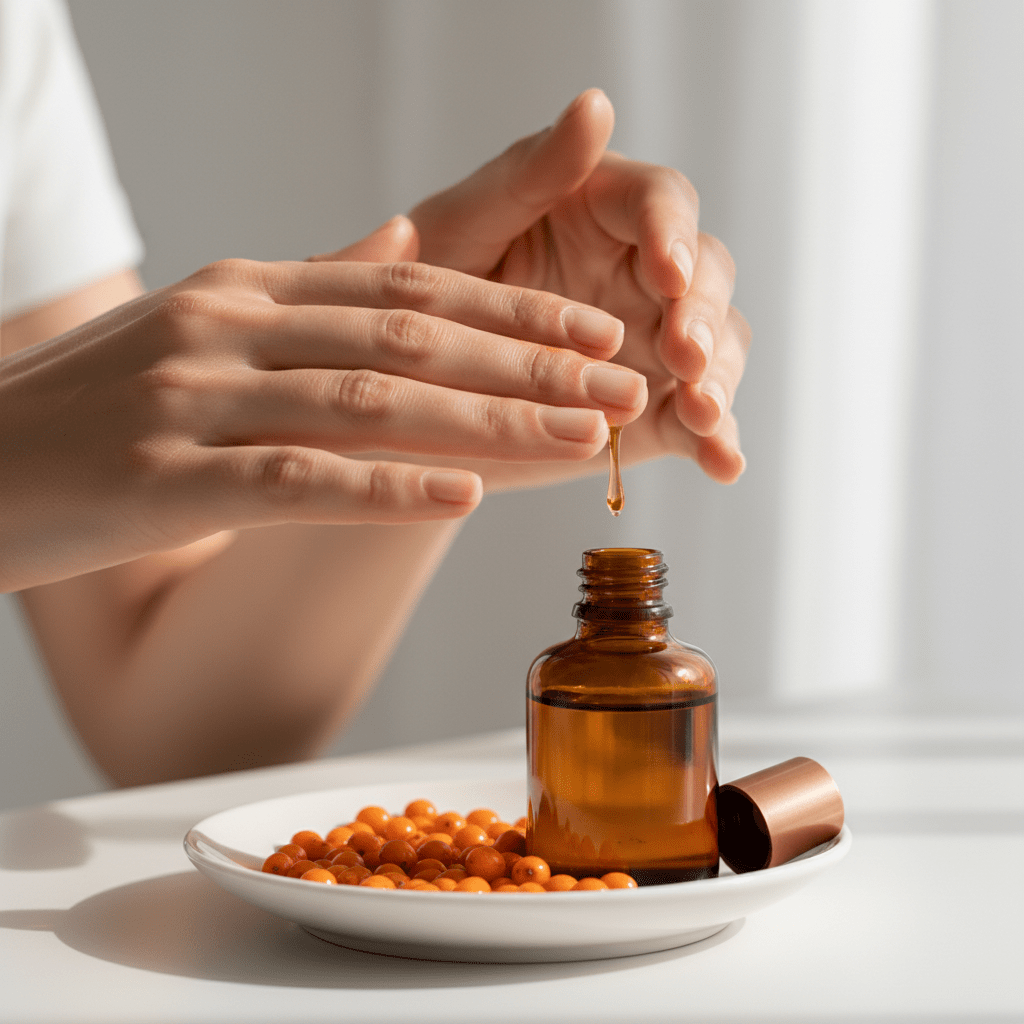
For skin, the human data is actually pretty encouraging. In one 3-month study with 60 women ages 50 to 70, four 0.5 g capsules a day of sea buckthorn oil helped improve skin hydration, elasticity, and surface roughness. That last part matters because rougher skin often goes hand in hand with the look of fine lines. Another 12-week trial with women over 45 found better facial moisture, brightness, elasticity, and collagen density. The collagen result was a nice surprise. It went up 3.3% at 4 weeks and 10% at 12 weeks.
So, is sea buckthorn oil effective for skin? For some people, it looks like it may help. Not in a movie-magic way. More like steady support over time.
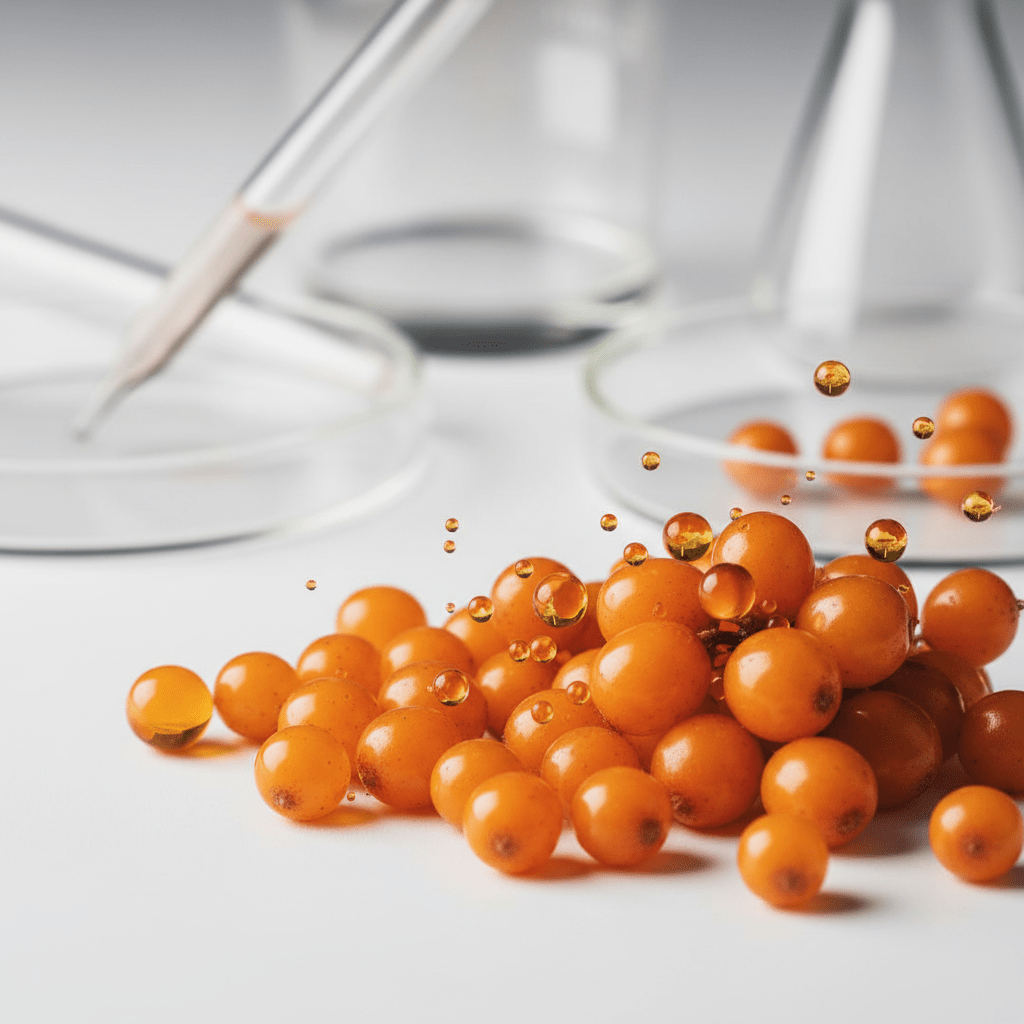
Here’s the part that makes the omega 7 supplement angle interesting. Palmitoleic acid, or omega 7, seems to help support cell membrane integrity. That’s a fancy way of saying it may help skin cells hold moisture better. Plus, sea buckthorn oil also has fatty acids and plant compounds that may help calm skin stress and support collagen activity. That combo is why people keep asking about sea buckthorn oil for skin, not just for general wellness.
It also shows up in eczema research. In a small trial on atopic dermatitis, people who took sea buckthorn seed or pulp oil had better skin lipid patterns, and the pulp oil group showed clinical improvement. That’s not a giant trial, so we can’t act like it’s a done deal. But it does point in a hopeful direction for dry, irritated skin.
And there’s more. Sea buckthorn oil has also been studied for wound healing and burn care. One human study found a 40% sea buckthorn cream helped second-degree burns heal about 5 days faster than 1% silver sulfadiazine. That’s a real-world result people notice. Less waiting. Less scar worry.
What the skin research points to
| Skin area | What the research found | Typical use in studies |
|---|---|---|
| Hydration | Better moisture levels and smoother skin | Oral capsules |
| Elasticity | Skin felt more supple | Oral capsules |
| Wrinkles and roughness | Surface roughness went down | Oral capsules |
| Eczema | Better skin lipid profile and symptom improvement | Oral pulp or seed oil |
| Burns and wounds | Faster healing in a burn cream study | Topical use |
But let’s keep our feet on the ground. These studies are promising, yet most are small and use different doses, different oils, and different timelines. That makes it hard to say every sea buckthorn capsules dosage will work the same way.
Still, if you’re looking at a sea buckthorn oil supplement for skin support, the research suggests the best fit may be people with dry skin, aging skin, or irritation-prone skin. And if you’re a brand building skincare or wellness products, Aroma Monk’s lab-tested natural oils can help you source clean, traceable ingredients for product development.
For more on the broader science, the traditional medicine review is a solid starting point.
Section 3: Efficacy for Cardiovascular and Metabolic Health
You know that moment when a supplement sounds great for your skin, and then people start saying it might help your heart too? That’s sea buckthorn oil in a nutshell. A little bit skin care, a little bit wellness aisle, and now a lot of people asking if the sea buckthorn oil supplement can do more than one job.
So let’s talk about what the research actually shows. Not the shiny label talk. The real stuff.
Does it help cholesterol and triglycerides?
This is where sea buckthorn research studies get interesting. In one double-blind study, people with high blood pressure and high cholesterol took 0.75 mL a day of sea buckthorn seed oil for 30 days. The results showed lower total cholesterol, LDL, oxidized LDL, and triglycerides in the people who had the lipid issues. Healthy people didn’t see much change. That pattern matters. It means sea buckthorn oil seems more useful as support for people who already have a problem, not as a magic fix for everyone.
A broader review of 11 randomized trials tells a similar story. Sea buckthorn supplementation lowered total cholesterol, LDL, and triglycerides in people with hyperlipidemia or fatty liver disease, and it also raised HDL in some cases. But again, the wins were seen mostly in people who already had blood fat issues. So if you’re wondering, is sea buckthorn oil effective for cholesterol support? The answer looks like “possibly, for some people, in the right setting.” Not for everyone. Big difference.
What about sea buckthorn anti-inflammatory effects?
This part gets talked about a lot, and for good reason. Some research has found a drop in CRP, which is a marker the body uses when there’s inflammation going on. CRP is not the whole story, of course. One lab number doesn’t tell us everything. But it does give a small clue that sea buckthorn oil may calm some of the body’s stress signals.
The oil’s mix of omega 7, other fatty acids, vitamin E, carotenoids, and flavonoids may help explain that. Or maybe I should say it likely helps explain it. Quercetin and isorhamnetin show up again here, and those plant compounds are known for antioxidant and anti-inflammatory activity. That’s part of why hippophae rhamnoides oil keeps showing up in wellness talks, even after all these years.
Could it help with blood sugar and metabolic syndrome?
This is where things get a little shaky. There’s interest in sea buckthorn and blood sugar control, and some animal and lab work looks promising. But human data is thin. I don’t have a clean set of big trials showing clear results for metabolic syndrome, pre-diabetes, or insulin sensitivity in people.
That doesn’t mean it does nothing. It just means we don’t have enough proof yet to make a strong claim. If you’re looking at sea buckthorn capsules dosage for metabolic health, the truth is that no standard dose has been nailed down for that use. And that’s okay to say out loud. We don’t need to pretend the evidence is stronger than it is.
Quick look at the heart and metabolic research
| Area studied | What researchers saw | What it means |
|---|---|---|
| LDL cholesterol | Lowered in people with high cholesterol | May help people with lipid issues |
| Triglycerides | Lowered in some trials | Could support blood fat balance |
| HDL cholesterol | Rose in some studies | A possible plus |
| CRP | Dropped in one study | Points to sea buckthorn anti-inflammatory activity |
| Blood sugar and insulin | Human data is limited | Still an open question |
So where does that leave us? Sea buckthorn oil supplement use looks most promising for people with high cholesterol, high triglycerides, or other metabolic concerns. It’s not a cure. It’s more like a possible helper. And if you’re healthy already, the payoff may be pretty small.
If you’re a brand owner or product developer, this is also where clean sourcing matters a lot. Aroma Monk offers lab-tested natural oils and bulk ingredients, which can help if you’re building wellness or personal care products and want traceable raw materials. Good inputs matter. A lot.
For people reading this as customers, the big takeaway is simple: sea buckthorn benefits are real in some areas, but the strongest human research still centers on skin, lipids, and mucous membranes. The rest still needs more work.
Get a quote from Aroma Monk.
Essential Oil Supplier – Bulk pricing • Samples • Fast response
Section 4: A Soothing Solution: Research on Mucous Membrane Health
You know that dry, scratchy feeling that makes you blink too much and sip water all day? That same kind of irritation can happen in a few places in the body, not just the eyes. And that’s where the sea buckthorn oil supplement gets really interesting.
For dry eyes, the human research is one of the stronger parts of the story. In a randomized study, people with dry eye symptoms took 2 g a day of sea buckthorn oil for 3 months. The oil helped slow the rise in tear film osmolarity, which is a fancy way of saying the tears stayed a bit more balanced. People also may have felt less burning and redness. That’s a big deal if you’ve ever sat at a laptop for 9 hours and felt like your eyes were full of sand.
The same pattern shows up in Sjögren’s syndrome research too. This condition can leave the eyes and mouth painfully dry, so any small bit of help matters. Sea buckthorn oil for dry eyes doesn’t look like a miracle fix, but it does seem to offer gentle support for comfort.
And it’s not just about eyes. A double-blind study in 116 postmenopausal women used 3 g a day of oral sea buckthorn oil for 3 months, and the results pointed to better vaginal health. Dryness, itching, moisture, pH, and mucosal changes all moved in a better direction compared with placebo. Vaginal epithelial integrity also improved. Not every measure changed, but the trend was clear enough to get people paying attention.
That fits with the idea that hippophae rhamnoides oil may help nourish mucous membranes all over the body. Basically, it seems to support the soft linings that need moisture to do their job well. Weirdly practical. But helpful.
There’s also early work on digestive health. Small human studies have looked at sea buckthorn oil for stomach lining support and peptic ulcers. One trial reported high improvement rates with daily capsules, and older work suggests the oil may help protect the gut lining by supporting mucosal repair. The gut barrier angle is still early, so I wouldn’t oversell it. But it does line up with the way sea buckthorn has been used in traditional medicine for stomach trouble for a very long time.
What the mucous membrane research points to
| Area studied | What researchers saw | Typical dose in studies |
|---|---|---|
| Dry eyes | Less tear film stress, possible symptom relief | 2 g/day for 3 months |
| Sjögren’s syndrome | Early support for eye comfort | Oral oil in small trials |
| Vaginal dryness | Better moisture, pH, and tissue health | 3 g/day for 3 months |
| Stomach lining | Better ulcer healing in small studies | Daily capsules for about 1 month |
| Gut barrier | Early mechanistic support only | No clear human dose yet |
So, is sea buckthorn oil effective for these softer, drier spots in the body? The short answer is: it looks promising, especially for dry eyes and vaginal dryness. For digestive support, the evidence is more preliminary, but not random guesswork. There’s a pattern here.
If you’re comparing sea buckthorn capsules dosage across uses, this is another reason not to assume one amount fits all. Skin studies, eye studies, and vaginal dryness studies all used different doses. That’s messy, but it’s real life.
And if you’re a brand owner or product developer, this is the kind of ingredient story that deserves clean sourcing and good testing. Aroma Monk’s lab-tested natural oils and bulk ingredients can help teams that want traceable, high-quality raw materials for wellness and personal care products.
The bottom line? Sea buckthorn benefits seem strongest where moisture and tissue repair matter most. Dry eyes, dry vaginal tissue, and irritated stomach lining are the spots where the research keeps circling back.## Section 5: How to Choose and Use a Quality Sea Buckthorn Oil Supplement
Ever stand in the supplement aisle and feel like every bottle is yelling at you? Same. Sea buckthorn oil can look simple from far away, but once you peek at the label, things get messy fast.
Here’s the deal. The way the oil is made matters a lot.
CO2 extraction vs. cold pressing
For a sea buckthorn oil supplement, supercritical CO2 extraction is often the cleaner pick. It uses low heat, so more of the delicate stuff stays in the oil, like omega 7, beta-carotene, and tocopherols. It also skips solvent residue, which is nice because nobody wants mystery leftovers in their capsule.
Cold pressing is older and simpler. It can work well for berry oil, but it’s usually less efficient, especially for seed oil. So if you’re shopping for a more refined product, CO2-extracted sea buckthorn oil often has the edge.
What dose do studies use?
There’s no single sea buckthorn capsules dosage for every use. But the human research gives us a pretty solid range to look at.
| Study use | Typical amount used |
|---|---|
| Skin support | 2 g/day for 3 months |
| Dry eyes | 2 g/day for 3 months |
| Vaginal dryness | 3 g/day for 3 months |
| Atopic dermatitis | 5 g/day for 4 months |
| Heart and cholesterol support | 0.75 mL/day for 30 days |
Most studies land around 2 to 5 grams a day. So if a bottle gives you a wild dose far outside that range, I’d pause and read the fine print twice.
What should you look for on the label?
A good product should tell you:
- Whether it’s berry oil or seed oil
- How much omega 7 it contains
- If it’s organic
- Whether it has third-party testing for purity and potency
- If it’s made in a cGMP facility
And yes, a clear label matters. A lot.
Berry oil is usually richer in omega 7 and carotenoids, while seed oil has more omega 3, 6, and 9. So if you want sea buckthorn oil for skin or mucous membrane support, berry oil may fit better. If you want a different fatty acid mix, seed oil might be the one.
If you’re a brand owner, formulator, or bulk buyer, this is where a trusted supplier makes life easier. Aroma Monk works with lab-tested natural oils, carrier oils, and bulk ingredients for cosmetics, wellness, and personal care products. That kind of traceability can save a ton of back-and-forth later.
So, is sea buckthorn oil effective? It can be, but only if the product is real, the dose makes sense, and the oil matches your goal. Tiny details. Big difference.
And one more thing. If you take blood thinners, blood pressure meds, or diabetes medicine, check with a clinician first. Sea buckthorn can interact with those.
Simple rule: pick the right oil, check the testing, and don’t guess on dose.## The Verdict: Is a Sea Buckthorn Oil Supplement Right for You?
So, after all that, what’s the real answer? Pretty simple. A sea buckthorn oil supplement looks most promising for skin support, dry eyes, vaginal dryness, and other moisture-heavy spots in the body. The research also points to some helpful sea buckthorn anti-inflammatory and heart health effects, especially for people who already have high cholesterol or high triglycerides.
But no, it’s not a cure-all. It won’t fix everything, and that’s okay. The strongest sea buckthorn benefits seem to come from the right oil, the right dose, and steady use over time. In the studies, sea buckthorn oil for skin and mucous membranes often used berry or pulp oil, while seed oil showed more promise for lipid support. Small detail. Big deal.
If you’re shopping for an omega 7 supplement or comparing sea buckthorn capsules dosage, pick a product that clearly says whether it’s berry oil or seed oil, and look for lab testing, purity checks, and clean sourcing. That matters a lot more than flashy claims on the front label.
Aroma Monk’s lab-tested natural oils and bulk ingredients can also be a good fit for brands that want traceable raw materials for beauty, wellness, or personal care products.
And one last thing. If you take blood thinners, blood pressure medicine, or diabetes meds, talk with a healthcare professional before starting sea buckthorn. Same goes if you’re pregnant, breastfeeding, or planning surgery.
So, is sea buckthorn oil effective? For some needs, yes. For others, the proof is still thin. Ask questions. Check the label. And choose it for a clear reason, not just because it sounds trendy.
Get a quote from Aroma Monk.
Essential Oil Supplier – Bulk pricing • Samples • Fast response