

The Growing Demand for Gentle, Natural Acne Solutions in Modern Skincare

Here’s a number that should get any product developer’s attention: 74% of surveyed Americans said organic ingredients matter when they choose personal care products, according to NSF International’s 2025 report. That’s a big deal.
And the money follows the preference. The global natural skincare market was around $45.5 billion in 2025, and Mordor Intelligence expects it to reach $66.6 billion by 2031. Facial care makes up about 85% of that.
But acne is the tricky part. Benzoyl peroxide and synthetic retinoids work for many people, yet dryness is the main complaint, as one market report points out. So shoppers keep hunting for natural acne treatment ingredients that feel kinder. Formulators feel the squeeze. You want a product that does something, without leaving skin tight, red and stinging.
This is where chamomile water for face care gets interesting. Chamomile hydrosol is the water left behind after steam distilling chamomile flowers. It’s light, gentle and carries soothing plant compounds. Lab studies hint at anti-inflammatory and antimicrobial potential. I’ll be straight with you, though: clinical proof for chamomile hydrosol for acne is still thin. So we’ll treat it as calming support, not a cure.
This guide walks through the science, the formulation tricks and the sourcing rules for pure chamomile water for cosmetics. First, let’s get clear on what a hydrosol really is.
1. Understanding Chamomile Water: The Science of a Potent Hydrosol
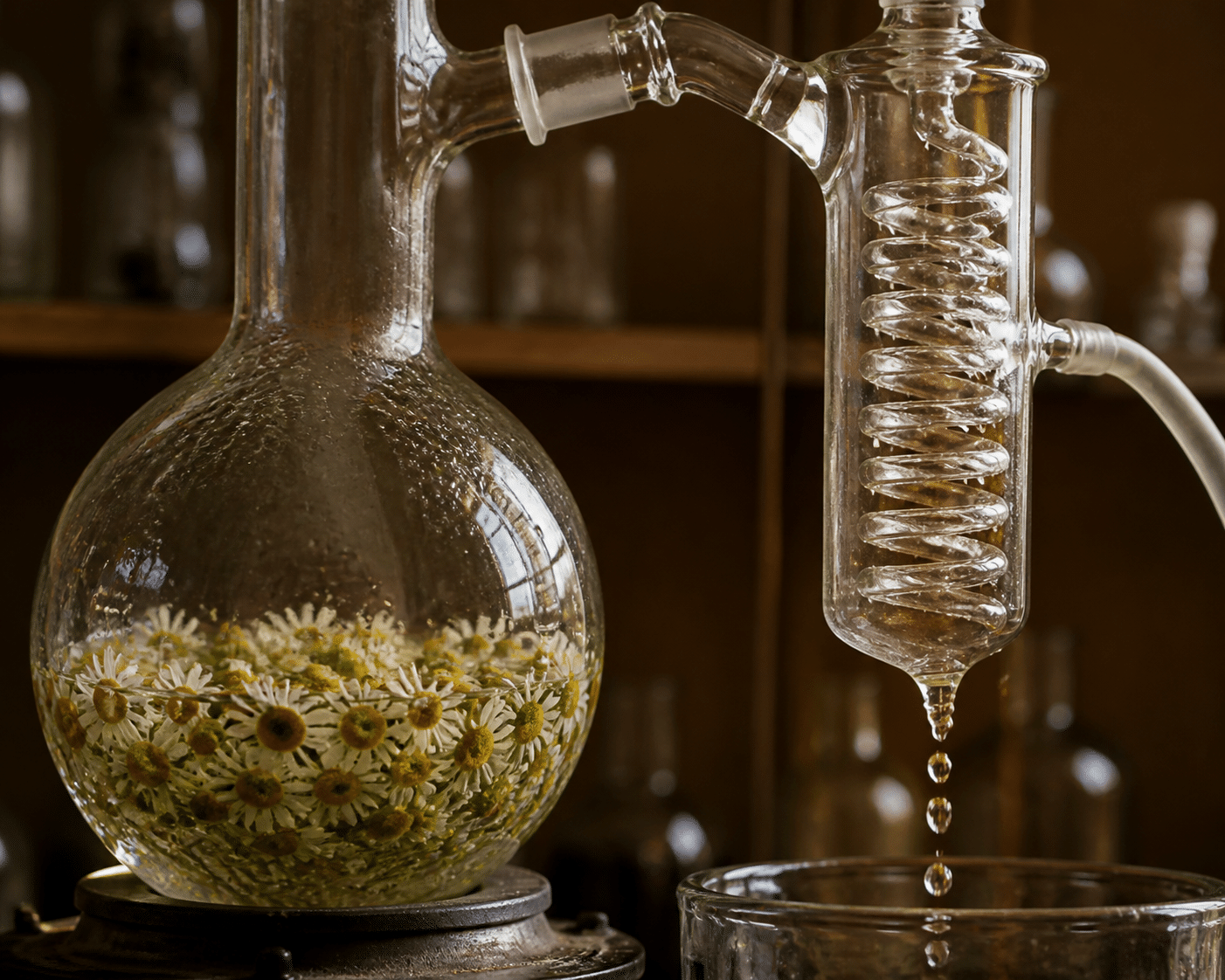
Picture a big steel still filled with chamomile flowers. Steam rushes through. Out the other end comes something that looks like plain water. It isn’t.
How Steam Distillation Makes Chamomile Water
Here’s the simple version. Steam passes through the flowers and picks up the volatile plant compounds. A cooled condenser turns that steam back into liquid. The liquid then splits into two layers: a tiny amount of essential oil and a much larger amount of water. That water is the hydrosol. The Food and Agriculture Organization describes this still, condenser and separator setup, where the oil and water part ways because of their different densities.
So chamomile water is a co-product, not leftover scented water. It carries water-soluble plant compounds plus a trace of dissolved oil, usually less than 1 g/L, according to a 2024 review of hydrosols. That’s why it feels so light on skin.
One warning, though. Not everything sold as floral water comes from a still. Some products are just water blended with fragrance and a solubilizer, which bulk buyer guides say is not the same as the real distillate. Pure chamomile water for cosmetics should trace back to actual distillation.
What’s Actually Inside
The stars people talk about are chamazulene, bisabolol and flavonoids. Chamazulene is the blue compound that forms during distillation. Bisabolol is a calming, skin-friendly alcohol. Flavonoids are plant antioxidants that dissolve in water.
But let’s be honest about amounts. Most published numbers come from the essential oil. One analysis of German chamomile oil found roughly 43 to 66% α-bisabolol oxide A. Those figures can’t be moved over to the hydrosol. In the water you’ll find only trace levels, and they change from batch to batch. So ask suppliers for a batch-specific GC-MS report. “Contains bisabolol” on a label tells you very little.
German vs Roman Chamomile Water
They sound alike. They’re not. German vs Roman chamomile water comes down to two different plants, and mixups do happen. Circle H Institute documented a Roman chamomile hydrosol sold under a German chamomile label.
| Feature | German Chamomile Water | Roman Chamomile Water |
|---|---|---|
| Botanical name | Matricaria chamomilla (syn. M. recutita) | Chamaemelum nobile |
| Key compounds | Bisabolol-related compounds, chamazulene (trace), flavonoids | Different volatile profile, mostly ester-type aroma compounds, flavonoids |
| Primary benefit | Anti-inflammatory support | Calming, comforting |
| Typical pH (supplier data) | About 4.5 to 7.0 | About 3.8 to 4.5 |
| Best for | Acne-prone and inflamed skin | Sensitive and baby-care formulas |
Treat that table as a starting point. Supplier pH ranges overlap, and composition shifts with harvest and distillation.
Where Chamomile Hydrosol for Acne Fits
So why does chamomile hydrosol for acne keep coming up? Because acne is partly an inflammation problem, and chamomile is one of the best-known anti-inflammatory hydrosols. It’s gentle enough for daily toners, which matters when shoppers are tired of dryness. We’ll look at how it may work next.
2. The Mechanism of Action: How Chamomile Water Combats Acne
A pimple isn’t just a clogged pore. It’s a tiny fire. Bacteria move in, the body sends in its defenders, and the skin turns red, puffy and sore.
So where might chamomile water step in? Let’s walk through it, and I’ll flag where the proof is strong and where it isn’t.
Calming the Redness and Swelling
This is chamomile’s best-known talent. Chamomile contains chamazulene, bisabolol and flavonoids (apigenin is the one you’ll hear about most). Lab work suggests they quiet the same chemical signals that make a breakout swell.
One macrophage study found chamomile cut the release of prostaglandin E2 and lowered COX-2 activity. Those are inflammation messengers. A 2025 skin cell study also saw calmer responses in stimulated keratinocytes after chamomile essential oil.
Here’s the catch. Both used concentrated material, not a dilute hydrosol. Water carries only trace amounts of these compounds, so I’d call the effect a gentle nudge. Not a punch.
What About the Bacteria?
Acne bacteria (formerly called P. acnes, now C. acnes) feed the inflammation. Chamomile shows some activity against them in the lab. A recent review of medicinal plants for acne reported that chamomile methanolic extract held back the bacteria.
But the same review found no randomized clinical trial proving chamomile clears acne lesions. None. That’s the honest picture.
So for chamomile hydrosol for acne, I’d say “antimicrobial potential,” never “antibacterial treatment.” Your regulatory team will thank you too.
Gentle Toning Without the Tight Feeling
This may be the most useful part for real shoppers. Benzoyl peroxide and retinoids can leave skin dry and stinging. Chamomile water is light, mildly acidic and doesn’t strip the skin. Formulators often use it as a soft toning base, since it leaves skin feeling fresh instead of tight.
That makes it a nice partner for stronger actives, or a calming step between them. Think support player, not star striker.
How It Might Work in One Inflamed Pore
Here’s the picture in a simple table.
| What’s happening in the pore | What chamomile may do | Strength of evidence |
|---|---|---|
| Bacteria multiply | May slow growth of C. acnes | Lab studies only |
| Inflammation signals spike | May lower COX-2 and PGE2 activity | Cell studies, mostly concentrated extracts |
| Skin looks red and puffy | May soothe the look of redness | Plausible, no acne trials |
| Skin feels tight from harsh treatments | Gentle, mildly acidic toning | Practical formulator experience |
See the pattern? Every row says “may.” That’s the right word.
If you describe the benefits of chamomile water on skin as calming support, you stay accurate and still give shoppers something they want. Next, let’s turn this science into a real formula.
3. Formulation Strategy: Incorporating Chamomile Water into High-Performance Products
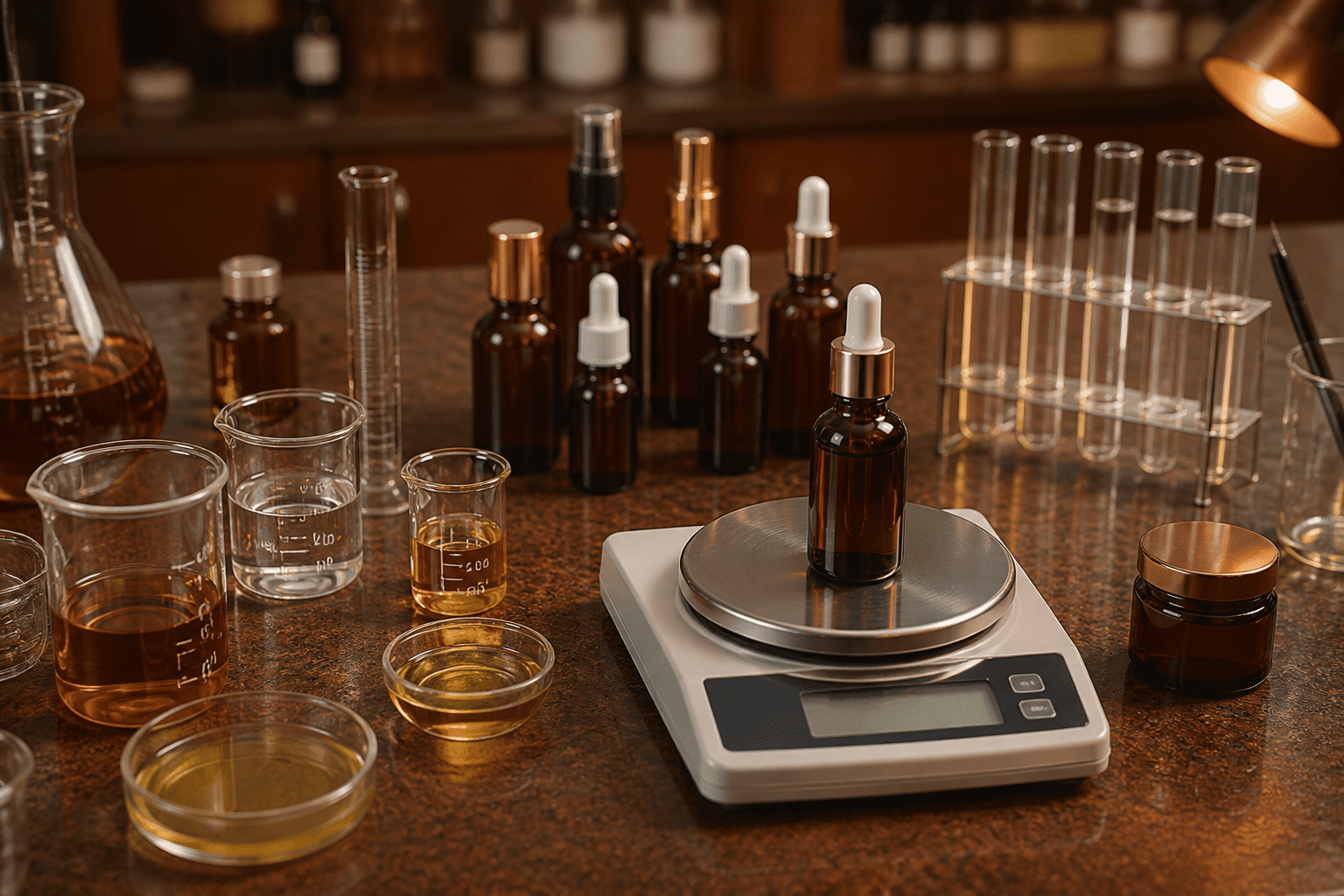
You’ve got the science. Now comes the fun part, and the part where batches go wrong. Chamomile water is mostly water, so it behaves like water. Thin. Easy to spoil. A little moody about pH.
How Much Chamomile Water Should Go In?
There’s no single right number. It depends on the product format and what else is in the bottle. A hydrosol formulation guide shares a simple toner base: 94% chamomile hydrosol, 3% glycerin, 2% panthenol and 1% broad-spectrum preservative. Toners can go as high as 90%, since the hydrosol is the whole point.
Serums usually sit around 10 to 30%. Cleansers and clay masks are less settled, so treat my numbers there as starting points for your own trials, not rules.
Formulator’s Cheat Sheet
| Product Type | Recommended % of Chamomile Water | Synergistic Ingredients | Key Formulation Tip |
|---|---|---|---|
| Toner | Up to 90% | Hyaluronic acid (0.05 to 0.1%), panthenol, glycerin | Aim for pH 4.0 to 5.5 and use a dark pump or spray bottle |
| Anti-acne toner or serum | 10 to 30% in serums | Niacinamide (2 to 4%), willow-derived salicylic acid, tea tree oil | Confirm niacinamide and preservative compatibility at your final pH |
| Gel cleanser | 20 to 40% (test range) | Gentle surfactants, glycerin | Check foam and viscosity, since low-pH hydrosol can thin some gels |
| Clay mask | 30 to 60% (test range) | Kaolin or bentonite, tea tree oil | Use it as the mixing liquid and watch drying time |
| Light lotion | 20 to 50% of the water phase | Panthenol, hyaluronic acid | Test emulsion stability before scaling up |
Pairings That Make Sense
Think of chamomile water as the calm friend at the party. It pairs well with louder actives. Niacinamide and chamomile make a friendly duo for redness-prone skin. Hyaluronic acid turns a basic toner into a soothing, hydrating one.
Salicylic acid and tea tree oil are the classic anti-acne partners. But salicylic acid doesn’t just dissolve in a water-only toner, and legal limits apply, so you’ll need a proper solubilizing plan. And keep your claims modest. Calling a chamomile product “soothing support” is safe; calling it an acne treatment can trigger drug rules in some markets.
The Three Things That Trip Up Formulas
Preservation
Hydrosols are basically a snack for microbes. “Natural” doesn’t cancel that out. Formula Botanica covers natural preservative options, and acid-friendly systems like Geogard Ultra tend to work best around pH 3 to 6. Whatever you pick, get an ISO 11930-style challenge test. A fridge test or a sniff check won’t cut it.
pH Stability
Supplier data for chamomile hydrosols runs from about 3.8 to 7.0. That’s a wide gap. So measure every batch with a calibrated meter, then measure the finished product again after everything’s mixed in. Niacinamide, acids and preservatives all have preferred ranges.
Emulsion Texture
Hydrosol can change how a cream or gel feels. Swap too much water for it and some thickeners lose viscosity. Check texture and pH after 24 to 48 hours, then run thermal cycling and centrifuge tests. Add heat-sensitive ingredients at cool-down.
Good formulas also depend on good raw material, which brings us to sourcing.
4. Sourcing for Success: Why a Certified Bulk Chamomile Water Supplier is Non-Negotiable

Get a quote from Aroma Monk.
Essential Oil Supplier – Bulk pricing • Samples • Fast response
You can build a beautiful formula and still lose it all to a bad drum of raw material. It happens more than people admit.
What Goes Wrong With Cheap Hydrosol
Remember the mislabeled Roman chamomile from earlier? That’s one kind of problem. There are others. Some “chamomile water” is mostly tap water. Some is plain water with synthetic fragrance and a solubilizer. And some is real hydrosol that was stored badly, so microbes moved in.
For your customers, that can mean stinging, redness or a breakout from a toner that was supposed to calm things down. For your brand, it means bad reviews, returns and a lot of lost trust. Even a recall unrelated to sourcing, like the 2024 Babyganics chamomile bubble bath recall, shows how fast a quality problem can become a public one. (To be fair, that notice doesn’t say chamomile sourcing caused it.)
So pure chamomile water for cosmetics isn’t a nice extra. It’s the foundation.
How to Vet a Bulk Chamomile Water Supplier
Here’s what I’d ask for before placing a first order:
- A batch-specific certificate of analysis tied to a lot number, not a generic “typical values” sheet
- GC-MS data from a third-party lab, so you can confirm the chamomile is what the label says
- Microbiology results, plus heavy metal and pesticide screening
- The exact species, plant part, country of origin and distillation date
- A clear statement of whether anything was added (preservative, solubilizer, fragrance)
- Organic certificates, if the supplier claims them
- A safety data sheet and technical data sheet for your regulatory file
Want to see what good paperwork looks like? This sample hydrosol COA shows the kind of detail you should expect. Also, some suppliers test every hydrosol batch for pH and microbes and check for heavy metals. That’s the standard to hold everyone to.
5 Red Flags to Watch for When Sourcing Hydrosols
| Red flag | Why it matters |
|---|---|
| No batch number on the COA | You can’t trace problems back to a source |
| “Natural” or “pure” with no process details | Those words aren’t regulated, so they prove nothing |
| Won’t share GC-MS or lab data | Hard to spot dilution or mislabeled botanicals |
| Vague origin or botanical name | German and Roman chamomile can get mixed up |
| Price far below the market | Often means diluted water or reconstituted floral water |
Why a Reliable Partner Pays Off
Cheap and inconsistent gets expensive fast. A batch that smells different, or lands at a different pH, can throw off your preservative system and force you to reformulate mid-launch.
A steady bulk partner like Aroma Monk helps here. They manage the chain from raw material sourcing to delivery, quality test, and focus on traceability and export. Buying direct from a manufacturer can also cut out broker markups, which helps your margins as you scale. Plus, you get the COA and MSDS paperwork you need to sell across borders, along with room to customize packaging.
Once your sourcing is locked in, the fun part opens up. Chamomile water can do a lot more than help with breakouts.
5. Beyond Acne: The Versatile Role of Chamomile Water for Overall Face Care
Here’s something I like about chamomile water. It doesn’t need a breakout to be useful. Plenty of your customers just want skin that feels calm and fresh.
A Gentle Hydrating Step for Sensitive Skin
Chamomile water is light, mild and mostly water. That makes it a friendly base for dry, sensitive or reactive skin, including skin that’s been through harsh treatments. It adds a cool, soft feel without a heavy film.
Now, a reality check. For rosacea, the clinical proof is for chamomile-type extracts and creams, not plain floral water. A 2026 narrative review of plant extracts in rosacea covers that work, and the same goes for eczema. So I’d call chamomile water a “soothing, refreshing step.” Not a treatment.
One more thing. Chamomile belongs to the Asteraceae family, and some people react to it. Patch testing is a must, especially for reactive skin.
The Antioxidant Angle
Chamomile carries flavonoids and phenolic compounds like apigenin and luteolin. These are plant antioxidants, and brands love to talk about them for dullness and visible aging.
But be careful here. I couldn’t find a verified ORAC value for chamomile hydrosol. The numbers out there mostly come from extracts or essential oils. A review of plant hydrosols found antioxidant activity from 4.43% to 39.87%, which shows how much it swings by plant and distillation. So if you want to say “antioxidant-rich,” test your own batch with a proper assay first. Otherwise, “may help skin feel protected from daily stress” is safer wording.
Post-Procedure Comfort
After a peel or microdermabrasion, skin feels tight, warm and a bit pink. A cool, mildly acidic mist feels great at that moment. Chamomile’s calming reputation fits well here.
Still, I’d keep the claims soft. Say it “comforts” and “refreshes.” Don’t promise faster healing, since no solid trial backs chamomile water for that. And skin after a procedure is more open to contamination, so a properly preserved, challenge-tested formula matters even more.
Product Concepts to Spark Ideas
Here are a few starting points for your development team:
| Concept | Chamomile water level | Pairs well with | Claim style |
|---|---|---|---|
| Post-Peel Calming Mist | Up to 90% | Panthenol, glycerin | “Comforts and refreshes skin” |
| Daily Antioxidant Essence | 60 to 80% | Hyaluronic acid (0.05 to 0.1%), niacinamide | “Helps skin feel protected” |
| Redness-Care Toner | Up to 90% | Panthenol, gentle humectants | “Soothes the look of stressed skin” |
| Barrier-Friendly Serum | 10 to 30% | Panthenol (1 to 3%), light emollients | “Soft, calm, hydrated feel” |
These are concept ideas, not validated formulas. Run your own stability and preservation tests before launch. Next, let’s pull it all together.
Elevate Your Skincare Line with the Proven Power of Pure Chamomile Water
So, where does all this leave us? Chamomile water for face care is a gentle, multi-purpose ingredient. It calms. It refreshes. And it fits neatly into the natural acne treatment ingredients shoppers keep asking for.
I’ll be honest, though. “Proven” needs an asterisk. The lab work on chamomile hydrosol for acne is promising, but the clinical proof isn’t there yet. The smart play is to position it as soothing support, pair it with partners like niacinamide or panthenol, and keep your claims modest.
Here’s the part people skip. A great formula can’t rescue weak raw material. Mislabeled botanicals, watered-down batches and shaky pH all show up in the finished product, and your customers feel it first. Pure chamomile water for cosmetics, backed by a batch-specific COA and GC-MS data, is the base everything else sits on.
The market is moving your way, too. Market Research Future’s natural cosmetics data is one of several forecasts pointing up, and one estimate has natural cosmetics growing from $23.88 billion in 2025 to $32.49 billion by 2030. Forecasts differ by source, so treat that as a direction, not a promise.
| Your next step | What to ask for |
|---|---|
| Qualify the ingredient | Technical data sheet, INCI details, safety data sheet |
| Check the quality | Batch COA, microbiology, GC-MS profile |
| Plan the supply | Origin, traceability, order sizes, lead times |
Ready to Start Formulating?
Contact us to request a sample of our lab-tested chamomile water and the corresponding technical data sheet to begin formulating your next bestselling product.
Reach the Aroma Monk team at aromamonk.com to start your sample request.
Get a quote from Aroma Monk.
Essential Oil Supplier – Bulk pricing • Samples • Fast response