

Meeting Market Demand: The Rise of Natural Ingredients in Advanced Hair Care

Natural hair care is a $10.17 billion business that’s expected to hit $16.99 billion by 2030, according to Grand View Research. That’s about 9.4% growth every year. Big number. And it keeps climbing.
Now, other firms count the category differently. Mordor Intelligence forecasts a slower 5.9% pace, for example. So the exact totals don’t match. But the direction does. Shoppers want hair products that feel gentle, look clean on the label, and still work.
That’s the squeeze product developers feel right now. Customers read ingredient lists like detectives. They skip harsh chemicals, yet they still expect results. Plain water as a base? Boring, and it adds nothing. Heavy synthetic blends? They can scare off the very buyers you’re trying to win.
This is where chamomile water comes in.
Also called chamomile hydrosol, it’s the aromatic water left behind after steam distillation of chamomile flowers. Think of it as a premium base that does more than fill the bottle. It brings a soft botanical character, a naturally mild acidity, and a gentle story that fits scalp mists, leave-in sprays, and toners. One ingredient, several jobs.
So here’s what this guide is for. If you’re a procurement manager, a formulator, or a brand owner, you’ll find practical steps for using chamomile water for hair, pairing it with essential oils, and standing out on a crowded shelf. I’ll keep it plain and useful. Aroma Monk works with these same questions every day on the supply side, and we’ll start with what chamomile water really is.
1. Beyond the Basics: Understanding True Chamomile Water (Hydrosol) for Commercial Formulation
Here’s a mistake I see a lot. Someone steeps a few chamomile tea bags, calls it chamomile water, and hands it to the lab. Nope. That’s tea, and it’s not what your buyers or your regulators mean by a hydrosol.
How True Chamomile Hydrosol Is Made

Steam gets pushed through chamomile flowers. The heat frees the aromatic compounds, and then the steam cools back into liquid. That liquid splits in two: a tiny layer of essential oil and a much larger volume of fragrant water. The water is the hydrosol. It’s a co-product of making the oil, which is part of why it can be such good value.
A tea or infusion is different. Flowers sit in hot water, and nothing is distilled. The chemistry changes, and it spoils fast. Floral waters can also be diluted, or just water mixed with essential oil or fragrance. This bulk buyer’s guide on hydrosols versus floral waters covers that gap well.
What to Check Before You Buy
A good bulk chamomile water supplier won’t flinch at paperwork. Ask for:
- A GC-MS report for the exact batch, with compound percentages
- The botanical species, plant part, distillation date and batch number
- Organic certification you can actually verify (not just a badge)
- Microbial results, pH and any preservative used
- Traceability back to the farm or raw material source
One catch: GC-MS reads volatile compounds. It can’t reliably measure flavonoids like apigenin, so if a supplier makes that claim, ask for HPLC or LC-MS data too.
Also, don’t judge by color alone. Chamazulene forms during distillation and gives that blue tint, but a pale hydrosol isn’t automatically bad. Published German chamomile oil profiles show chamazulene anywhere from about 5 to 24%, and that’s for the oil, not the water. So batch data matters more than looks.
German vs. Roman: Which One Fits Your Formula?
Both show up as “chamomile water.” They aren’t twins, though.
| Feature | German Chamomile (Matricaria recutita) | Roman Chamomile (Anthemis nobilis) |
|---|---|---|
| Key compounds | Chamazulene, bisabolol, bisabolol oxides | Mostly esters, softer profile |
| Main character | Soothing, more “active” feel | Calming, gentle, sweet aroma |
| Plant type | Annual | Perennial |
| Best uses | Scalp mists, toners, sensitive-scalp sprays | Leave-in sprays, hair refreshers, mild fragrance-led products |
| Watch out for | Color and scent vary by batch | Needs its own batch testing, don’t assume it matches German |
For most scalp-focused products, German is the usual starting point. Roman suits formulas where a calm, soft aroma leads. I’d test both on your own base, because the best pick often comes down to scent and finished-product results.
Next up, we’ll look at what the science says chamomile water can actually do for hair and scalp.
2. The Science-Backed Benefits of Chamomile Water for Hair and Scalp Health
So what does chamomile water actually do? Let’s separate the solid science from the marketing fluff. Some of it is well supported. Some of it needs careful wording.
Calming an Itchy, Irritated Scalp
Itchy, red, uncomfortable scalps are one of the top complaints in hair care. Chamomile hydrosol gives you a gentle way to speak to that.
The star compound here is alpha-bisabolol. Dermatology literature describes it as anti-inflammatory and anti-itch, and it seems to work even better when paired with other barrier-friendly ingredients. Chamazulene, the compound behind that blue tint, gets similar praise. Reviews of chamomile preparations report less redness and itching in eczema-type models.
Here’s the catch, though. Most of that evidence comes from extracts, creams and lab work. I haven’t found a large, modern human trial on chamomile water sprayed on scalps. So I’d position it as a supporting ingredient for sensitive-feeling scalps. Skip words like “treats dermatitis.” Those cross into drug-claim territory.
Brighter-Looking Highlights (Without the Bleach Talk)
You’ll hear that chamomile lightens blonde and light brown hair, and that apigenin is the reason. I wanted that to be true. Actually, the research points the other way.
Studies on apigenin show it tends to boost melanin production. One 2025 study on human melanocytes found about 1.8 times more melanin at 10 μM. That’s not a lightening mechanism. And I couldn’t find human data showing predictable lightening from chamomile water.
So what can you say? Something like “supports golden-looking, sun-kissed highlights.” It’s honest, and it still appeals to buyers who want a gentler alternative to harsh lighteners. Your claims team will thank you.
Gentle Conditioning for Leave-Ins
Chamomile water isn’t a cleanser in the shampoo sense. It has no foaming power. But it’s a mild, water-based way to refresh the scalp and hair between washes, and its natural acidity (commonly around pH 4.5 to 5.5) sits close to the scalp’s own pH.
That’s why it works so well in leave-in sprays, toners and scalp mists. It adds a soft, calm feel, and hair often looks smoother and shinier after a light mist. Test that on your own base though. Shine and softness depend on the full formula, not just the hydrosol.
Quick Reference: What Each Compound Brings
| Compound | What it’s linked to | How to word it |
|---|---|---|
| Alpha-bisabolol | Soothing, anti-itch support | “Helps scalp feel calm and comfortable” |
| Chamazulene | Calming, anti-inflammatory support | “Soothing botanical” |
| Apigenin | Lab data shows it boosts melanin | “Supports golden-looking highlights” |
| Hydrosol base | Mild acidity, light hydration | “Conditions and refreshes hair” |
With the benefits mapped out, the next step is pairing chamomile water with the right oils to make those benefits work harder.
3. Strategic Synergy: Selecting Essential Oils to Amplify Chamomile’s Effects
Chamomile water is a calm, soft base. On its own, though, it can smell a bit like hay and honey. Nice, but not a product people remember. Adding the right essential oil gives it a job and a personality.
The trick is to pick oils by the outcome you want, not by what’s trending. Here’s a simple way to think about it.
Pairing Oils by Outcome
Get a quote from Aroma Monk.
Essential Oil Supplier – Bulk pricing • Samples • Fast response
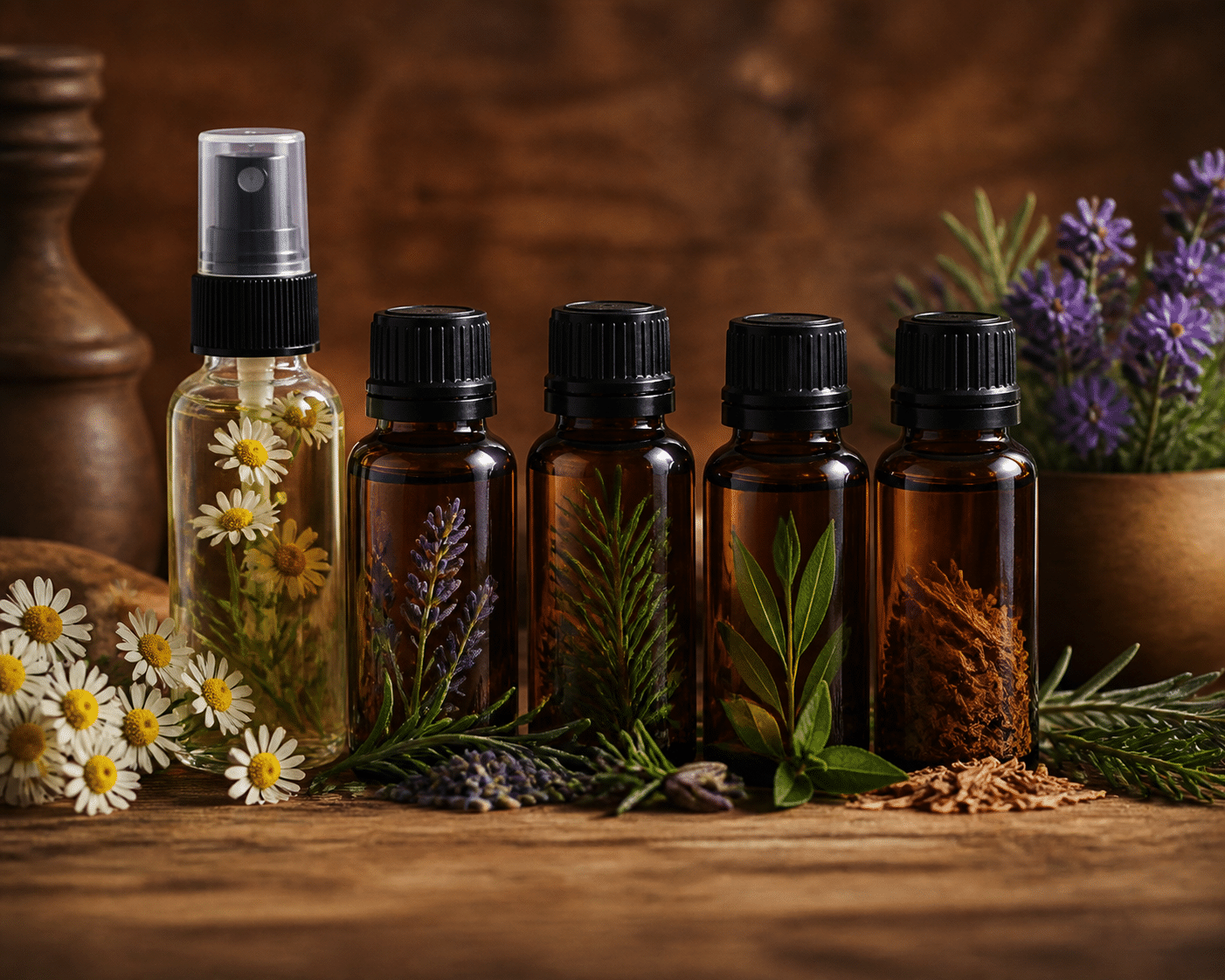
Scalp health: tea tree and rosemary. Chamomile brings the soothing story. Tea tree adds a fresh, clean, medicinal edge that buyers already link with scalp care. Rosemary is the one with real research behind it. A 2015 trial of 100 men compared rosemary lotion with 2% minoxidil for six months, and hair counts rose in both groups with no big gap between them. It’s one small study, so I’d call rosemary a promising partner, not a miracle. Pair it with calming chamomile and you get a scalp serum story that feels balanced: soothing plus stimulating.
Hair strength and growth feel: cedarwood and lavender. Cedarwood is woody and grounding. Lavender is soft and familiar. Together with chamomile, they suit a “strong, healthy-looking hair” line. I’m not aware of solid evidence for these two on hair growth, so keep the wording about appearance and feel.
Aroma and conditioning: ylang ylang and geranium. Both are floral and rich, and they make a leave-in mist smell expensive. They’re about sensory pleasure more than science. And that’s fine! People buy hair mist partly because it smells good.
Essential Oil Synergy Matrix for Hair Care Formulations
| Essential Oil | Primary Benefit | Synergizes with Chamomile for | Ideal Product Type |
|---|---|---|---|
| Tea Tree | Clean, fresh scalp feel | A refreshed, balanced-feeling scalp | Scalp toner, pre-wash mist |
| Rosemary | Stimulating scalp feel, backed by one small trial | Soothing plus invigorating scalp care | Scalp serum |
| Cedarwood | Woody, grounding aroma | Strong, healthy-looking hair story | Scalp serum, hair tonic |
| Lavender | Calming, familiar scent | A comfortable, sensitive-friendly feel | Hair mist, leave-in spray |
| Ylang Ylang | Rich floral aroma | Soft, conditioned-feeling hair | Leave-in spray, hair perfume mist |
| Geranium | Rosy, balanced aroma | Smooth, polished finish with a floral lift | Hair mist, refresher |
Building a Scent That Sells
Fragrance is where brands win or lose a shelf spot. Chamomile is herbaceous, so it sits nicely in the middle of a blend. Add a bright top note, like sweet orange or bergamot, and a deeper base, like cedarwood.
A common starting point from AromaWeb is 30% top notes, 50% middle notes and 20% base notes. Treat that as a scent guide only. It says nothing about safety or strength.
Some easy directions to try:
- Floral: chamomile, geranium and ylang ylang for a soft, feminine mist
- Woody: chamomile, cedarwood and lavender for a calm, spa-like tonic
- Citrus-herbal: chamomile, rosemary and orange for a bright, clean scalp serum
Before You Blend
Oils don’t dissolve in water. Drop them straight into chamomile hydrosol and you’ll get floating droplets and uneven dosing, which can irritate a scalp. You’ll need a suitable solubilizer, plus patch testing and a proper safety assessment for any leave-on product. Natural doesn’t mean gentle by default.
Aroma Monk supplies pure, lab-tested essential oils in bulk, so you can run these pairings as small pilot batches before you scale.
Next, we’ll turn these pairings into actual formulas.
4. Formulation Blueprint: Incorporating Blends into High-Performance Hair Products
OK, time to get practical. You’ve picked your chamomile water and your oils. Now you need a formula that actually holds together on a shelf.
I’ll be upfront: the numbers below are starting points for pilot batches, not final specs. Your safety assessor and your own stability data get the last word.
Inclusion Levels, pH and Preservation
How much chamomile water is enough? For most leave-on products, 30 to 70% hydrosol is a workable range. Go higher in scalp mists and serums, where the botanical water is the star. Go lower in rinses, where surfactants and other ingredients need room.
But here’s the thing about water-based formulas. They grow things. Hydrosols are especially open to microbes, so preservation isn’t optional. Two routes look practical:
- A fermented system: Leucidal Liquid type preservatives are often used around 2 to 4% and work in acidic formulas. Supplier guidance isn’t proof, though. Run a challenge test on your finished product.
- Sodium benzoate plus potassium sorbate: a label-friendly pair that tends to do best when the final pH sits below about 5.
Then there’s pH. Aim for 4.5 to 5.5 in the finished product. Scalp pH is about 5.5, and dermatology literature suggests scalp-focused products shouldn’t go above that. Chamomile water already lands near this range, which helps. Still, don’t assume. Measure the whole batch after everything is in, adjust with a little citric acid or a mild base, and check again after stability testing.
Getting Oils to Stay Mixed
Remember, oils don’t dissolve in water. Skip this step and you’ll see droplets by day three.
A solubilizer like Caprylyl/Capryl Glucoside fixes that. Mix your essential oils into the solubilizer first, until the blend looks uniform. Then stir that into the chamomile water slowly. Many formulators start with a few parts solubilizer to one part oil, then trim it back until the product stays clear. Use as little as you can get away with, since too much can leave a sticky feel.
Keep the total essential oil level low and let your safety assessor set the final limit. Natural doesn’t mean gentle by default.
Sample Formulation Sheet: Calming Chamomile & Lavender Scalp Serum
Here’s a simple blueprint for a leave-on scalp serum. Ranges are for pilot work, and they’ll need adjusting once you test.
| Ingredient (INCI) | Range (%) | Function |
|---|---|---|
| Chamomilla Recutita (Matricaria) Flower Water | 50 to 70 | Botanical base, mild acidity, soothing character |
| Aqua | q.s. to 100 | Balances the batch |
| Glycerin | 1 to 3 | Humectant, light hydration |
| Panthenol | 0.5 to 1 | Conditioning, comfort feel |
| Caprylyl/Capryl Glucoside | 1 to 3 | Solubilizer for the oil blend |
| Lavandula Angustifolia (Lavender) Oil | 0.1 to 0.3 | Fragrance, calming scent |
| Leuconostoc/Radish Root Ferment Filtrate | 2 to 4 | Preservative system |
| Citric Acid or Sodium Hydroxide | q.s. | Adjust final pH to 4.5 to 5.5 |
Want a cedarwood or rosemary twist? Swap part of the oil share, then re-check solubility and irritation.
Two More Product Directions
The same base can stretch into other formats. Each needs its own testing.
| Product | Hydrosol level | What changes | Claim wording |
|---|---|---|---|
| Brightening Hair Mist | 60 to 70% | Lighter feel, citrus or floral oils (orange, geranium), a little glycerin and panthenol | “Supports golden-looking highlights” |
| Gentle Micellar Hair Rinse | 30 to 50% | Adds a mild surfactant such as Caprylyl/Capryl Glucoside at a few percent, kept low-foaming | “Gently refreshes scalp and hair” |
The mist is the easiest to build, so I’d start there. The rinse is trickier because surfactant choice changes both feel and preservation. Funny enough, that’s usually where pilot batches teach you the most.
Aroma Monk supplies the lab-tested essential oils for these trial runs, so you can test small before you scale.
Next, we’ll look at how to check quality and market these formulas honestly.
5. Quality Control and Marketing: From Lab Bench to Customer Shelf
You’ve built the formula. It smells great and the pilot batch looks perfect. Now comes the part that decides whether it survives a hot warehouse in August.
Test Before You Talk

Water-based products grow things. I know I’ve said it before, but it’s the biggest risk in this whole guide, so it’s worth saying again. A chamomile mist can look fine on day one and turn cloudy by week six.
Before anything ships, run these checks on the finished product in its final package:
- Preservative challenge test: ISO 11930 is the usual standard. Supplier guidance on a preservative isn’t proof.
- Microbial limits: total aerobic count, yeast and mold, and pathogen screening.
- Stability testing: heat, cold, light and time. Watch for color shifts, separation and scent drift.
- pH recheck: measure again after stability. It can wander.
- Packaging compatibility: fine-mist pumps and light-protective bottles can behave differently than your lab beakers.
One more thing. Ask your supplier for a batch COA with every delivery and compare it against your spec. It takes ten minutes and saves a recall.
Claims That Sell and Stay Legal
This is where good brands trip. In the US, the FDA explains that a cosmetic can be treated as a drug if its claims say it treats a condition or changes how the body works. And a botanical ingredient doesn’t give you a free pass.
In the EU, Regulation 655/2013 says claims must be truthful, backed by evidence and not misleading. The evidence has to cover your finished product, not just chamomile in general.
Here’s how I’d reword the common ones:
| Risky wording | Safer wording |
|---|---|
| Soothes scalp irritation | Helps your scalp feel calm and comfortable |
| Enhances natural highlights | Supports golden-looking highlights |
| Powered by pure botanicals | Made with real chamomile water (then list the rest honestly) |
Do’s and Don’ts for Marketing Your Chamomile Hair Product
- Do name the species, plant part and how the water was made.
- Do keep a claim file linking every label and website line to its proof.
- Do say “hydrosol” only when it’s a true distillation product.
- Don’t write “treats dermatitis” or “promotes hair growth.”
- Don’t call the formula “100% natural” while skipping the preservative and solubilizer.
- Don’t let influencer posts or before-and-after photos hint at regrowth. Regulators read those too.
Quality Is Your Price Tag
Shoppers can’t smell a COA. But they can feel trust. When your label says what’s inside and your documents back it up, a higher price feels fair instead of random.
That’s where ingredient sourcing starts paying you back. Lab-tested, traceable oils, like the ones Aroma Monk supplies in bulk, give you something real to stand behind. Cheap, mystery-grade inputs give you something to apologize for.
Next, we’ll look at how to pick the supplier who makes all of this easier.
Your Partner in Purity: Sourcing Ingredients for Your Next Best-Seller
Let’s pull it all together. Chamomile water gives you a calm, gentle base that fits what shoppers already want: natural hair care ingredients they can understand. It has a real story behind it. Soothing support for sensitive-feeling scalps. Golden-looking highlights, worded honestly. A soft aroma that pairs well with rosemary, lavender or cedarwood. Few single ingredients let you stand out on a shelf this crowded.
But here’s the thing I keep coming back to. None of it works if the raw material is wobbly.
A clever formula can’t rescue a diluted hydrosol. A great claim file falls apart when the batch data doesn’t match the label. And a beautiful scent blend? One off-spec drum, and your customers notice. So the strength of your finished product hinges on what shows up at your dock, every single time.
What to Look for in a Supply Partner
You already have the checklist from earlier in this guide. Batch COAs. Clear species and plant part. Microbial results. Traceability back to the source. A good partner hands these over without a fuss, and keeps doing it on order number twenty, not just order number one.
Aroma Monk works this way on the supply side. We manage the whole chain, from sourcing raw materials to final delivery. Our essential oils are lab-tested and certified for purity, and we can talk through custom blends or packaging if you want a line that looks and smells like yours alone. Fewer handoffs means fewer surprises. Simple as that.
Your Next Step
Start small. Get a sample, run your pilot batch, check it against your spec, and see how it behaves in your base. If it passes, you scale with confidence.
Request a Bulk Sample of Our Certified Pure Chamomile Hydrosol
Your next best-seller might just be one good batch away.
Get a quote from Aroma Monk.
Essential Oil Supplier – Bulk pricing • Samples • Fast response