
Unlocking the Potential of Chamomile Water for Next-Generation Skincare
Ever stood in a skincare aisle and counted how many labels say “gentle”? I tried once. I gave up at 40.
Shoppers want products that feel kind to their skin and still work. That’s why natural skincare ingredients keep winning shelf space. Fortune Business Insights values the global clean beauty market at $10.79 billion in 2025 and expects it to reach $37.91 billion by 2034, a growth rate of about 15% a year. (Reports define “clean” and “natural” in different ways, so treat those numbers as a direction, not a promise.)
Chamomile water for skin fits this moment nicely. People know the plant. They trust it. And it suits the soft, simple formulas that shoppers love, like toners, facial mists, and products made for sensitive skin.
Here’s the catch. Not every bottle labeled “chamomile water” is the same thing. Some is true chamomile hydrosol, made by steam distillation. Some is closer to chamomile tea, a simple infusion. And some is little more than scented water. Those differences change quality, safety, and shelf life. Plenty of brands also assume a hydrosol protects itself from germs. It doesn’t. As Formula Botanica’s guide for formulators points out, hydrosols are water-rich and can support bacteria, yeast, and mold.
So this guide is for the people who build and buy: formulators, product developers, and procurement managers. We’ll look at the science, the skin benefits, how to formulate, and how to check a supplier before you place a bulk order. Let’s start with the biggest question of all: what are you actually buying?
True Hydrosol vs. Simple Infusion: A Critical Distinction for Quality Control
Picture two bottles on your desk. Both say “chamomile water.” Both smell a little like a calm Sunday afternoon. But one came out of a still, and the other came out of a tea bag. Big difference.
Let’s sort out which is which.
What a true chamomile hydrosol is
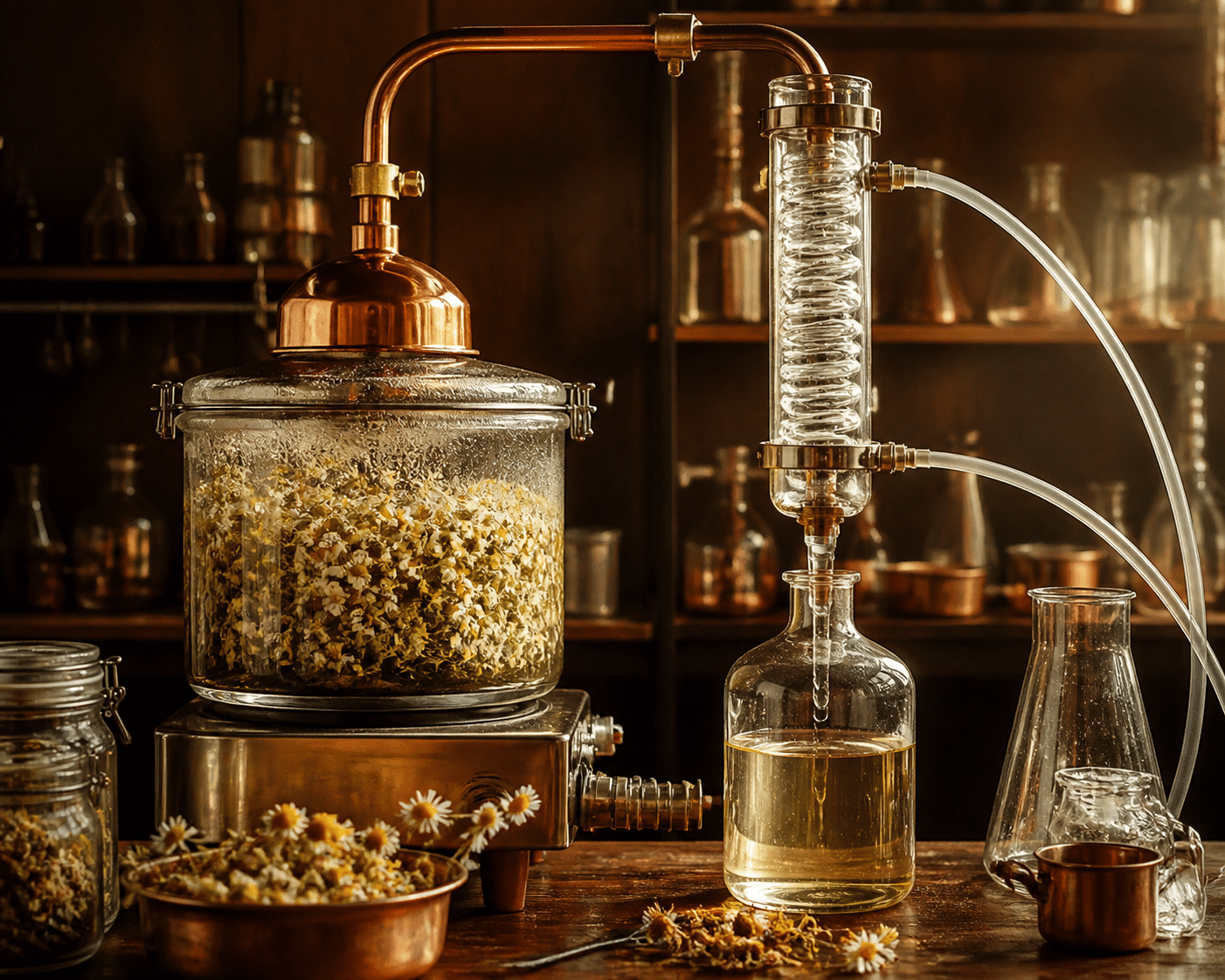
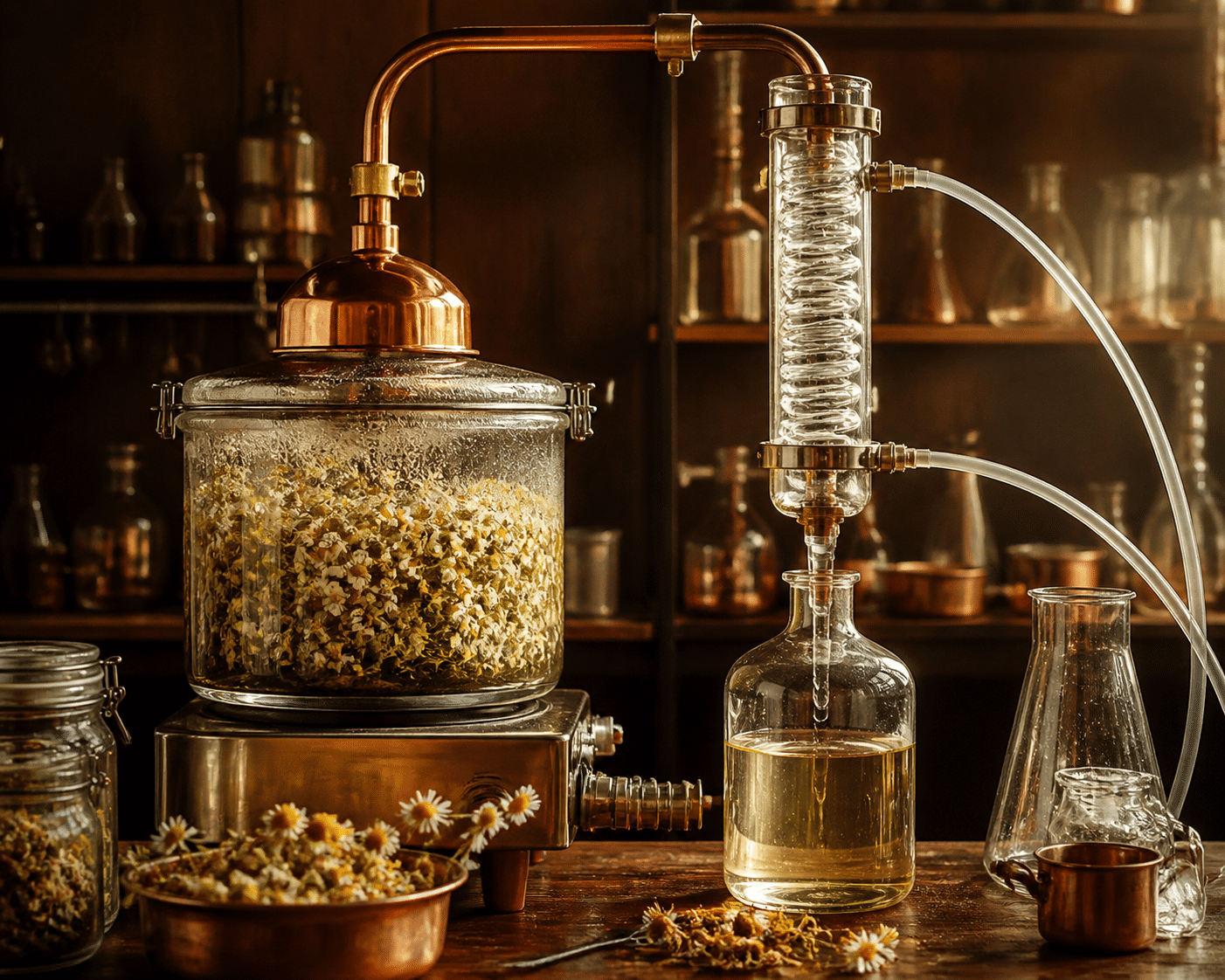
A true chamomile hydrosol is the aromatic water that comes along with steam distillation. Steam passes through fresh or dried chamomile flowers, usually German chamomile (Matricaria recutita) or Roman chamomile (Chamaemelum nobile). The steam carries tiny aromatic molecules with it. When it cools, it turns back into water, and the essential oil and the water separate. That leftover water is the hydrosol.
So it’s a co-product. It holds small amounts of water-friendly aromatic compounds from the flower. Not a lot, mind you. Hydrosols are dilute, and that’s normal.
One honest caution: there’s no single compound that’s in every hydrosol and never in a tea. The real gap is the type of compounds, as the table below shows. And because batches differ, a developer should ask for a GC-MS profile and certificate of analysis instead of trusting a fixed recipe.
What a simple infusion is
An infusion is what you make at home. Steep chamomile flowers in hot water, strain, done. It takes about 10 minutes and costs almost nothing.
It’s lovely in a mug. For a product that sits on a shelf for a year? Not so much. An infusion mostly pulls out heavier, non-volatile plant compounds like flavonoids and tannins. Many of the light aromatic ones fade fast. It also has no built-in protection, spoils in days, and changes from one brew to the next.
Why the difference matters for professional use
For a brand, four things stand out:
- Chemical makeup: A hydrosol carries the steam-volatile aromatic fraction. An infusion carries mostly the water-extracted, non-volatile fraction.
- Microbial stability: Neither protects itself. A hydrosol still needs a preservation plan, but it comes from a controlled, heated process. An infusion starts with a much higher germ risk.
- Consistency: A distillery can set and document specs. A kitchen brew can’t.
- Scale: Distillation can run in batches of hundreds of liters with paperwork to match. Infusions don’t scale cleanly.
Here’s the side-by-side view.
| Feature | Chamomile Hydrosol | Chamomile Infusion |
|---|---|---|
| Production method | Steam or hydro-distillation of flowers | Steeping flowers in hot water |
| Key compounds | Dilute, steam-volatile aromatics (such as bisabolol-related compounds) | Mostly non-volatile compounds (flavonoids, phenolic acids, tannins) |
| Shelf life | Longer with proper preservation and packaging | A few days, even refrigerated |
| pH level | Often around 4.5 to 7.0 (varies by batch, so check the COA) | Varies with water and brewing time |
| Commercial viability | Good, with specs, testing, and batch records | Poor, too inconsistent and unstable |
A quick tip: if a supplier can’t tell you how the water was made, treat that as a red flag. Even a true hydrosol isn’t a finished, self-protecting ingredient, which is why the formulation steps come later in this guide. First, let’s look at what chamomile can actually do for skin.
The Science-Backed Skin Benefits Driving Consumer Demand

Here’s a confession. When I first started reading about chamomile for skin, I assumed the science was settled. It isn’t. Not fully. But what we do have is promising, and it explains why shoppers keep reaching for it.
Let’s look at what the research says, and where it runs out.
Soothing and anti-inflammatory support
Most of chamomile’s calming reputation traces back to a few compounds: apigenin, alpha-bisabolol, and chamazulene. A 2022 review of chamomile chemistry and uses found that apigenin can limit oxidative damage in cell models. It also noted that topical chamomile oil lowered inflammation markers in an animal model of allergic dermatitis.
That’s a plausible story. But it’s not human proof for a hydrosol. Big gap.
The human data is smaller. A 2025 clinical study tested a chamomile microparticle formula on 30 people for four weeks. It caused no redness, peeling, burning, itching, or pain, and skin hydration improved. So we can say “well tolerated.” We can’t say “treats redness.”
For sensitive skin, rosacea-prone skin, and acne-prone skin, the smart move is gentle positioning. Think “may help soothe temporary irritation,” not “treats rosacea.” Also, chamomile belongs to the daisy family, and some people react to it. The NCCIH calls short-term topical use “possibly safe” at certain doses, which is a lot more careful than a blanket promise. Patch testing belongs in your plan.
Available research supports chamomile’s antioxidant and anti-inflammatory potential, but evidence for chamomile water itself in sensitive skin is less developed than evidence for chamomile extracts.
That’s the fair summary, and honestly, it makes for more trustworthy marketing.
Antioxidant power from flavonoids
Chamomile also carries flavonoids, and flavonoids are known for mopping up unstable molecules called free radicals. Those are the ones linked to pollution, sun, and everyday skin stress.
A 2022 review reported lab results for chamomile flower water. Radical-scavenging IC50 values landed around 7.3 to 16.8 µg/mL in the ABTS test and 10 to 45 µg/mL in the DPPH test. (Lower numbers mean stronger activity.) Not bad for a bottle of flower water.
But these are test-tube numbers. They don’t prove a finished mist protects a face from city air. So an “anti-pollution” or “anti-aging” angle works best as a supporting story, backed by your own testing.
Gentle hydration and toning
This is where chamomile water feels most natural. A water-based ingredient is already a good fit for facial mists, toners, and cleansers. And with a typical pH near the skin’s mildly acidic surface, it can mean less pH fiddling later.
It won’t replace a rich moisturizer. It’s a soft, light base that respects the skin barrier instead of stripping it.
Here’s the quick version:
| Benefit | What the evidence shows | How to word it |
|---|---|---|
| Soothing | Cell and animal data on apigenin and bisabolol; small human tolerability study | “May help soothe temporary irritation” |
| Antioxidant | Lab radical-scavenging results for flower water | “Contains plant antioxidants” |
| Hydration and toning | Better hydration in a small 2025 study; skin-friendly pH range | “Light, gentle hydrating base” |
So the benefits are real enough to build on. Next up: how to turn them into a stable, properly preserved formula.
Formulation & Application: Integrating Chamomile Water into Your Product Line
Get a quote from Aroma Monk.
Essential Oil Supplier – Bulk pricing • Samples • Fast response
You’ve got a good hydrosol in hand. Now what? Time to put it in a bottle that people will actually buy.
The good news is that chamomile water for skin is easy to work with. It’s water-based, mild, and friendly to light formulas. The tricky part is knowing how much to use and where.
Where to Use Chamomile Water in Your Skincare Line
Think of this as a quick map of your shelf: toner, serum, cleanser, and baby cream. The ranges below are starting points, not rules. Supplier guides vary a lot, so run your own tests.
| Product | Starting range (of total formula) | Why it fits |
|---|---|---|
| Toner or facial mist | Up to 90% | Mostly water already, so chamomile can lead |
| Serum | 10 to 30% | Leaves room for actives and thickeners |
| Cleanser | 5 to 20% | Rinses off, so a little goes a long way |
| Lotion or baby cream | Start near 10 to 25%, then test higher | Water phase shares space with oils and emulsifiers |
Baby creams and sensitive-skin lotions get a lot of love from chamomile positioning. But keep claims soft, and patch test first.
Swapping It In for Deionized Water
Many brands simply replace some of the deionized water with hydrosol. That works. But don’t swap everything on day one.
A hydrosol can change pH, smell, color, thickness, and how your emulsifier behaves. WF Academy’s hydrosol guide suggests checking the final formula and running stability tests before a full water replacement. A simple path is 10%, then 25%, then 50%, then 100% of the water phase. Test each step.
One more tip. If you heat your water phase, hold back part of the chamomile water for the cool-down stage. Heat can knock out some of the delicate aroma.
Pairings That Play Well Together
Chamomile water is gentle on its own. Add a few partners and it gets more interesting.
- Hyaluronic acid: Pulls in moisture. Chamomile water brings the calm, and this brings the bounce.
- Niacinamide: Supports the skin barrier. Just check the final pH, since niacinamide can be picky.
- Rose water: Adds extra toning and a softer scent. Aroma Monk offers rose water for skincare use, so a chamomile and rose toner is an easy first prototype.
A toner with all three? Light, soft, and simple to explain on a label.
Preservation Is Not Optional
Here’s the part I’d never skip. Every water-based product needs a preservative. Chamomile water is no exception, even if it’s organic and smells like a meadow.
Preservation has to cover the whole formula, not just the hydrosol. Some natural and nature-identical options include:
- Benzyl alcohol with dehydroacetic acid (often sold as Geogard 221), usually around 0.2 to 1%
- Sodium benzoate with potassium sorbate, which works best in mildly acidic products
- Gluconolactone with sodium benzoate, also suited to acidic, water-based formulas
These tend to depend on pH, so measure your finished formula first. Formulabai’s overview of COSMOS-friendly preservatives is a handy place to compare choices.
Then run a challenge test (ISO 11930) on the final product in its final packaging. Pumps and sprays beat open jars here.
Formula sorted? Good. Next comes the part that can make or break it: finding a supplier you can trust.
Sourcing for Success: A Procurement Manager’s Checklist for Bulk Chamomile Hydrosol
You found a formula you love. Now comes the part that keeps procurement managers up at night: buying it by the drum without getting burned.
I’ll be honest. A nice sample and a friendly email prove very little. Paper proves a lot more.
Start With the COA and GC/MS Report
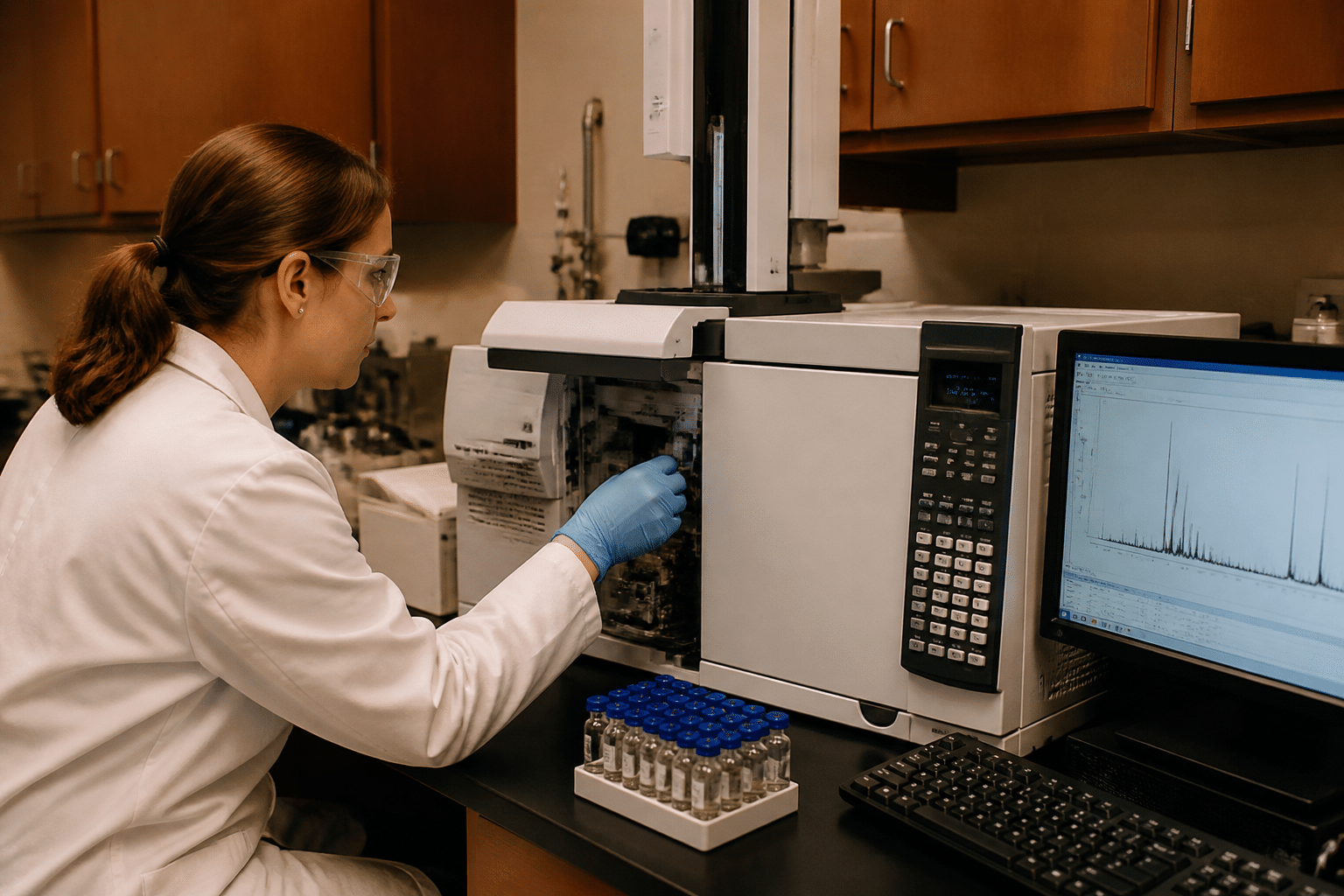
Ask for a Certificate of Analysis (COA) and a Gas Chromatography-Mass Spectrometry (GC/MS) report before anything else. And make sure they’re for the exact batch you’re buying. A line like “GC/MS available on request” doesn’t count.
A good report names the plant by its Latin name, either Matricaria recutita (German chamomile) or Chamaemelum nobile (Roman chamomile). It should also show the full chromatogram, not just a summary. Hydrosols are dilute, so the numbers should look dilute. One commercial comparison puts alpha-bisabolol in chamomile hydrosol at roughly 0.002 to 0.008%. If a report shows essential-oil-level numbers, ask why. It could mean someone added oil to the water.
That’s not a made-up worry. In one study of retail neroli oils, more than 19% of samples held diluents like propylene glycol or vegetable oil. Same trick, different flower.
Ask How It Was Made
Next, question the process. Simple, but many buyers skip it.
- Do you run steam distillation in-house, or buy from partner distilleries?
- Is it a true co-distillate, or water blended with oil, extract, or fragrance?
- Can you trace the flowers back to a farm and a harvest?
- Were any solubilizers, glycols, or colorants added?
Partners aren’t a bad thing. Plenty of good suppliers use them. But they should name them and show the records. Cosmetic industry groups already ask for this kind of detail. The IKW supplier questionnaire, for example, asks for regulatory declarations, analysis certificates, raw material specs, and safety data sheets.
Can They Deliver, Batch After Batch?
A great first order means nothing if the third one smells different. So look at reliability too:
- Volume: Can they handle your launch and your reorders?
- Consistency: Do batches stay within an agreed spec for pH, aroma, and microbes?
- Shipping know-how: Have they exported to your country, with the right paperwork?
- Communication: Do they answer questions quickly, and warn you before changing species, origin, or lab?
This is the area where Aroma Monk focuses, managing the supply chain from raw material sourcing to final delivery for B2B buyers.
Your Supplier Vetting Checklist
Copy this into your own document and send it with your first inquiry.
| Check | What to ask for | Red flag |
|---|---|---|
| Identity | Latin name, plant part, country of origin | Just “chamomile” |
| Batch COA | pH, microbiology, appearance, odor, lot number | Generic or undated COA |
| GC/MS | Full chromatogram, method, lab name | Summary only |
| Process | Steam distillation details, additives list | Vague or “proprietary” answers |
| Traceability | Farm to filling records | No batch history |
| Capacity | Annual volume, lead time, MOQ | Can’t commit to numbers |
| Change control | Notice before any change in origin or process | No policy |
| Samples | Retained sample, third-party testing allowed | Refuses outside testing |
Want a second opinion on a COA? Send it to an independent lab. A good supplier won’t mind. Once your supplier passes, you’re ready to think about the bigger picture of what this ingredient can do for your brand.
From Ingredient to Innovation: Make High-Quality Chamomile Water Your Brand’s Signature
Here’s the whole story in one breath. Chamomile water for skin only works as well as the water you start with. Quality, purity, and how it was made decide everything else.
A true steam-distilled hydrosol, with a batch COA and a GC/MS report behind it, gives you something you can build on. A tea-style infusion, or a bottle of lightly scented water, gives you a story and not much more. And honestly, shoppers can tell. A NielsenIQ report on better-for-you products found that 76% of shoppers said transparent product information from brands mattered in 2023, up from 69% in 2018. People want proof.
So here’s a small homework task for this week. Pull up the aqueous ingredients in your current formulas and ask a few blunt questions:
- Is this a true hydrosol, or an infusion, or something blended?
- Do I have the Latin name and a batch-specific COA?
- Has the full finished formula passed a challenge test?
- Could I explain this ingredient to a customer without squirming?
If any answer is “not sure,” that’s your starting point. It might be a quick fix. It might mean changing suppliers. Either way, you’ll know.
And that’s where a reliable partner earns their keep. Aroma Monk supplies lab-tested, natural ingredients to B2B buyers, with bulk and export support and traceability from raw material to delivery. If you’re ready to compare a real chamomile hydrosol against what you’re using now, start with the Aroma Monk team and ask for the documents first. The samples can follow.
Make chamomile water more than a line on your label. Make it proof that your brand cares about purity.
Ensure Product Purity.
Partner with Aroma Monk for Certified Chamomile Hydrosol.
Request Your Bulk Quote & COA Today
Get a quote from Aroma Monk.
Essential Oil Supplier – Bulk pricing • Samples • Fast response