
Introduction: The Growing Demand for Natural Antimicrobials in Cosmetics and Personal Care
Picture this. You’re a product developer, and your boss walks in with a new brief: “Make it clean. Make it natural. Make sure it still lasts 24 months on a shelf.” Sound familiar? Yeah, I thought so.
That tension is everywhere right now. Shoppers want plant-based formulas, and brands still need products that stay safe and stable.
Why Natural Is More Than a Trend
The numbers back this up. The natural cosmetic ingredients market was about $10.6 billion in 2025, and Grand View Research is the kind of report that tracks it heading toward $21.7 billion by 2033. That’s a 9.5% yearly growth rate. Natural options also hold a big share of the antimicrobial side. Dataintelo reports that natural agents made up 38.6% of cosmetic antimicrobial revenue in 2025, and they’re growing faster than the rest of the category.
Shoppers are pushing it, too. A 2025 study cited by NSF International found that 74% of consumers saw organic ingredients as a must in personal care. And rules are shifting. The EU is limiting methylisothiazolinone in rinse-off products to 15 ppm starting 1 May 2026, so teams are looking harder at plant-based options.
Where Tea Tree Water Fits In
This is where tea tree water, also called tea tree hydrosol, comes in. It’s the gentle, aromatic water left behind when Melaleuca alternifolia leaves are steam distilled. It carries small amounts of plant compounds like terpinen-4-ol, and many brands are curious about its tea tree water benefits for toners, mists and cleansers.
Now, I’ll be straight with you. It’s not a magic preservative. Hydrosols can still grow microbes, and your finished formula needs proper testing. But as a botanical ingredient with a real story, it has a lot going for it.
What This Guide Covers
This guide is written for product developers and procurement managers. We’ll look at what tea tree water really is, what the science says, how to formulate with it, and how to check quality when buying in bulk. The goal is simple: help you stand out with a product that’s honest, tested and built to last.
What is Tea Tree Water? A Formulation-Focused Overview
Before you can formulate with something, you need to know what’s actually in the bottle. So let’s start there.
How Tea Tree Water Gets Made
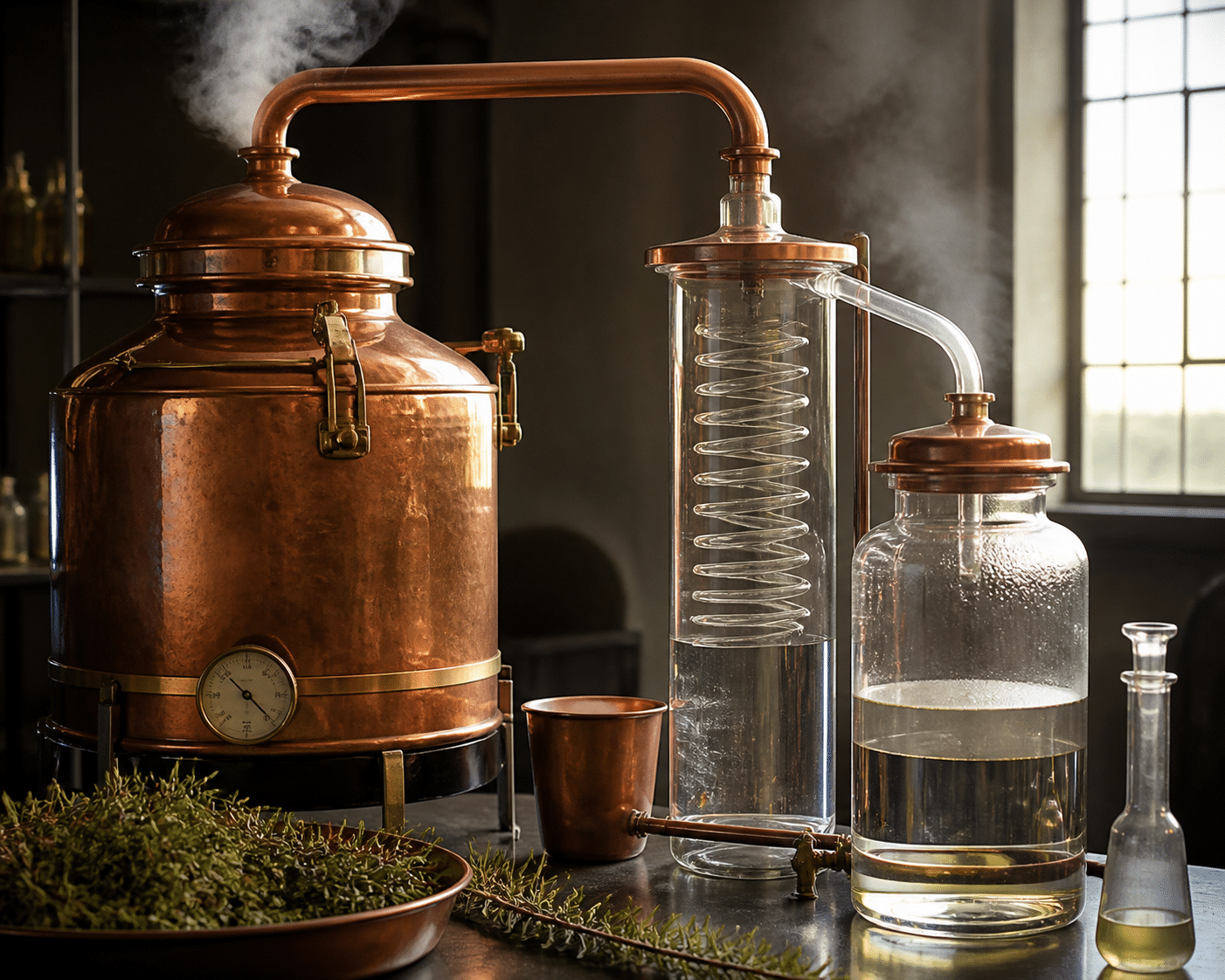
Tea tree water starts the same way tea tree essential oil does. Steam passes through Melaleuca alternifolia leaves. The heat pulls out the aromatic compounds, and the steam then cools in a condenser and turns back into liquid. That liquid separates into two layers. The light oil floats on top. The water underneath is the hydrosol.
Here’s the simple flow:
- Water is heated in the still.
- Steam rises through the tea tree leaves.
- Aromatic compounds move into the vapor.
- The vapor hits a cold condenser and becomes liquid.
- The oil is separated from the aromatic water.
- The water is filtered, tested and packed.
If you want to see it in action, this 3D animation on distilling essential oils and hydrosols walks through each step.
Now, a common mistake. People call hydrosol “diluted essential oil.” It isn’t. The water phase holds only the compounds that dissolve or disperse in water, so its makeup is different. One 2021 lab study found terpinen-4-ol at about 624 µg/mL in tea tree hydrosol, which is roughly 0.06%. That’s a trace amount, not a punch.
Tea Tree Water vs. Tea Tree Essential Oil
This is where formulators often get tripped up. The two ingredients come from one plant, but they behave very differently in a batch.
| Feature | Tea Tree Water (Hydrosol) | Tea Tree Essential Oil |
|---|---|---|
| Composition | Water-based, with trace terpinen-4-ol and other soluble compounds | Concentrated oil, with much higher terpinen-4-ol |
| Application | Mixes straight into water phases of toners, mists and cleansers | Needs a solubilizer or emulsifier to blend into water |
| Safety | Milder, usually used at higher percentages | Strong, used at low percentages with tight limits |
| Cost | Usually lower per kilo, but you use more of it | Higher per kilo, but you use very little |
The big plus? Tea tree water goes right into a water-based formula. No extra solubilizer needed just to get it to mix. That keeps your ingredient list shorter, which clean-label brands tend to love.
But (and it’s a big but) milder also means weaker. Please don’t treat tea tree water as a stand-in for the oil’s strength. Think of it as a gentle botanical water with a nice story.
What to Check When You Buy
When a sample lands on your desk, a few quick checks tell you a lot:
- Origin: The label should say Melaleuca alternifolia, plus the plant part and extraction method.
- Clarity: It should look clear. A slight haze can happen, but heavy cloudiness, sediment or a film is a red flag.
- Scent: Real hydrosol smells soft, fresh and herbal. A harsh, perfumey or one-note smell may mean added fragrance.
- Additives: Ask directly about solubilizers, fragrance and preservatives. If it’s sold as pure, the spec sheet should say so.
- Paperwork: Every batch needs a lot number and a certificate of analysis.
There’s no single global standard for tea tree hydrosol, and pH ranges differ from supplier to supplier. So set your own release spec and hold every lot to it. We’ll get into the science next.
The Science of Efficacy: Unpacking the Antimicrobial Properties of Tea Tree Water
Here’s where I have to be honest with you. Most of the big antimicrobial claims you’ll see online come from tea tree essential oil, not tea tree water. That difference matters a lot for your formulas.
So let’s look at what we know, what we don’t, and how to talk about it without overpromising.
Terpinen-4-ol and How It Works
Terpinen-4-ol is the star compound in tea tree. In plain terms, it’s a small, oily molecule that can slip into the outer wall of a microbe. Once there, it’s thought to make that wall leaky, so the cell loses what it needs to survive. Think of a water balloon with tiny pinholes.
That’s the mechanism most often described for the oil. But there’s a catch. Water carries far less of this compound. Earlier we saw about 0.06% terpinen-4-ol in tea tree hydrosol, and the amount can swing from batch to batch. A leaky-wall effect that works at oil strength may not show up at that level.
The compound also doesn’t love sitting in water. In a 2023 lab study, terpinen-4-ol in a pH 7.4 buffer kept about 91% after 1 hour but only about 63% after 6 hours. So stability is a real thing to watch.
What the Evidence Says About Skin Microbes
You’ve probably heard tea tree is “broad-spectrum.” For the oil, researchers have looked at acne bacteria, Staphylococcus aureus, Candida albicans and Malassezia. A frequently cited MIC for C. acnes is 0.25% v/v. But that number belongs to the essential oil.
For tea tree water, the picture is thinner. I couldn’t find a validated MIC for it against any of these microbes. A 2024 review of hydrosols says they may have antimicrobial, antioxidant and antibiofilm activity, but the field is still underexplored and results depend on the plant and the formula.
| Microbe | What oil studies suggest | What we can say about tea tree water |
|---|---|---|
| C. acnes (acne bacteria) | MIC of 0.25% v/v for the oil | No validated MIC found |
| S. aureus | Commonly studied with the oil | No hydrosol data to point to |
| C. albicans | Commonly studied with the oil | No hydrosol data to point to |
| Malassezia | Commonly studied with the oil | No hydrosol data to point to |
One bright spot: a 2026 study on 11 hydrosols, tea tree among them, found tea tree water stayed microbiologically stable for up to 13 months. That’s about storage, though, not killing pathogens.
The Calming Side of the Story
Tea tree is also known for soothing, which is why people reach for it on blemish-prone skin. Terpinen-4-ol is often linked to that calming reputation. Still, the research I found is mostly about the oil, so I wouldn’t lean on it as a hard claim for the water.
What feels safe? Position tea tree water as a gentle, botanical, soothing-style water phase. It fits toners and mists for problem-prone skin. Then back it up with a proper preservative and challenge testing on the finished formula. Next, we’ll look at where this ingredient fits in a real product line.
Commercial Applications: Integrating Tea Tree Water into Your Product Portfolio
OK, so you know what tea tree water is. You know what the science can and can’t say. Now the fun question: where does it actually go in a product line?
Here are three spots where it makes real sense. I’ll flag the limits as we go, because nobody wants a rejected claim at launch.
Toners, Mists and Cleansers for Oily, Blemish-Prone Skin
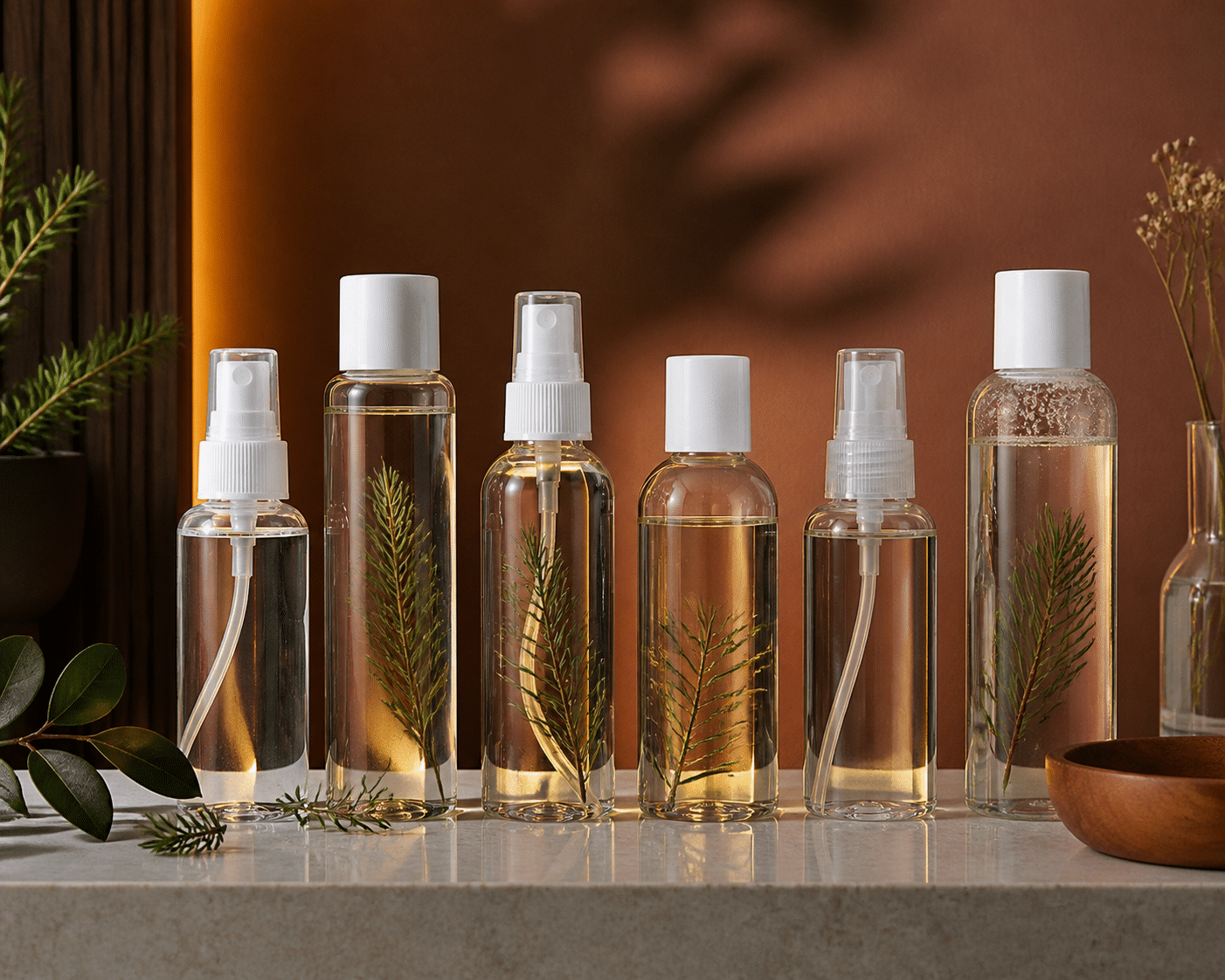
This is the obvious home. Tea tree has a name for blemish-prone skin, and the water phase is gentle enough for daily use.
The market already shows how it’s done. The Vivid Glossy Tea Tree Toner lists tea tree leaf water at 80.2%, so it’s the headline of the formula. It sits next to niacinamide, panthenol, centella and allantoin. Another example is the Theratree Clarifying Toner, which blends tea tree hydrosol with neem, witch hazel and other plant waters.
Here’s a rough guide to starting levels. Treat these as test points, not rules. Supplier advice varies a lot, and every batch needs stability and preservation testing.
| Product type | Starting range |
|---|---|
| Facial toner or essence | 20 to 80% |
| Facial mist | 50 to 100% |
| Serum, cream or lotion | 5 to 30% |
| Cleanser, shampoo or shower gel | 5 to 30% |
A word on claims. Say “soothing” and “botanical,” and say “tea tree leaf water.” Skip words like “antimicrobial treatment,” since no validated MIC exists for the water.
A Helper in Your Preservation Plan, Not the Whole Plan
This is the one people get excited about, so let me slow us down. Tea tree water is not a stand-alone preservative. Hydrosols are mostly water, and water feeds microbes.
But it can be a nice supporting player. With the EU limiting methylisothiazolinone in rinse-off products to 15 ppm from 1 May 2026, more teams want shorter, gentler preservation lists. Tea tree water can add a botanical story while you work with your preservative supplier on a lower-dose system. And any reduction has to pass ISO 11930 challenge testing. No pass, no change.
Here’s a simple, made-up example of how an ingredient list might shift in a toner concept:
| Before | After (needs full testing) |
|---|---|
| Water, glycerin, niacinamide, phenoxyethanol, ethylhexylglycerin, fragrance | Tea tree leaf water, glycerin, niacinamide, a lower-dose approved preservative blend |
The “after” list is shorter, and the fragrance is gone because the plant water brings its own soft scent. But the preservative stays. It just works with a gentler base. That’s a fair claim, and it’s one you can back up.
And about those market numbers: 57% of U.S. natural personal-care buyers say they avoid unnecessary chemicals, per Mintel. Still, avoid “chemical-free.” Water is a chemical too, and regulators notice.
Scalp Care, Deodorants and Foot Care
Tea tree has a long link to dandruff and itchy scalps, and a water-based version fits where oil would feel heavy. Think of a light spray you can use between washes.
For body and foot care, the idea is simple. A fresh, herbal mist gives a clean feel without a strong perfume. The science on deodorizing and antifungal action mostly comes from the oil, so keep the wording sensory: “refreshing,” “clean-feeling,” “calming.”
Here are some product ideas to get your team brainstorming:
- Purifying Scalp Tonic (leave-on mist for oily roots)
- Post-Shave Soothing Mist
- Clarifying Face Toner for combination skin
- Gentle Foaming Cleanser with a tea tree water base
- Cooling Foot Spritz
- Light Deodorant Spray for sensitive underarms
- Spot-Care Mist (use as a calming water phase, not a treatment claim)
Pick two or three, build small pilot batches, and test them. Rinse-off products like shampoo can take lower levels, so start near 5% and move up from there.
The pattern is clear: use tea tree water for its botanical charm, then back it with testing. Next, we’ll get into how to build these formulas so they stay stable on the shelf.
Get a quote from Aroma Monk.
Essential Oil Supplier – Bulk pricing • Samples • Fast response
Formulation and Stability: A Guide for Product Developers
You’ve picked your product idea. Now comes the part where things can quietly go wrong. Formulating with tea tree water is easier than working with the oil, but it has its own quirks.
pH, Scent and Mixing in Water
Tea tree water is usually on the acidic side, but suppliers don’t agree on a number. One lists a pH of 3.5 to 4.5. Another says 5.5 to 6.5. Weird gap, right? So measure every lot yourself, and write down the temperature you measured at.
That pH matters. Thickeners, preservatives and some actives each have a sweet spot. Adjust pH only after you’ve checked how your preservative and packaging behave at that level.
Solubility is the easy win. The water phase mixes straight in, with no solubilizer needed. But scent is a different story. At 80% in a toner, the herbal smell is obvious. At 10% in a cream, it may almost vanish. Smell your pilot batches again after two weeks, because aroma tends to shift.
Shelf Life and Careful Handling
Here’s the plain truth. A hydrosol is mostly water, so it’s an easy home for microbes. Ask your supplier for a batch certificate, microbial results and the filtering method. For example, Aroma-Zone says its hydrosol is microfiltered to 0.2 µm.
Then protect it on your side:
- Store it sealed, cool and out of light.
- Use clean, sanitized tanks and transfer lines.
- Don’t leave drums open while you work.
- Keep headspace small in finished packs. Airless pumps help.
Terpinen-4-ol is also fussy in water. One supplier sheet advises not storing its aqueous solution for more than a day. That’s a lab chemical, not your hydrosol, so don’t copy the number. But it’s a reminder to run your own stability tests at 4°C, room temperature and 40°C.
How It Plays With Other Ingredients
I can’t promise results for your exact base, so treat this as a starting map.
| Ingredient type | What to expect | What to check |
|---|---|---|
| Glycols and glycerin (propanediol, glycerin) | Mix easily into the water phase | Stickiness at higher levels |
| Mild surfactants | Usually fine in cleansers at 5 to 30% | Foam, thickness and scent loss |
| Other botanical waters and extracts | Often blended, as in multi-hydrosol toners | Clarity, color drift, odor |
| Thickeners and polymers | Depends on the polymer | Viscosity at your final pH |
| Preservatives | Needed in the finished product | pH window and challenge test results |
Formulating with Tea Tree Water: 5 Key Steps
- Set your spec. Define pH, appearance, scent and microbial limits for incoming lots.
- Pick your level. Start in the ranges we covered earlier, then adjust.
- Choose a proven preservative. Check that it works at your final pH.
- Build small pilot batches. Watch clarity, color and smell over time.
- Test the finished product. Run ISO 11930 challenge testing in the final pack, plus stability checks.
Get these five right and you’ll avoid most headaches. Next, we’ll look at how to choose a bulk supplier you can trust.
Sourcing for Success: Quality Assurance in Bulk Tea Tree Water Supply
You can write the perfect formula and still lose a batch to a bad drum of hydrosol. It happens more than people admit.
So let’s talk about how to pick a supplier you can trust, and what paperwork to ask for before any money moves.
Why Supplier Vetting Matters
Tea tree water is mostly water. That makes it easy to water down, easy to scent up, and easy to contaminate. A cheap lot might carry added fragrance, a bit of solubilized oil to fake the aroma, or microbes from poor filtering.
None of that shows up on a label. And a recall costs far more than a careful audit would have.
One supplier guide on hydrosols notes that GC/MS testing can help spot additions like synthetic linalool or solvents. Your nose can catch some problems. Your lab catches the rest.
What to Demand Before You Buy
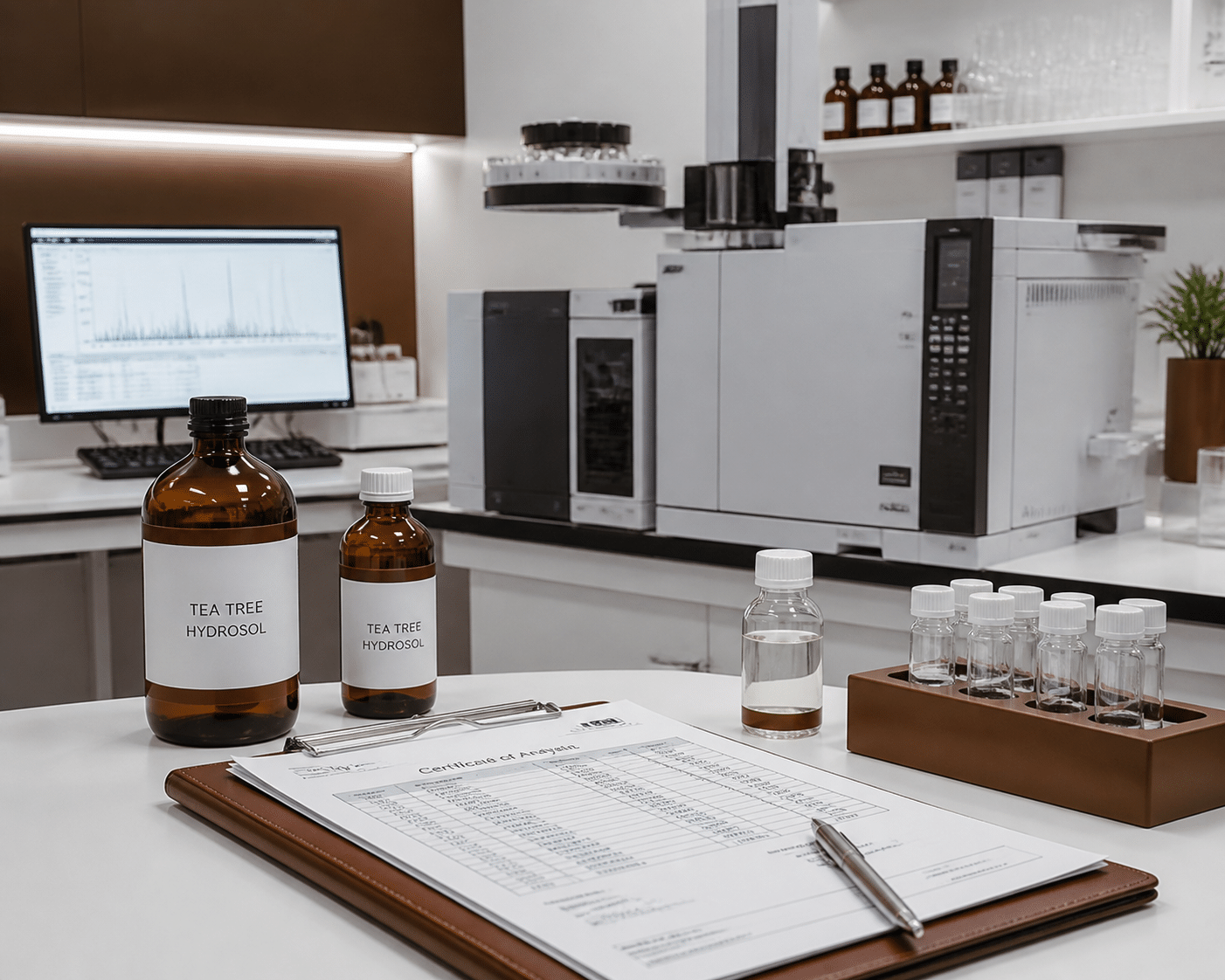
Ask for these, in writing, for every lot:
- A batch-specific Certificate of Analysis (CoA). A generic template with no real results doesn’t count.
- A GC/MS report. This shows the chemical fingerprint and confirms terpinen-4-ol is present at a believable level. Since we saw earlier that it’s only a trace in the water, you’re checking for consistency, not strength.
- Microbial results. Look for total aerobic count, yeast and mold, and pathogen limits.
- Traceability details. Botanical name, plant part, extraction method, lot number, production date and country of origin.
- Sourcing proof. Ask how the leaves are grown, who harvests them, and whether farms follow ethical labor and sustainability practices.
Here’s a quick way to read a GC/MS report and CoA:
| What to look at | What a good result looks like |
|---|---|
| Botanical identity | Melaleuca alternifolia, clearly stated |
| Main marker compound | Terpinen-4-ol listed, within the supplier’s own range |
| Odd peaks | No unexplained solvents or synthetic aroma chemicals |
| pH | Reported with the test temperature |
| Microbiology | Actual counts, not just “passes” |
| Lot number | Matches the drum you received |
For an idea of how a full hydrosol CoA reads, check this published lavender hydrosol document set. Same structure, different plant.
Certifications help too, but read the fine print. Cosmetic certification schemes like organic and natural standards each cover specific sites and products. A logo on a website isn’t proof. Ask for the certificate number, issuer, expiry date and scope. ISO 22716 (cosmetics GMP) is a good one to look for first.
Why Going Direct Can Help
Brokers and distributors can make buying simple. But every extra hand adds cost and blurs the story of where your leaves came from.
A direct manufacturer-supplier usually offers:
- Traceability. One company handles sourcing, distilling, testing and shipping, so questions get real answers.
- Steadier supply. Fewer links means fewer surprises when you need a repeat order.
- Better bulk pricing. No middle layer taking a cut.
- Customization. Specific packaging, or blends with other plant waters, are easier to discuss when you talk to the maker.
Aroma Monk works this way, managing the chain from raw material to final delivery with lab testing along the way. That’s the kind of setup worth looking for, whoever you buy from.
Once your supplier checks out, there’s one last step: pulling it all together into a plan for your own line.
Conclusion: Elevate Your Brand with the Proven Benefits of Tea Tree Water
So, where does that leave us? Tea tree water isn’t a miracle preservative. We’ve said that a few times, and it’s worth saying once more. But it’s a smart, honest ingredient with a lot to offer.
Here’s what it does well. It gives your toners, mists and cleansers a soft botanical story. It mixes right into water phases, so your formulas stay simple. And it can help you build a cleaner, shorter ingredient list, as long as a tested preservation system sits behind it.
The business case is just as clear. Shoppers want plant-based products, and the natural cosmetic ingredients market is on track to nearly double, from $10.6 billion in 2025 to $21.7 billion by 2033. Brands that back their claims with real testing and transparent sourcing will earn trust. Brands that overpromise won’t.
So keep it simple:
- Describe tea tree water as soothing and botanical, not as an antimicrobial treatment.
- Run ISO 11930 challenge testing on every finished formula.
- Ask for a batch-specific CoA and GC/MS report on every lot.
- Buy from a direct supplier who can show you where the leaves came from.
Ready to try it? Request a sample and CoA for 100% Pure Tea Tree Water from Aroma Monk, and talk with our specialists about your formulation needs. Tell us your product type, your target market and your expected volume. We’ll help you build something honest, tested and made to last.
Get a quote from Aroma Monk.
Essential Oil Supplier – Bulk pricing • Samples • Fast response