
Introduction: Beyond the Hype – The Search for Effective Natural Ingredients
Picture a product developer staring at a spec sheet at 9pm. The brief says “natural, gentle, and it has to work.” The usual toner base? Alcohol and a long list of things the brand’s customers now refuse to buy. Sound familiar?
You’re not alone. The global natural cosmetic ingredients market was valued at $10.6 billion in 2025, and it’s forecast to reach $21.7 billion by 2033, a 9.5% yearly growth rate. Brands want plant-based options. But “natural” on a label doesn’t do much if the ingredient can’t pull its weight.
That’s where sandalwood water comes in. It’s the aromatic water collected when Santalum album wood is steam distilled, sometimes called sandalwood hydrosol or chandan water. It has a soft, warm scent and a mild, tightening feel that suits a natural astringent for face care. Gentle, but not boring.
Now, I want to be straight with you. Hard clinical proof for sandalwood water and pores or oil control is still thin. So this guide sticks to what’s known, what’s plausible, and what you should test yourself. Honest beats hyped.
For brands aiming at wellness-minded shoppers in 2026, that honesty is a real edge. People read labels, ask questions, and notice vague claims. A clean, traceable, well-tested ingredient like pure sandalwood water gives you something specific to say.
Let’s start with what true sandalwood water actually is, and what to ask your supplier about it.
1. What is True Sandalwood Water? A Guide for Procurement and R&D
Here’s a mistake I see a lot. Someone orders “sandalwood water,” and what shows up is tap water with a splash of fragrance. Looks fine in the bottle. Smells fine, too. But it isn’t the real thing.
Hydrosol, Not Infusion
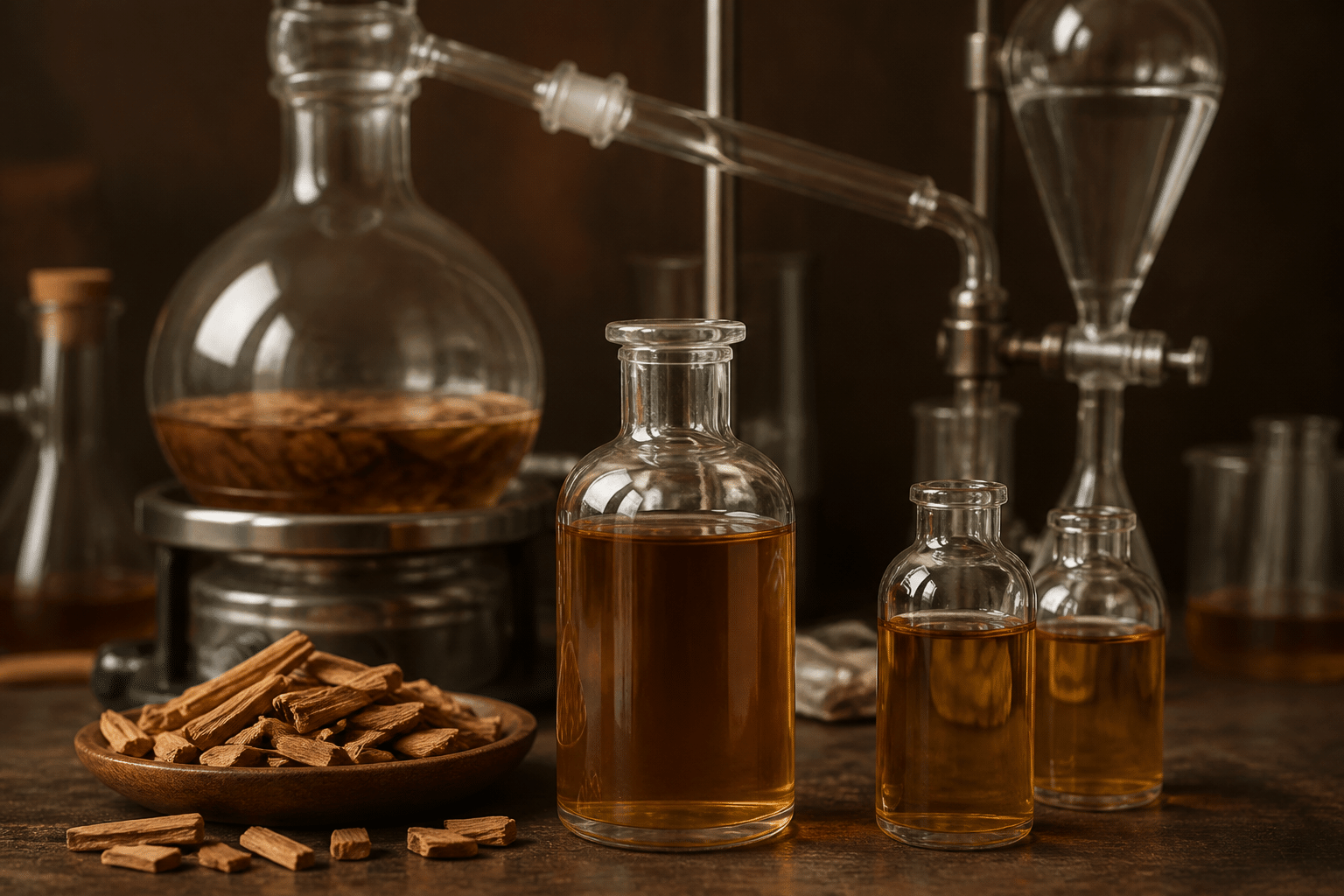
True sandalwood water is a hydrosol. It forms during steam distillation, when steam passes through sandalwood heartwood, picks up volatile compounds, and then cools back into liquid. The oil and water separate in the receiver. The oil becomes essential oil. The water-rich condensate is the hydrosol.
So it’s a co-product of the same run, not a leftover and not a tea. Soaking wood chips in water gives you an infusion, which is a different thing entirely. Mixing essential oil into water gives you something else again.
| Hydrosol | Essential Oil | Infused Water | |
|---|---|---|---|
| How it’s made | Steam distillation, water fraction collected | Steam distillation, oil fraction separated | Wood soaked or steeped in water |
| What’s in it | Water-soluble aromatics plus trace oil | Concentrated, oil-soluble compounds | Whatever leaches out into water |
| Strength | Gentle, soft scent | Very concentrated | Varies a lot, often weak |
| Typical use | Toners, mists, water phase of formulas | Fragrance, small-dose additions | Not a standard cosmetic ingredient |
Why the Species Matters
Not all sandalwood is equal. Santalum album, or Indian sandalwood, is the gold standard for fragrance and tradition. Other species exist, like Santalum spicatum and Santalum paniculatum, and each has its own chemical fingerprint. So “sandalwood” alone on a spec sheet isn’t enough. You want the Latin name, the plant part (heartwood), and the origin.
The INCI name helps too. A real product should read something like Santalum album (Sandalwood) Distillate.
What’s Actually Inside the Bottle
Now for the part where I admit what we don’t know. Published numbers for santalols in a Santalum album hydrosol are hard to find. Most studies test the essential oil. For example, the ISO standard for the oil lists roughly 41 to 54% α-santalol and 16 to 24% β-santalol, but those figures don’t carry over to the water.
Why? Santalols prefer oil over water. A hydrosol holds dissolved, water-friendly aromatics plus tiny traces of oil, so it isn’t just a watered-down essential oil. Its profile is its own.
For R&D, that means one practical rule: ask for a batch-specific GC/MS report instead of trusting a single “santalol percentage.” Aroma Monk’s approach of lab-testing and tracing each batch is the kind of paperwork you want to see. We’ll get into the full supplier checklist later. First, let’s look at how this ingredient actually behaves on skin.
2. The Science of Astringency: How Sandalwood Water Refines and Tones Skin

Let’s talk about that tight, fresh feeling after a good toner. What’s actually happening on your skin?
I’ll be upfront again. Nobody has published a human trial showing sandalwood water shrinks pores. What we have is a plausible mechanism, some related research, and a lot of traditional use. Here’s how it fits together.
How an Astringent Tightens Skin
An astringent causes a short-lived contraction of skin tissue. One review of natural astringents describes this tissue contraction as something that can temporarily reduce the look of pores, oiliness, and laxity. Temporary is the key word.
The usual suspects are tannins. They can bind to proteins on the skin’s surface, and that protein binding creates the tightening or drying sensation. Pores look a bit smaller because the tissue around them firms up for a while.
Does sandalwood have these compounds? Lab work on Santalum album extracts has found condensed tannins, proanthocyanidins, flavonoids, and other phenolics. But that study used extracts, not hydrosol. Steam distillation is a different process, so we can’t assume the same tannins end up in the water. A 2025 Australian sandalwood hydrosol monograph calls it “mildly astringent,” yet it offers no pore or sebum measurements.
So: plausible, not proven. Test it in your own base.
Gentle Tone vs. the Alcohol Sting
Many classic astringent toners lean on alcohol. It gives that instant squeaky feel. Formulators often worry that it can strip surface oils, irritate sensitive skin, and set up a rebound where skin makes more oil to make up for the loss. That rebound idea is common in the industry, though I couldn’t find a head-to-head study with sandalwood water, so treat it as a formulation concern and not a proven fact.
Sandalwood water offers a softer route. It’s mostly water with a mild, warm aroma, and it brings a light tightening feel without alcohol’s bite.
| Header Table | Sandalwood Water | Alcohol-Based Toners |
|---|---|---|
| Mechanism | Mild astringency, likely from plant phenolics (not confirmed in hydrosol) | Solvent action and quick evaporation, which can remove surface oils |
| Skin feel | Soft, cool, lightly tightening | Sharp, tight, sometimes stinging |
| Long-term effects | Little clinical data, so test your own formula | Possible dryness, irritation, and rebound oiliness |
| Ideal skin type | Oily, combination, and mature skin that wants gentle toning | Very oily, resilient skin (and even then, with care) |
Who Might Benefit Most
Three skin types stand out for a natural astringent for face care.
- Oily skin: Shine and visible pores are the main worry. A gentle tightening feel without harsh stripping is the appeal for sandalwood water for oily skin. For a sense of what’s possible, a guava toner study found sebum dropped 21.43% on the nose after 28 days. That’s guava, not sandalwood. But it shows a botanical toner can be measured.
- Combination skin: An oily T-zone with drier cheeks does better with a toner that doesn’t over-dry.
- Mature skin: Laxity is the concern here. Broader research helps a little: a 2025 meta-analysis of eight studies and 396 people found topical plant preparations improved skin elasticity over placebo. Again, it’s botanicals in general, not sandalwood water specifically.
The honest takeaway for R&D? Use sandalwood water as a gentle toning base, then prove your claims with your own testing. Next, we’ll look at what else this ingredient can do beyond tightening.
3. More Than an Astringent: The Multifunctional Cosmetic Benefits of Sandalwood Water
Tightening is only one part of the story. Sandalwood water has a few other tricks, and they might matter more to your formula than the astringent feel does.
Here’s the quick version, then we’ll unpack each one.
- 🔥 Soothing: traditionally used to calm skin that feels hot, tight or irritated
- 🛡️ Mild antimicrobial support: useful context for blemish-prone skin products
- 🌿 Functional scent: a soft, woody aroma that can carry a product on its own
Calming Redness and Irritation
This is the benefit people mention most. After-sun mists, after-shave splashes, sensitive-skin sprays. Sandalwood water fits all of those formats nicely.
The science needs a careful read, though. A 2025 systematic review reported anti-inflammatory activity for Santalum album extracts and compounds in lab and animal studies. But it also pointed out that most research focuses on the oil fraction, and that the mechanisms still need sorting out. So the evidence for hydrosol itself is thin.
Suppliers do market it for calming use. One sandalwood hydrosol supplier suggests it as a compress for delicate and mature skin and reports mixed results for rosacea and eczema. That’s a product description, not a clinical trial. So I’d say “soothing” and “comfortable” are fair words. “Treats rosacea” is not.
Support for Blemish-Prone Skin
Now the antimicrobial side. A 2025 lab study tested water, ethanol and methanol extracts of sandalwood and found both antioxidant and antimicrobial activity. That’s encouraging for toners aimed at oily, breakout-prone skin.
But (and it’s a big but) those were extracts in a dish. A hydrosol is a different animal, and it’s more than 99% water. That brings up an irony: the same water that makes it gentle also makes it a friendly home for germs if it isn’t preserved properly. So don’t count on sandalwood water to protect your formula. Preserve it like any other water phase.
A Scent That Earns Its Place
Sandalwood water smells warm, soft and a little creamy. In a toner or mist, that can be the whole sensory experience, no extra perfume needed. For brands trying to cut synthetic fragrance, that’s a real draw.
Still, let’s not oversell it. A 2026 consumer study found shoppers didn’t consistently prefer naturally derived fragrances, and sandalwood scored lower than bergamot and rose. Interesting, right? It suggests the luxury feel comes from the story and the ritual, not just “natural” on the label.
So test the scent with real people. Also remember that natural aromas can still contain allergens, so label them clearly.
We’ve covered what sandalwood water can do. Next up is how to actually put it into a formula without it going sideways.
Get a quote from Aroma Monk.
Essential Oil Supplier – Bulk pricing • Samples • Fast response
4. Formulation Guide: Incorporating Sandalwood Water into High-Performance Products
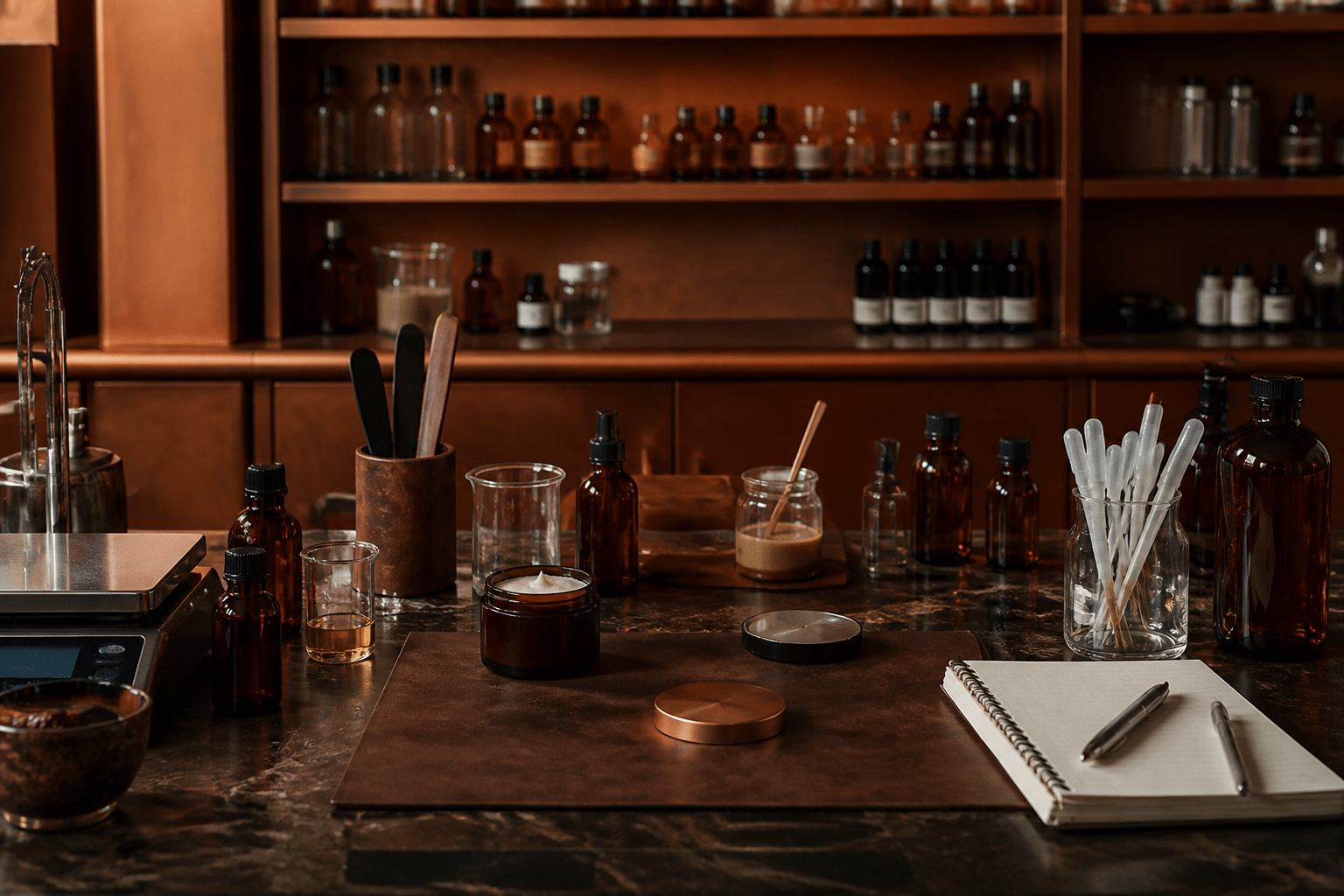
You’ve got a good ingredient in hand. Now what do you actually make with it?
Here’s the honest part first. Most sandalwood hydrosols on the market today are sold as single-ingredient toners or mists. That’s fine, but it leaves a lot of room for smarter products. And since there’s no standard recipe, treat everything below as a starting point for your own bench trials. Not a validated formula.
Five Product Ideas Worth Prototyping
- Clarifying toner: the obvious one. Sandalwood water becomes the main water phase, with a little humectant for comfort.
- Pore-refining serum: a light gel serum where the hydrosol carries niacinamide and hyaluronic acid.
- Setting spray: a fine mist over makeup that smells warm and soft, with no heavy perfume.
- Clay mask activator: swap plain water for sandalwood water when mixing clay. Simple. It gives a nicer scent and a more “spa” feel.
- Men’s grooming: aftershave splashes and post-shave mists. Alcohol-free and gentle is the selling point here.
For all five, stick to claims like “refreshing” and “comfortable,” since pore and sebum data for this ingredient is still thin.
Usage Levels, pH and Good Partners
How much should you use? Anywhere from 10% to 100%, depending on the format. A toner can run mostly or fully hydrosol. A serum might use far less. I can’t promise one magic number, so here’s a rough matrix to start from.
| Product Type | Target Concern | Starting Sandalwood Water % | Synergistic Ingredients |
|---|---|---|---|
| Clarifying toner | Oily skin | 70 to 100% | Glycerin or propanediol (2 to 5%), rose water, panthenol |
| Pore-refining serum | Oily and combination skin | 30 to 60% | Niacinamide, hyaluronic acid |
| Hydrating mist | Mature skin, anti-aging | 60 to 90% | Hyaluronic acid, rose water |
| Setting spray | Makeup wear, light scent | 40 to 80% | Glycerin, light film formers |
| Clay mask activator | Oily skin | 50 to 100% (as the mixing liquid) | Kaolin or other clays |
| Aftershave splash | Men’s grooming, comfort | 50 to 90% | Panthenol, glycerin |
Now pH. One supplier lists sandalwood water at pH 5.0 to 6.0, which sits close to skin’s natural acidity. But batches vary, so measure each one yourself. A target of about 5.0 to 5.5 in the finished product is a sensible place to begin.
That range suits hyaluronic acid, panthenol and glycerin just fine. Niacinamide is usually happy around pH 5 to 7. Vitamin C is the awkward guest, because L-ascorbic acid wants a much lower pH (around 2.5 to 3.5), and pulling the hydrosol down that far can weaken your preservative. Skip that pairing unless you enjoy extra stability testing.
Rose water makes a lovely blend partner too. Aroma Monk supplies rose water for cosmetic use, so brands can test a two-hydrosol base from one source.
Keeping It Safe: Preservation and Stability
Here’s the part people skip. A hydrosol is mostly water, and that same supplier lists water at more than 99.85%. Water plus no preservative equals a happy home for microbes.
Some suppliers say a hydrosol lasts about 18 months unopened and 6 months once opened, if stored cool and dark. That’s for the raw ingredient. It’s not a promise for your retail bottle.
So preserve it like any other water phase:
- Pick a broad-spectrum system that fits your pH. Options formulators often test include benzyl alcohol with dehydroacetic acid, gluconolactone with sodium benzoate, and levulinic acid systems.
- Run preservative challenge testing on the finished product.
- Check pH, smell, color and microbial counts after stability storage.
- Choose pumps or sprays over open jars.
Don’t count on essential oils, low pH or the words “natural” and “alcohol-free” to do the job. None of them will.
Once your formula is solid, the next question is where to buy a hydrosol you can trust.
5. Sourcing & Quality Control: A Procurement Manager’s Checklist for Bulk Sandalwood Water
You’ve built the formula. Now comes the part that can quietly wreck it: the drum that actually arrives at your dock. A pretty sample means nothing if batch 12 smells different from batch 1.
Here’s how I’d vet a bulk sandalwood hydrosol supplier.
Paperwork First: GC/MS and Microbial Reports
Ask for a batch-specific GC/MS report. Not a generic one. Not last year’s. The lot number on the report, the drum label and your sample should all match.
What should you look for? The report should name Santalum album and show a believable sandalwood fingerprint. But remember, GC/MS is an identity check. It tells you nothing about germs. So ask for separate microbiology results too: total plate count, yeast and mold, and pathogens. Good hydrosol guidance calls for batch-level pH, microbial and shelf-life data, plus preservation and challenge-test details.
One warning. A supplier quoting a fixed “santalol percentage” for a hydrosol, with no method behind it, deserves a raised eyebrow. As we covered earlier, those numbers belong to the oil.
Where Did the Wood Come From?
Sandalwood is slow-growing and heavily protected in many places. So you need to know the story behind the heartwood, not just the bottle.
Ask about harvesting practices, plantation records, felling permits and replanting. Check the current CITES and export rules for the origin and destination countries, because they differ by species. Certifications like FSC, PEFC or organic can help, but verify the certificate scope. A logo alone doesn’t prove your batch used certified wood.
Want to see what good looks like? One Pacific sandalwood supply chain pairs harvest certificates, quota and replanting records with social-responsibility certification. That’s the kind of trail you want from plantation to filling line. Aroma Monk’s lab-tested, traceable approach follows the same logic.
Red Flags That Should Make You Pause
| Red flag | Why it matters |
|---|---|
| Price far below the market | Real sandalwood is costly. A bargain often means dilution or substitution |
| No COA, or a one-page “pass” note | You can’t verify identity or safety |
| Added alcohol | It changes the product and defeats the gentle, alcohol-free story |
| Added fragrance or essential oil | The product is blended, not a true distillate |
| Solubilizers like Polysorbate 20 | A sign someone is forcing oil into water |
| Vague origin (“Asian sandalwood”) | No species, no traceability |
| Broker who can’t name the distillery | You can’t audit what you can’t find |
10 Questions to Ask Before You Sign
- What is the exact species, plant part and origin?
- Is it a true steam distillate, with no added oil or fragrance?
- Can I see a recent batch-specific COA and full GC/MS chromatogram?
- Which independent lab ran the tests?
- What are the pH and microbial results for this batch?
- What preservative system is used, and has challenge testing been done?
- What are the manufacture date, shelf life and storage needs?
- Which sustainability and CITES documents apply?
- Can you show chain-of-custody records from harvest to filling?
- Will you agree to a retained sample and our own incoming tests?
Want these on one printable page? Grab the downloadable PDF, “10 Questions to Ask Your Bulk Sandalwood Hydrosol Supplier,” and keep it next to your purchase order.
Solid suppliers won’t flinch at any of this. They’ll just send the files. With sourcing sorted, let’s pull the whole picture together.
Conclusion: Integrate the Power of Sandalwood Water to Elevate Your Brand
So, where does all this leave you? Somewhere honest, I hope. Sandalwood water isn’t a miracle in a bottle. But it’s a smart, gentle ingredient that can do real work in the right formula.
Here’s the short version:
- A gentle natural astringent: it gives a light, cool tightening feel without the sting of alcohol. Just keep your claims to “refreshing” and “comfortable” until your own testing says more.
- A multitasker: it’s traditionally used for soothing, there’s early lab interest in its antimicrobial side, and its soft, woody scent can carry a toner or mist all by itself.
- A story that sets you apart: shoppers read labels, and a pure, well-documented ingredient gives you something specific and true to say.
Now the part I’d tape to the wall. Your finished product is only as good as the water going into it. Species, steam distillation, batch testing, preservation, and ethical sourcing all matter. Skip one, and the “natural” story gets shaky fast.
So here’s your next step. Product Development and Procurement managers, request a sample of pure Santalum album hydrosol, along with the matching CoA and MSDS. Check the lot numbers. Run it in your own base. See how it smells, feels, and holds up.
Ready to try it? Request a sample from Aroma Monk and put pure, lab-tested, traceable sandalwood water through its paces in your next product line.
Get a quote from Aroma Monk.
Essential Oil Supplier – Bulk pricing • Samples • Fast response