
The Sandalwood Dilemma: Choosing the Right Ingredient for Your Product Line
Last month I watched a product developer hold up two samples of “sandalwood” and ask a simple question. “Which one is actually sandalwood?” Both smelled nice. Both came with a nice label. One cost about $15 a liter. The other cost thousands. Funny enough, they were both real, and they weren’t even close to the same thing.
That’s the sandalwood dilemma in a nutshell.
Why Everyone Wants Real Sandalwood Right Now
Demand for authentic sandalwood keeps climbing. One Mordor Intelligence report values the sandalwood oil market at about $164.85 million in 2026, with roughly 8% yearly growth expected through 2031. And natural oil held around 73.5% of that market in 2025. Keep in mind these are third-party estimates, not audited numbers. Still, the direction is clear. Natural cosmetics and wellness brands see sandalwood as a premium, woody, calming ingredient that makes a product feel luxurious.
The Confusion Behind the Label
Here’s where it gets messy. Sandalwood water (the hydrosol, made from the water left after distillation) and sandalwood essential oil are very different ingredients. Different strength. Different price. Different way of behaving in a formula. But suppliers sometimes use the words “sandalwood water,” “floral water” and “sandalwood oil” loosely, so buyers can end up with the wrong thing.
If you’re a procurement manager, that means risk. Adulterated oil, vague labels, and no clear way to stand out from the next brand with “sandalwood” on the box. If you’re in product development, it means picking an ingredient that might not fit your toner, serum or body mist at all.
What This Guide Will Do
We’re going to sort it out together. This article gives you a clear, data-driven comparison of sandalwood water vs. oil, so you can make smarter sourcing calls and build better formulas. We’ll start with what sandalwood water really is.
Understanding Sandalwood Water (Hydrosol): The Gentle Aromatic
Let’s start with the quieter ingredient. Sandalwood water doesn’t get the glory, but it might be the better fit for more formulas than you’d guess.
How Sandalwood Water Is Made
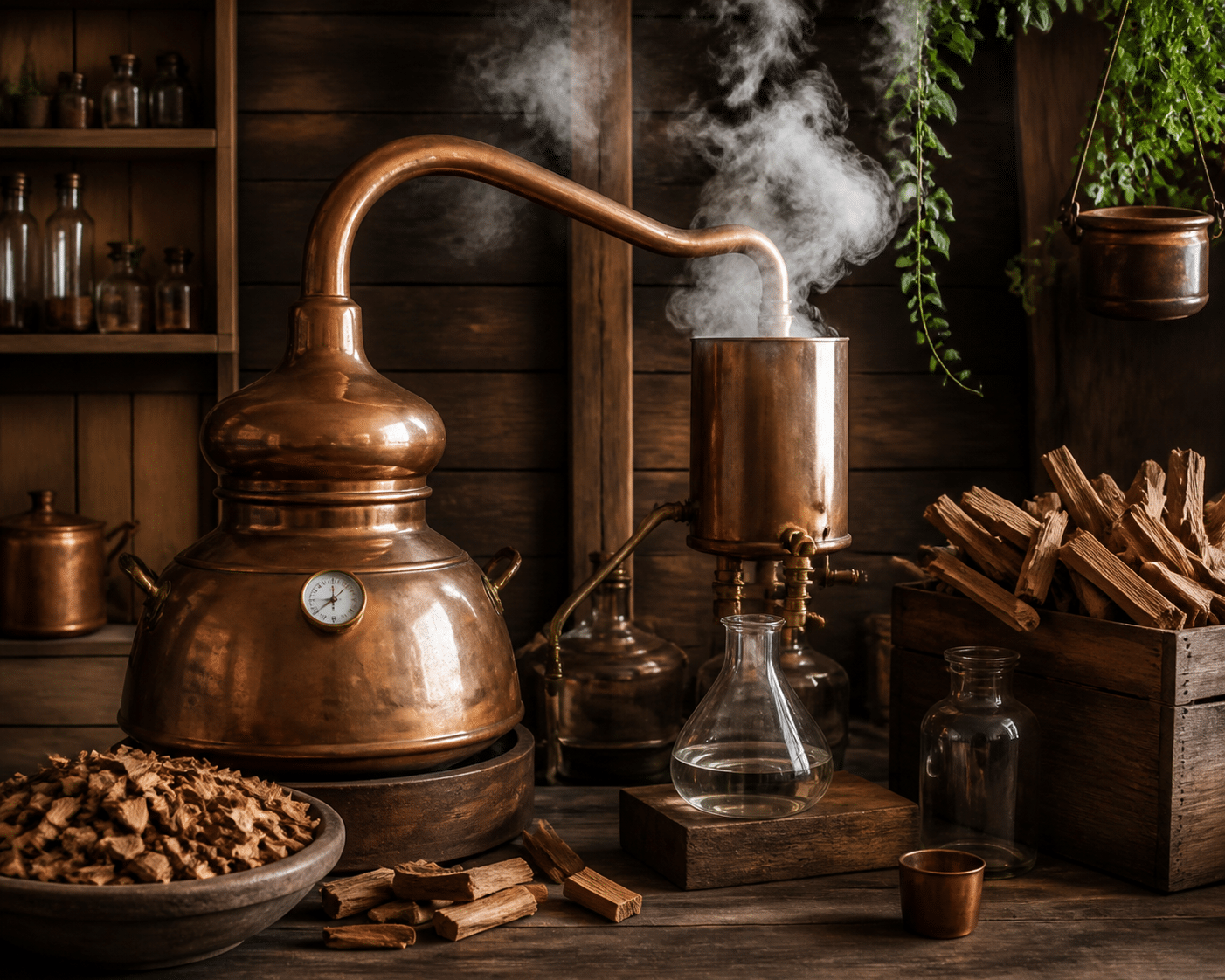
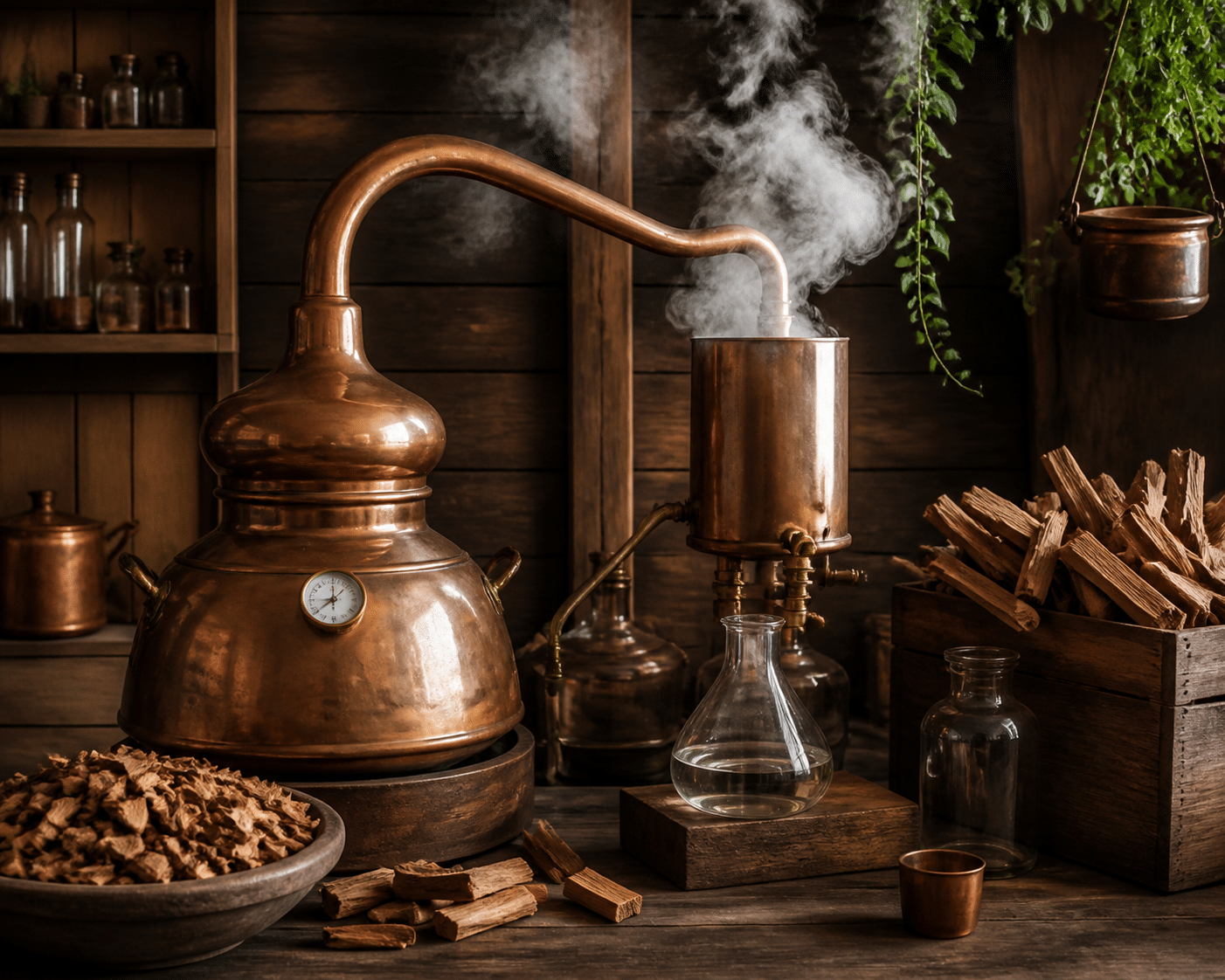
Here’s the key thing: sandalwood water is not watered-down oil. Nobody opens a bottle of oil and pours in some water. It’s a co-product. When sandalwood chips go into a still, steam passes through them and carries aroma out. That steam cools back into liquid. The oil floats or separates, and the water left behind is the hydrosol.
So it’s the same trip through the still, just a different result. If you’re searching for sandalwood hydrosol, this is what a real one should be. Here’s the sandalwood distillation process in plain steps:
- Sandalwood heartwood is chipped or powdered.
- Steam (or water plus steam) passes through the wood.
- The vapor carries aroma compounds up and out.
- A condenser cools the vapor into liquid.
- Oil and water separate. The oil is collected. The water is the hydrosol.
There’s one catch. Terms get fuzzy fast. A Formula Botanica guide for formulators points out that “floral water,” “aromatic water” and “hydrosol” get swapped around by different sellers. Some products labeled this way are just distilled water, sandalwood oil and a solubilizer (like a polysorbate) mixed together. That’s a reconstituted water, not a true hydrosol. Ask which one you’re buying.
What’s Actually Inside
A true hydrosol holds water-soluble plant compounds plus tiny traces of the volatile aromatic material. Think microscopic droplets of oil constituents, at far lower levels than in the oil itself.
That matters for sandalwood. The big names in the oil, alpha-santalol and beta-santalol, mostly love oil, not water. So you shouldn’t assume the water carries them at the same strength, or does the same job. And I’ll be honest here: solid public data on the exact makeup of sandalwood hydrosol is thin. Be wary of any supplier promising “clinically proven” brightening or anti-aging compounds without batch-specific lab data to back it up.
The upside? Lower strength means a gentler ingredient.
Why Formulators Like It
In practice, sandalwood water in skincare tends to show up for a few simple reasons:
| Property | What it means in a formula |
|---|---|
| Hydrating | Works as part of the water phase in toners, gels and lotions |
| Mildly astringent | Light, fresh feel on skin without heavy tightness |
| Soothing | Gentle enough for mists and after-sun style sprays |
| Subtle, woody, watery scent | A soft sandalwood note, not a loud perfume hit |
| Mildly acidic | Often falls around pH 3.5 to 5.5, which suits many facial toners |
That pH range comes from general supplier and formulator guidance, not a sandalwood-specific standard. So treat it as a batch spec to check on the COA, and test your finished product anyway.
It also works well in alcohol-free body mists, hair mists and pillow sprays. Water-based products are where it feels most at home. Need that deeper, richer sandalwood punch instead? That’s a job for the oil, which we’ll get into next.
Demystifying Sandalwood Essential Oil: The Potent Concentrate
Now for the heavy hitter. If sandalwood water is a whisper, the oil is the full voice in the room.
How the Oil Is Made
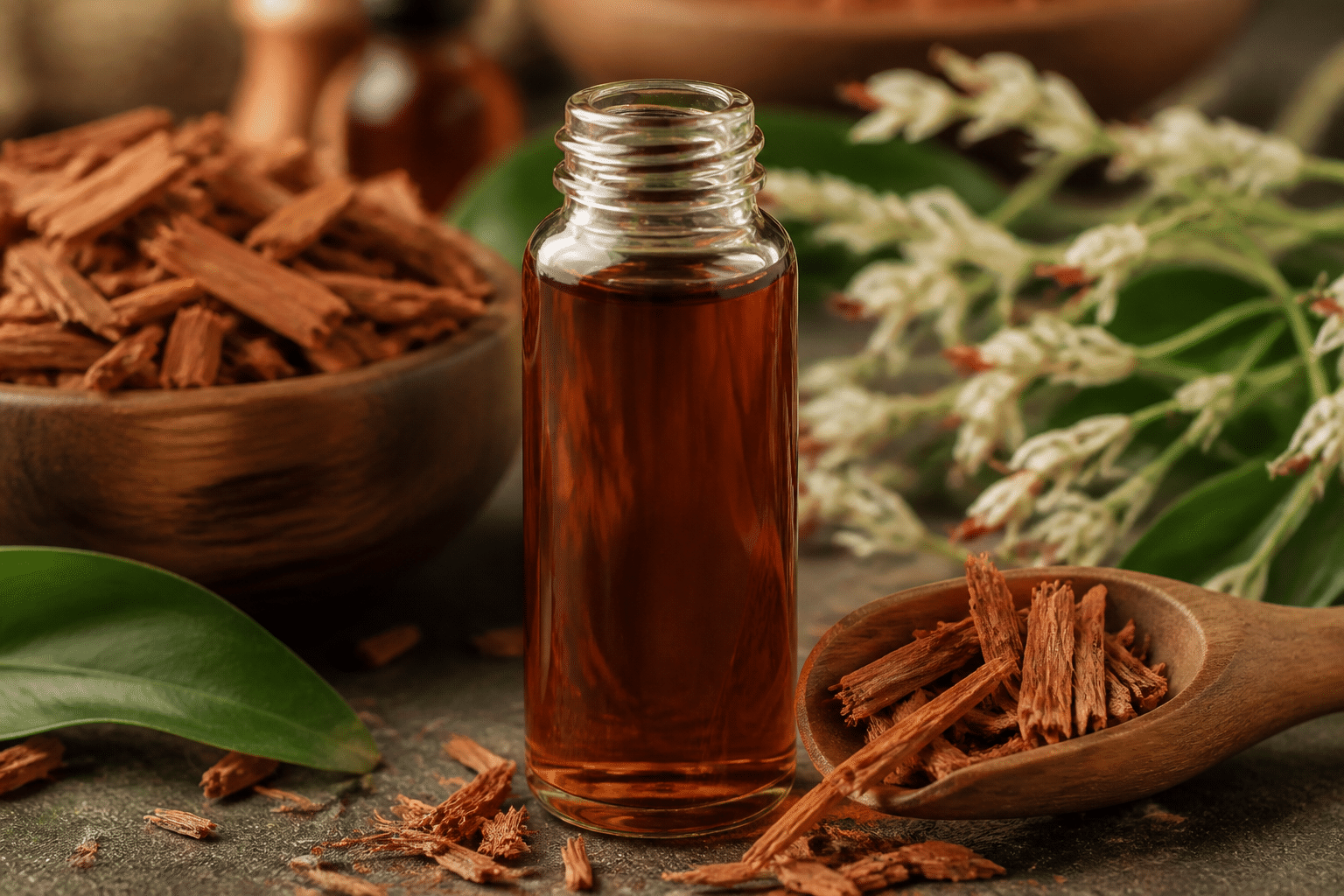
Pure sandalwood essential oil is the main product of the still. Same heartwood, same steam as before, but this time the oil is the star and the water is the leftover. Some producers use CO2 extraction instead. That method uses pressurized carbon dioxide to pull out the aroma, and it tends to give a slightly different scent profile than steam.
Either way, you end up with a very concentrated collection of volatile, oil-soluble aroma compounds. Not a drop of it is filler.
That concentration comes at a cost, though. Published commercial estimates put the oil yield at roughly 3% to 6.5% of the wood’s weight. So 1 kg of good heartwood might give you around 30 to 65 g of oil. That’s a lot of wood for a small bottle.
The Santalols: Where the Magic Lives
Two compounds do most of the work here: alpha-santalol and beta-santalol. They give sandalwood its signature creamy, woody smell. They’re also the compounds most often linked to the oil’s soothing, anti-inflammatory and antimicrobial reputation. (I’d say “linked to,” not “proven for,” since any claim on your label needs its own evidence.)
For genuine Indian sandalwood (Santalum album), the most defensible benchmark is the ISO 3518:2002 profile. Here’s the rough picture:
| Compound | Typical range in S. album oil |
|---|---|
| (Z)-alpha-santalol | About 41% to 55% |
| (Z)-beta-santalol | About 16% to 27% |
| Combined santalols | Roughly 57% to 82%, depending on the batch |
You’ll still see “90% santalols” on some supplier pages. That number comes from older literature and marketing, so don’t use it as your only quality test. Ask for the actual alpha and beta numbers instead.
And this matters more than you’d think. A 2021 comparison of commercial sandalwood oils found that only one of six products matched the true S. album pattern. Six bottles. One real match. Yikes.
What It Feels and Smells Like
The oil is thick and viscous, almost syrupy compared with water. The scent is deep, rich and complex: woody, soft, a little sweet, and it hangs around for hours. Perfumers call that staying power tenacity. It’s why the oil works as a fixative, helping lighter notes last longer.
Here’s the practical bit. A tiny amount goes a long way, both for fragrance and for any wellness appeal. That’s the upside. The downside is that the oil needs careful handling in a formula, since it doesn’t mix with water on its own, and each cosmetic category has its own IFRA limit.
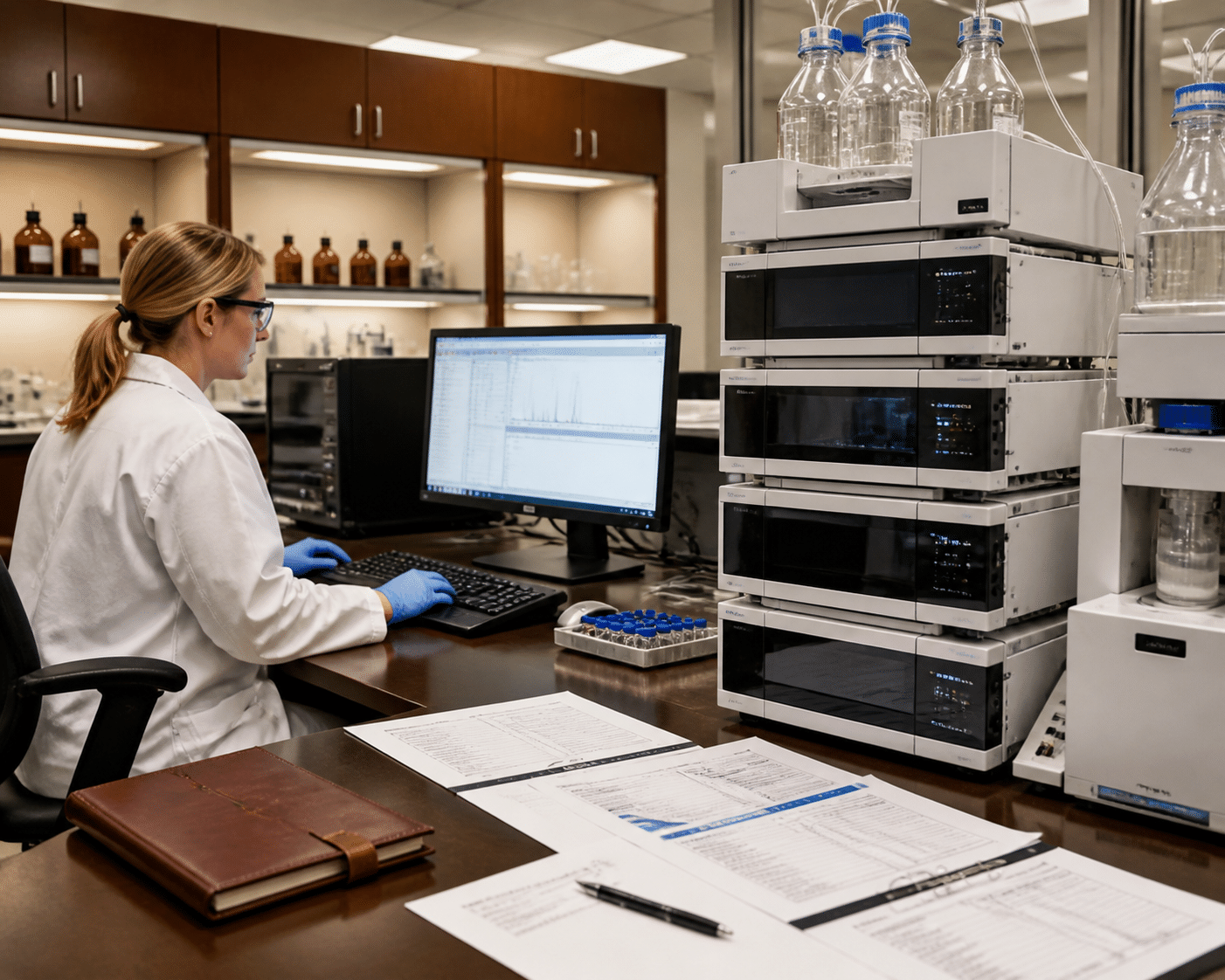
So how do you know what’s in the bottle? The standard answer is a GC/MS report, which separates the oil into its parts and shows each one as a peak on a chromatogram. A proper report lists the batch number, the lab, the method and the full santalol breakdown. If a supplier can only say “passes GC/MS,” keep asking questions. Next up, we’ll put water and oil side by side.
Head-to-Head Comparison: Sandalwood Water vs. Oil
OK, time to put them side by side. Think of it like comparing a cup of tea to a shot of espresso. Same plant family of idea, very different jobs.
The Quick Comparison Table
| Property | Sandalwood Water | Sandalwood Essential Oil |
|---|---|---|
| Production | Condensed water left after steam or hydro-distillation | The oil collected from the still (or a CO2 extract) |
| Aroma | Soft, light, watery woody note | Deep, creamy, rich, lasts for hours |
| Key compounds | Water-soluble plant compounds plus trace volatiles (public data is thin) | Alpha-santalol and beta-santalol, oil-soluble |
| Cost | Roughly $15 to $16 per liter in bulk | Hundreds to thousands of dollars per liter or kg |
| Application phase | Water phase: toners, mists, gels, lotions | Oil phase or fragrance blend, needs a solubilizer for water products |
| Concentration in use | Can be used neat or at high levels | Low percentages, capped by IFRA category |
| Shelf life | About 12 to 24 months, preservative dependent | Often 3 to 5 years unopened (check the retest date) |
So what jumps out? Strength and price are on opposite ends. Everything else follows from that.
Why the Price Gap Is So Big
The oil is expensive because the wood gives up so little of it. We covered the low yield already, and that scarcity shows up on the invoice. One buying guide cites Indian sandalwood oil near $2,500 per kg, though prices swing a lot by origin, age, certification and order size.
The water is a different story. Organic Creations lists a 5 gallon sandalwood hydrosol at $301 preserved, which works out to around $15.50 to $15.90 per liter. That’s one supplier listing, not a market average. Still, it shows the scale.
Here’s the catch, though. Cheaper doesn’t mean “same thing for less.” The water gives you a gentle sandalwood touch, not the full woody punch. And I wouldn’t try to price water by multiplying oil yield. There’s no reliable public number for hydrosol yield per kilo of wood, so ask suppliers for real batch data.
Safety and How Much You Can Actually Use
This is where formulas live or die.
Hydrosol is often used generously. Purenso Select suggests a use level of 1% to 100% depending on the product. (That’s a supplier recommendation, so test for preservation and feel before you trust it.)
Oil is a tighter game. IFRA limits depend on the exact oil and the product category. One 2026 IFRA certificate lists 7.27% for leave-on body and facial products and 2.80% for deodorants. Other oils can be far stricter. Many formulators land well under those caps, often below 1 to 2%, since the scent is strong and the oil costs a lot. A cap is a ceiling, not a target.
Shelf life matters here too. Jade Bloom says its sandalwood hydrosol lasts up to 18 months when kept cool and dark. Water-rich products invite microbes, so preservation and clean handling aren’t optional. The oil is steadier, but it can oxidize over time, so always ask for a retest date.
So Which One Wins?
Neither. It depends on the job. Toners, body mists and light lotions lean toward water. Perfume-style blends and rich, scented products lean toward oil. If you’re unsure, ask suppliers like Aroma Monk for lab-tested samples of both and compare them in your own formula. Next, we’ll look at how that plays out in real product development.
Get a quote from Aroma Monk.
Essential Oil Supplier – Bulk pricing • Samples • Fast response
Strategic Application in Product Development
OK, so you know what each ingredient is. Now the fun question: where does each one actually go?
I’ve watched teams burn weeks trying to force oil into a toner, or water into a serum that needed punch. Picking the right job for the ingredient saves you a lot of headaches (and a lot of money).
Where Sandalwood Water Fits Best
Sandalwood water belongs in the water phase. That’s its home. Because it’s already water-soluble, you don’t need a solubilizer to make it behave, and that keeps your ingredient list shorter.
Here are the jobs where sandalwood water in skincare tends to shine:
- Facial toners and mists: It can replace part or all of the aqueous base. A soft, woody note without a heavy perfume hit.
- Sensitive skin lotions: Lower strength usually means a gentler feel, though you still need to patch test the finished product.
- Clay mask activators: Mix it with kaolin or rhassoul clay instead of plain water. Same job, nicer scent and feel.
- Gentle cleansers: It adds a light aromatic touch to the water side of the formula.
- Body, hair and pillow mists: Alcohol-free and easy to scent.
One quick reminder. Water-rich means microbes love it, so build your preservation system early, not at the end.
Where Sandalwood Essential Oil Earns Its Price
The oil is the premium player. You’re paying for concentration, so use it where people can actually notice and value it.
Think luxury facial serums, anti-aging creams, rich aromatherapy blends, and natural perfumery. It also fits spot treatments where the santalol content is the whole reason the product exists. (Just keep your claims honest. A scent story is easy to back up. A therapeutic claim needs its own evidence.)
And don’t forget the fixative job. In perfume-style blends, sandalwood oil helps lighter notes stick around longer. For sandalwood for cosmetics at the high end, that staying power is hard to fake.
Because the oil doesn’t mix with water, it goes in the oil phase or a fragrance blend. Stay under the IFRA limit for your category, and honestly, most good formulas land well below it.
Quick “Best For” Cheat Sheet
| Product type | Better fit | Why |
|---|---|---|
| Facial toner | Sandalwood water | Water phase, light feel |
| Alcohol-free body or hair mist | Sandalwood water | Easy to scent, gentle |
| Clay mask activator | Sandalwood water | Replaces plain water |
| Gentle cleanser | Sandalwood water | Soft aroma, low load |
| Facial serum | Sandalwood oil | Oil phase, concentrated |
| Anti-aging cream | Sandalwood oil | Premium positioning |
| Natural perfume or attar-style blend | Sandalwood oil | Depth and tenacity |
| Aromatherapy blend | Sandalwood oil | Strong, lasting scent |
Using Both: The Layered Line
Here’s my favorite idea, and it doesn’t get enough attention. You don’t have to choose.
Build a two-step routine. A sandalwood water toner goes on first, light and fresh. A sandalwood oil serum follows, richer and deeper. Your customer gets one scent story, two textures, and a full ritual from a single botanical.
It also makes sense on the business side. The toner carries a lower ingredient cost and a friendly price point. The serum carries the premium margin. Same ingredient family, two entry points for shoppers.
A good way to test it: ask Aroma Monk or any supplier you’re vetting for samples of both. Run them in your toner and serum bases side by side, and check scent match, stability and feel before you scale up. Once the formula works, the next question is how to buy it safely, and that’s where we’re headed.
Sourcing & Quality Control: A Guide for Procurement Managers
You know that sinking feeling when a drum arrives, the paperwork says one thing, and your nose says another? I’ve heard that story more than once. Let’s make sure it doesn’t happen to you.
Buying Bulk Sandalwood Water Without Getting Burned
First rule: ask for a true steam-distilled hydrosol. Not a mix of distilled water, sandalwood oil and a solubilizer. That’s a reconstituted product, and it behaves differently in your formula. Formula Botanica’s guide to spotting fake hydrosols is a handy read before you talk to any seller.
When you’re shopping for bulk sandalwood water, the Certificate of Analysis (COA) is your best friend. A good one shows the batch number, distillation date, botanical name, pH and microbial counts (yeast, mold, and key pathogens). It also states plainly whether alcohol or preservatives were added. If you want an unpreserved product, put that in writing. Just know that water-rich liquids spoil faster, so plan your storage and shelf life around it.
A COA that only says “colour: clear, odour: pleasant”? That’s not enough. Not for a botanical you’re paying real money for.
Sourcing Pure Sandalwood Oil: Proof Over Promises
For sourcing pure sandalwood oil, we already talked about GC/MS reports. Here’s the short version: demand the full chromatogram, the species (Santalum album is the premium one), and the actual alpha and beta santalol numbers. “Passes GC/MS” tells you nothing.
Why so picky? Because fraud is common. One adulteration guide points to cheaper woody oils like amyris, synthetic santalol, and fillers such as carrier oils, DPG or diethyl phthalate. Some of these hide well in a quick sniff test. An independent lab on your first shipment (and now and then after that) costs little compared to a recalled batch.
Legal and Ethical Supply Matters Too
Here’s the part people skip. Santalum album is listed under CITES Appendix II, which means trade is regulated. That same reference warns that unverified “Mysore sandalwood” can involve illegal harvesting or adulteration.
So “natural” doesn’t automatically mean legal or sustainable. You want harvest and transport permits, plantation records, and species-level traceability from wood to drum. A luxury sourcing guide from Liflor makes the same point about responsible supply chains.
This is why one partner who manages the whole chain helps so much. Aroma Monk handles sourcing, testing and delivery under one roof, with lab-tested and traceable material. Fewer middlemen means fewer places for paperwork to go missing, and steadier bulk supply when your production schedule is tight.
Supplier Vetting Checklist
| What to check | What to ask for | Red flag |
|---|---|---|
| Product identity | INCI name, botanical name, plant part | Just “sandalwood” on the label |
| Hydrosol origin | Steam or hydro-distillation records | Water plus oil plus solubilizer |
| Water COA | pH, microbial limits, preservative status | Only colour and odour listed |
| Oil COA | Full GC/MS chromatogram, santalol percentages | “Passes GC/MS” with no data |
| Lab credibility | Lab name, method, batch number, test date | Undated or unsigned reports |
| Legal status | CITES and harvest permits, replanting proof | Vague origin stories |
| Traceability | Lot tracking from wood to drum | Broker with no source details |
| Samples | Both water and oil, before you commit | Refusal to send samples |
If a supplier gets nervous about any row, that tells you plenty. With quality sorted, we can pull everything together and make the final call.
Conclusion: Making the Informed Choice for Your Brand’s Success
So, which one wins? Honestly, that’s the wrong question.
Sandalwood water isn’t better than the oil. The oil isn’t better than the water. They just do different jobs. Water is for gentle hydration and a soft woody hint in toners, mists and light lotions. Oil is for deep, lasting fragrance and premium products where people can really notice it. The right pick depends on your goal, your budget and who’s buying.
Get that match right and the business side takes care of itself. You spend less on ingredients you don’t need. Your formulas behave. And your brand has a clear story to tell, instead of a vague “sandalwood” label like everyone else.
Still undecided? Here’s my best tip: run a side-by-side pilot. Get samples of both, test them in your own base, and let your product team and your buyers compare notes. Scent, stability, cost, paperwork. All of it, in one go.
That’s where Aroma Monk comes in. Contact Aroma Monk’s B2B team to receive specification sheets, COAs and samples for both our pure Sandalwood Water and our ethically sourced Sandalwood Essential Oil. You’ll also get a look at pricing and lead times, so product development and procurement can sign off together.
Sandalwood sourcing doesn’t have to feel like a guessing game. With lab-tested, traceable material and one partner handling the chain from raw wood to delivery, you can build with confidence.
Get a quote from Aroma Monk.
Essential Oil Supplier – Bulk pricing • Samples • Fast response