
Rediscovering Ancient Wisdom: Why Sandalwood Water is the Future of Natural Cosmetics
The Ayurvedic cosmetics market is forecast to grow from about $2.09 billion in 2026 to $3.56 billion by 2030, a pace of roughly 14% a year. That’s not a small blip. It tells us shoppers are hungry for ingredients with real history behind them.
And they’re reading labels, too. One 2025 survey found that 65% of consumers always or usually read ingredient labels when they shop for beauty and wellness products. So “natural” on the front of a bottle isn’t enough anymore. People want to know what’s inside, where it came from, and why it’s there.
Where Sandalwood Water Fits In
This is where sandalwood water comes in. In Ayurveda it’s known as Chandan Ark, and most people still treat it as a nice smell and nothing more. That’s a missed chance. Classical texts describe sandalwood (Chandana) as cooling and soothing, which is why it shows up again and again in Pitta balancing skincare. It has centuries of use behind it, not just a trendy label.
I’ll be honest, the science isn’t all tidy. Much of the lab work is on sandalwood oil, not the water. We’ll be upfront about that as we go. But the tradition is strong, the story is clear, and few brands have claimed it properly yet. For a team trying to stand out on a crowded shelf, that’s an opening.
What You’ll Get From This Guide
This guide is written for product developers and procurement managers. We’ll look at how Chandan Ark is made, how Ayurveda uses it, and how to turn that into a real formula. We’ll also cover what to check before you buy in bulk. Aroma Monk works with brands on exactly these sourcing questions, so we’ve kept the practical side front and center.
Ready? Let’s start with the basics: what true sandalwood water actually is.
What Is True Sandalwood Water? The Science Behind Ayurvedic ‘Chandan Ark’
Picture two bottles on your desk. Both say “sandalwood water.” Both smell lovely. But only one of them has ever met a piece of sandalwood.
That gap matters a lot, so let’s sort it out.
How Chandan Ark Is Made
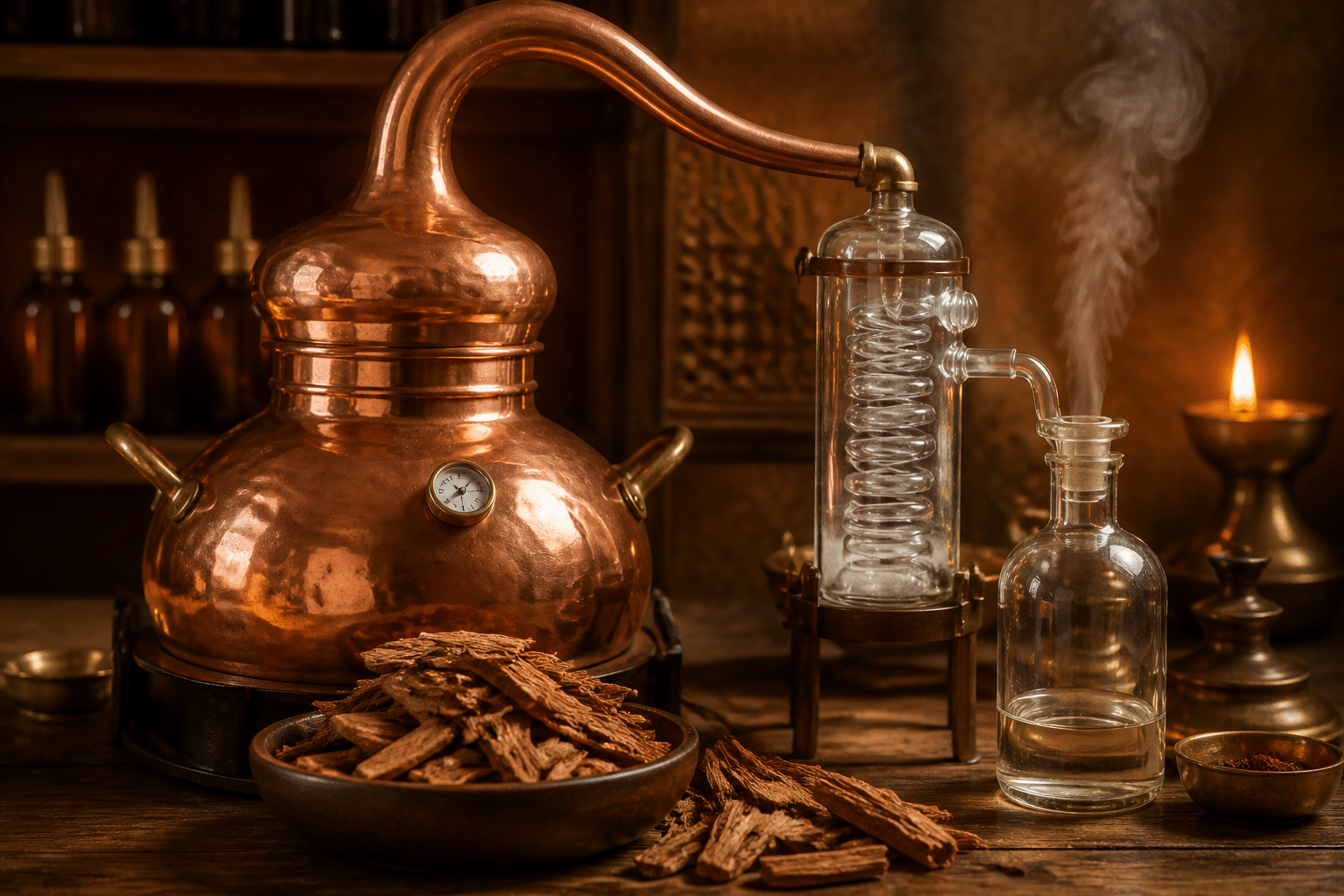
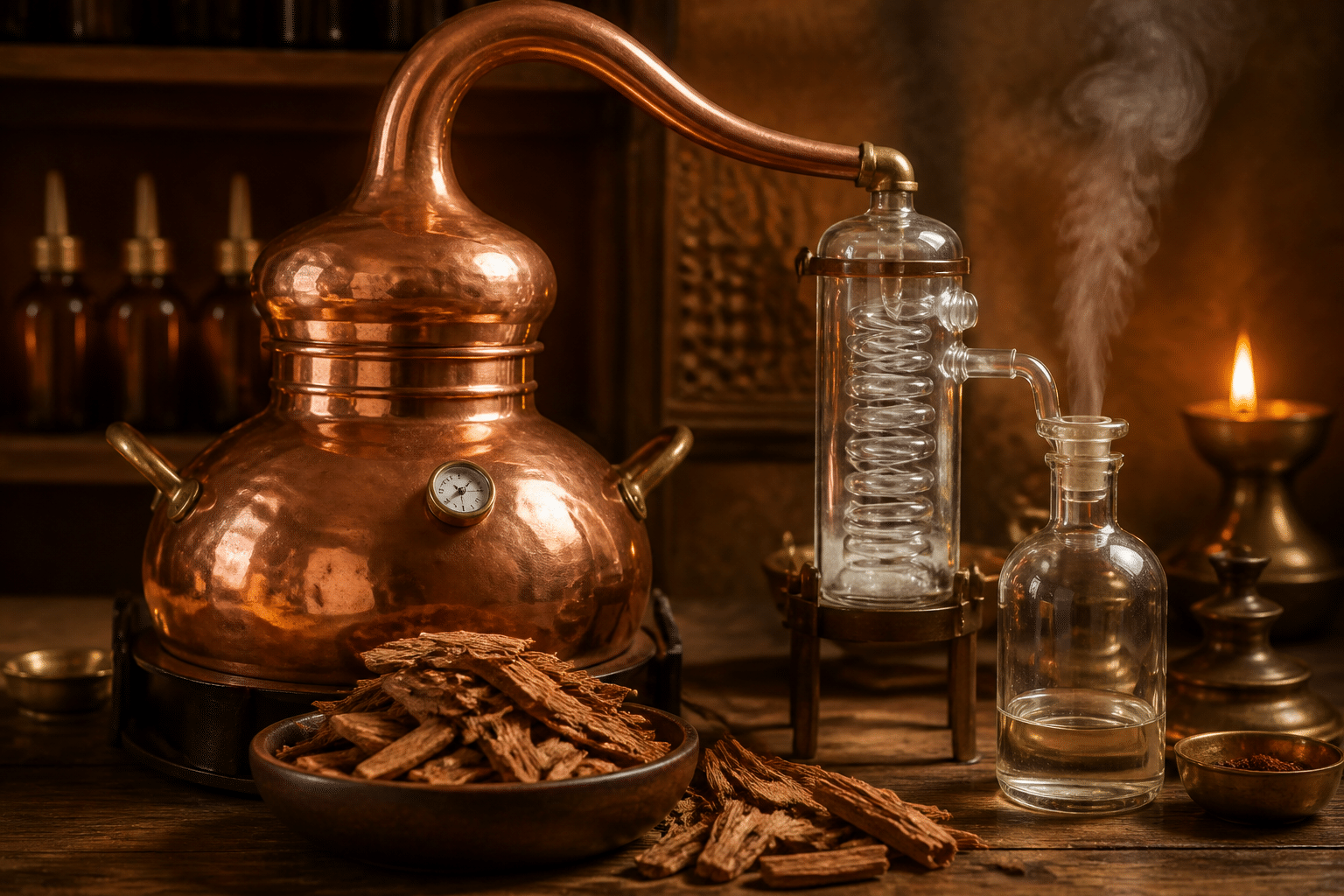
The traditional method is called Ark Kalpana. Coarse chips of Santalum album heartwood get soaked in water, often overnight. Then the mix is heated in a still (an Arka yantra), the vapor runs through a condenser, and the liquid drips into a receiver. That liquid is the ark.
Here’s a detail I like. Ayurvedic standardization guidance notes that the first runnings can be thrown out because they’re mostly steam. Middle fractions are then blended so each batch stays consistent. It’s a careful craft, not a quick soak.
The result is a true sandalwood hydrosol. An infusion is different, since the wood is just steeped or boiled and you miss the volatile part. And a synthetic version? That’s water plus fragrance chemicals. It can smell right and still contain zero sandalwood.
| True hydrosol (Chandan Ark) | Infusion | Synthetic fragrance water | |
|---|---|---|---|
| Process | Soak, steam-distill, condense | Steep or boil wood in water | Blend fragrance chemicals into water |
| Contains sandalwood volatiles | Yes, in trace amounts | Little to none | Not from real wood |
| Typical extras | Preservative system | Particles, color | Solubilizers, alcohol, preservatives |
| Proof of origin | Botanical name, batch lab data | Hard to verify | None without full ingredient list |
What’s Actually in the Bottle
Sandalwood’s star compounds are alpha- and beta-santalol. In steam-distilled oil they’re huge, around 84% combined in one extraction comparison.
Now, a warning. That number belongs to the oil, not the water. Hydrosol holds only a trace, and I couldn’t find any reliable industry standard for it. So if a seller quotes “84% santalol” for sandalwood water, walk away.
Santalol has been linked in lab work to anti-inflammatory activity, and tradition calls sandalwood cooling. Most of that research used oil, though. We’ll keep claims honest and tied to traditional use.
Why Source and Lab Proof Matter
For B2B buyers, this is the real test. Ask for three things:
- The botanical name on paper: Santalum album, not red sanders or a vague “sandalwood.”
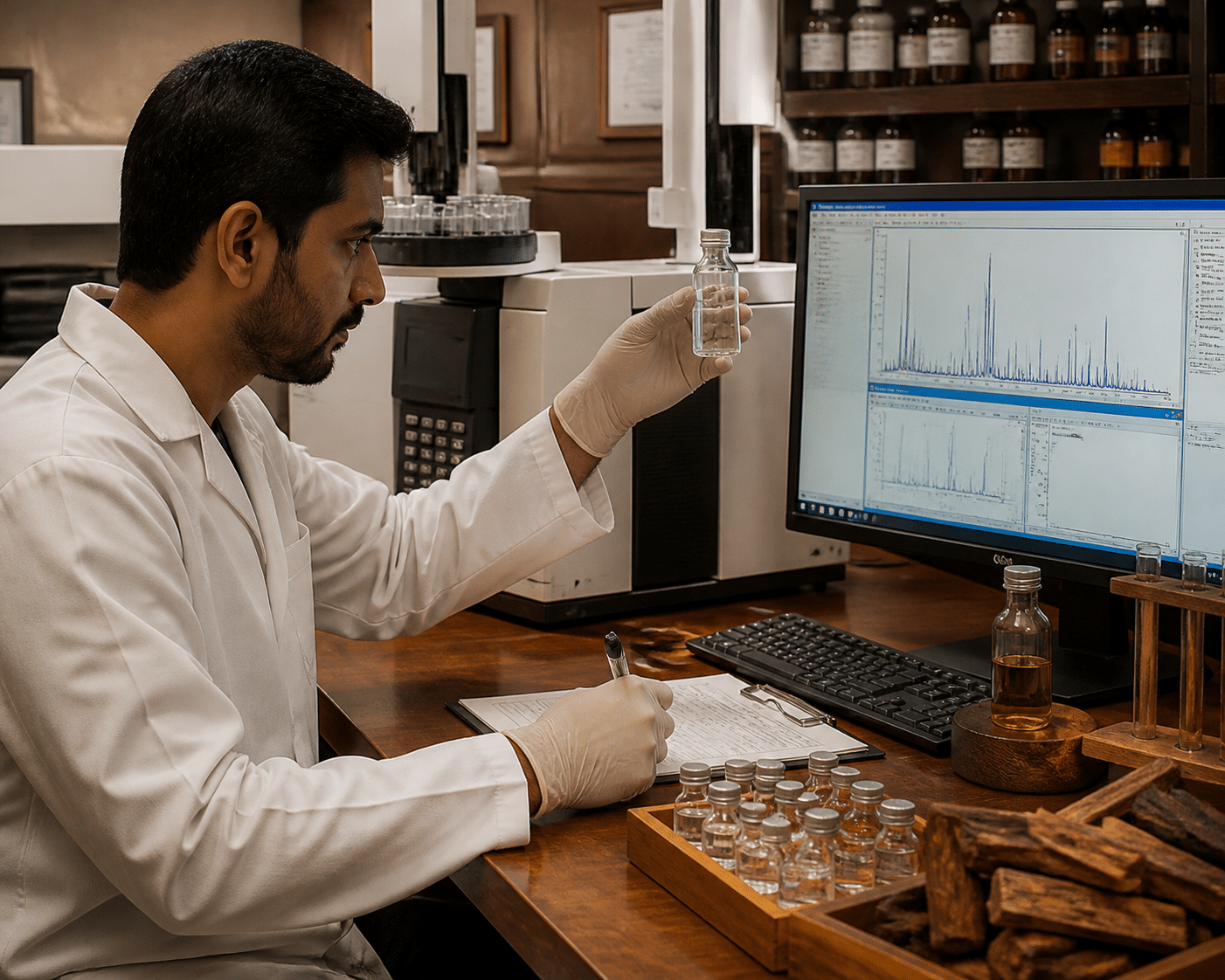
- A GC-MS report with the full chromatogram, showing alpha- and beta-santalol separately (in mg/L or ppm).
- Batch numbers that match the bottle you’re buying.
One report isn’t a magic stamp. Industry guidance points to pairing GC-MS with methods like NMR and DNA barcoding to catch adulteration. Also, a hydrosol should show a low, plausible oil level. Oddly high numbers can mean someone added essential oil.
So what does Ayurveda actually say about this wood? That’s next.
2. Sandalwood’s Esteemed Place in Ayurveda: A Pillar of Holistic Balance
Open any Ayurvedic materia medica and you’ll find Chandana sitting near the top of the “cooling” list. Not buried. Near the top.
That’s no accident. Ayurveda describes every plant using a small set of traits, and sandalwood’s traits all point the same way.
Reading Sandalwood’s Ayurvedic Profile
Ayurvedic pharmacology (called Dravyaguna) uses a few terms to describe a plant. Rasa is taste. Guna is quality. Virya is potency, meaning whether something heats or cools the body. Vipaka is the after-effect. According to this Dravyaguna teaching blog on Chandana, sandalwood is classically listed with the profile below.
| Property | Sandalwood (Chandana) | What it means in plain words |
|---|---|---|
| Rasa (taste) | Tikta, Madhura | Bitter and sweet |
| Guna (qualities) | Laghu, Ruksha | Light and dry |
| Virya (potency) | Sheeta | Cooling |
| Vipaka (after-effect) | Katu | Pungent |
| Dosha effect | Reduces Pitta and Kapha | Calms heat, redness and burning |
One small catch. Many online pages are modern summaries, not critical editions of the old Sanskrit texts. So if you plan to quote Charaka or Sushruta on your packaging, check a recognized translation first.
Pitta Imbalance, Meet Modern Skin Concerns
Here’s where it gets useful for product teams. Pitta is the dosha tied to heat and fire. When it runs high, the Ayurvedic picture on skin looks like redness, sensitivity, burning, flushing and quick irritation. Ayurvedic skincare guidance for sensitive skin lists sandalwood alongside rose and aloe as go-to cooling botanicals for exactly that pattern.
See the overlap? Those are the same things shoppers complain about in reviews: “my face gets red,” “everything stings,” “I need something calming after the sun.” A cooling, gentle ingredient fits right in.
But let’s be careful. Pitta is a traditional concept, not a medical diagnosis. Acne, rosacea and dermatitis are different things. So the honest claim is “traditionally used for cooling and soothing,” not “treats” anything.
The Sattvic Story: Calm Mind, Calm Ritual
Ayurveda also calls sandalwood sattvic, meaning pure, clear and harmonious. That’s why it shows up in temples, in meditation spaces and on the forehead as chandan tilak. The idea is simple: cool the body, settle the mind.
This is the part I find most useful for wellness brands. It gives you a story beyond skin. A mist that’s “traditionally used in calming rituals and contemplative practice” is easy to explain and easy to feel. Just keep the wording grounded. Studies on sandalwood aroma and relaxation are limited and mixed, so skip words like “reduces anxiety” or “improves focus.”
So we know what the wood is and why Ayurveda values it. Next, let’s see how people actually use it day to day.
3. Traditional Ayurvedic Skincare Rituals with Sandalwood Water
Picture a hot afternoon in Mysore, years before anyone sold “clean beauty.” Someone grinds a bit of sandalwood on a stone, mixes it with rose water, and presses a cool cloth to a flushed face. No label. No launch plan. Just a ritual that worked well enough to last centuries.
That’s the story we can borrow. Let’s look at how it actually went.
Cooling and Calming: The Lepa and the Compress
The classic move is the Lepa, a paste applied to the skin. Chandana lepa is finely ground sandalwood mixed with water, rose water or milk, then used for burning, heat and redness. Charaka’s texts list sandalwood as daha-prashamana (eases burning) and kandughna (eases itching). So the old use is clear: heat on the skin, cool it down.
Sandalwood water fits that same idea in a lighter form. Think of a compress. You soak a clean cotton cloth in diluted sandalwood water and rose water, wring it out, and rest it on the skin for a few minutes. The texts I found describe pastes, not compresses with a tested protocol, so treat this as a sensible adaptation. Not a proven method.
For brands, that points toward toners, facial mists and after-sun products. Just keep the wording honest. “Traditionally used to cool and soothe” is fine. “Treats acne” or “heals sunburn” is not, since sandalwood water hasn’t been tested that way.
Brightening the Ayurvedic Way: Varnya
Now for glow. Ayurveda groups sandalwood with Varnya herbs, meaning ones that support a clear, even-looking complexion. That’s why it lands in so many face packs (ubtans). One sandalwood, turmeric and yogurt ubtan mixes chickpea flour, sandalwood powder, turmeric, yogurt and honey, left on for about 10 minutes. Another Kerala-style favorite adds saffron and raw milk.
Here’s the catch. Those are powders and pastes, and the lab work on brightening mostly involves sandalwood oil. So for serums and masks, sandalwood water works best as a supporting player in the water phase, with the glow story told as tradition.
Old Pairings, New Product Ideas
Ayurveda rarely used one herb alone. Sandalwood was blended with rose, vetiver (Ushira), lotus and turmeric, so cooling and brightening pulled together. Utpaladi preparations pair sandalwood with Utpala and other cooling drugs for external use. Aroma Monk’s rose water is a natural partner here, since rose and sandalwood show up together again and again.
Product Inspiration
| Product idea | Core blend | Tradition behind it |
|---|---|---|
| Pitta-Balancing Facial Mist | Sandalwood water, rose water | Chandana lepa, cooling for heat and redness |
| After-Sun Cooling Toner | Sandalwood water, vetiver | Cooling Pitta-pacifying liquids |
| Ayurvedic Radiance Serum | Sandalwood water, rose, a turmeric extract | Varnya (complexion) ubtans |
| Calming Compress Cloths | Sandalwood water, rose water, in single-use pads | Cooling cloth ritual |
One warning for any water-based idea. These need a tested preservative system, because “natural” doesn’t mean self-preserving. We’ll get into that later.
So that’s the skin. But sandalwood was never only about skin, and the next part looks at what else it was used for.
4. Beyond the Skin: Holistic Uses for Mind and Body Wellness
Here’s something I didn’t expect when I started digging into Chandan Ark. Some of the oldest uses had nothing to do with a face pack. They were about calming a busy head and cooling a tired body.
That’s good news if you build wellness products. It means one ingredient can stretch across a lot of shelves.
A Calm Mind: The Nervine Tonic Idea
Ayurveda often describes sandalwood as soothing to the mind, and some practitioners call it a nervine tonic, meaning something that settles the nerves. The cooling quality matters here. A hot, racing mind is treated much like hot, red skin: cool it down and slow it down.
The science is thinner than the tradition. A well-known 2006 study on sandalwood odor found it changed pulse rate, skin conductance and blood pressure. But it didn’t act like a simple sedative. Some measures even pointed to more arousal. And a 2026 narrative review of just 10 studies linked inhaled sandalwood and other oils to changes in anxiety and nervous system balance. Interesting, yes. Proof, no.
So what does that mean for you? Room sprays, pillow mists and desk spritzes are a natural fit, as long as the copy stays grounded. “A grounding aromatic experience” works. “Reduces anxiety” doesn’t.
Cooling the Body and Resting Tired Eyes
Sandalwood’s cooling label also stretches to the whole body. Classical preparations used it for heat-type discomforts, including fevers. I wouldn’t go near that in a product claim, though. Fever is a doctor’s job. What you can say is that sandalwood water suits a cool, refreshing body mist for hot days.
Now the eyes. Ayurveda has traditional eye-care practices, including Netra Tarpan, and screen fatigue is something every one of us knows. It’s tempting to sell sandalwood water as an eye wash.
Don’t. Water-based herbal liquids can carry germs, and particles can scratch the eye. Safety data for sandalwood powder also warns that direct eye contact may cause irritation. A smarter route is a cooling compress pad or mist used around the eyes, with a tested preservative system and a clear “avoid direct eye contact” line on the label.
Sacred Space and Mindful Rituals
Then there’s the sattvic side we touched on earlier. Sandalwood has long set the mood for prayer, meditation and quiet time. A light mist over a yoga mat, a meditation cushion or an altar cloth carries that same feeling.
The market is there too. Grand View Research puts aromatherapy at about $9.9 billion in 2025, though other firms land much lower because they define the category differently. I couldn’t find a trustworthy size for “spiritual wellness” as a whole, so I won’t invent one. The demand for mindful, ritual-style products is real either way.
| Product idea | Traditional angle | Safer wording |
|---|---|---|
| Pillow mist | Calming evening ritual | “A grounding bedtime aroma” |
| Meditation space spray | Sattvic, sacred atmosphere | “Traditionally used in contemplative practice” |
| Cooling body mist | Heat-soothing Chandana use | “Refreshing and cooling to the senses” |
| Desk-break compress pad | Cooling cloth ritual | “For use around closed eyes, not in them” |
These ideas all depend on one thing: a sandalwood water you can actually trust. So let’s turn the tradition into a working formula next.
Get a quote from Aroma Monk.
Essential Oil Supplier – Bulk pricing • Samples • Fast response
5. From Ancient Text to Modern Lab: A Formulation Guide for Brands
OK, so you love the tradition. Now you’ve got a lab bench and a launch date. How do you actually get Chandan Ark into a bottle people will buy?
I’ll share starting points, not gospel. Every formula behaves differently, so test everything.
Where Sandalwood Water Fits in the Formula
Think of sandalwood hydrosol as part of your water phase. It’s not a booster you sprinkle on top. One cosmetic-grade supplier lists 100% for toners and 30 to 50% of the water phase in creams and lotions. Industry consensus? There isn’t one. So treat these as prototype ranges.
| Product type | Starting % of sandalwood water | Complementary Ayurvedic ingredients | Modern actives | Target claim |
|---|---|---|---|---|
| Toner | 50% (up to 100% once validated) | Rose water, vetiver | Glycerin, panthenol | “Traditionally used to cool and refresh” |
| Serum | 30% | Rose water, turmeric extract | Hyaluronic acid, niacinamide | “Inspired by Varnya complexion rituals” |
| Eye gel (for use around closed eyes only) | 20 to 30% | Aloe, rose water | Hyaluronic acid, caffeine | “A cooling, refreshing feel” |
| Body mist | 50% | Vetiver, lotus | Light humectants | “A grounding, cooling aroma” |
The eye gel numbers are my own suggestion, not a supplier spec. Same goes for the others, really. Check pH, thickness, smell over time and freeze-thaw stability.
Pairing It With Hyaluronic Acid and Niacinamide
This pairing is easier than it sounds. Hyaluronic acid gels up nicely in a water base, and niacinamide dissolves right in. Sandalwood water simply replaces part of the plain water.
But watch the pH. Niacinamide is usually happiest in a mild range, and natural preservatives often want things slightly acidic. Aim for a middle ground, then let your stability tests decide. Also, strong sandalwood scent can fade or shift next to other actives, so check the smell at week four, not just day one.
Keeping It Preserved (and Still Clean)
Here’s the part brands skip, and it hurts them later. “Natural” doesn’t mean self-preserving. Hydrosols are mostly water, which bacteria and mold love.
Two common clean-label choices are Leucidal Liquid and radish root ferment. Suppliers usually suggest 2 to 4% for Leucidal, added during cool-down. Both tend to work better below about pH 6. Leucidal can also be weaker against yeast and mold, and some thickeners interfere with it. So you need a preservative challenge test on your actual formula. I couldn’t find a study proving either one is enough on its own for sandalwood hydrosol. Test it.
Telling the Story Without Overselling It
A simple framework helps:
- Name it. Use “Chandan Ark” and the botanical name, Santalum album.
- Place it in tradition. “Traditionally used in Pitta balancing skincare” is honest and clear.
- Prove the basics. Share your batch data and distillation method.
- Keep claims modest. “Cooling” and “refreshing,” not “treats” or “heals.”
Santoor is a handy example. Its turmeric and sandalwood story worked because it tied ingredients to a clear promise. Your version just needs to be more transparent.
Once the formula and story are set, everything depends on the water itself. So let’s look at how to buy it well.
6. Sourcing for Purity & Scale: A Checklist for Procurement Managers
Picture this. You approve a gorgeous sample, place a big order, and batch two arrives smelling like a different product. Nobody’s happy. And the formula you spent months building is now a guessing game.
That’s the risk with sandalwood water. So let’s build a checklist you can actually use.
The Paperwork to Demand Before You Buy
Start with documents, not promises. A good supplier shouldn’t blink when you ask for these. A hesitant one tells you plenty.
| What to ask for | What good looks like | Red flag |
|---|---|---|
| Certificate of Analysis (CoA) | Batch number matches your bottle, with pH, microbial results and preservative details | Generic, undated or one-size-fits-all CoA |
| GC-MS report | Full chromatogram, alpha- and beta-santalol listed separately (mg/L or ppm), lab method stated | One-page “passed” certificate, or an oddly high oil-like number |
| Botanical identity | Santalum album named, plant part and distillation method stated | “Sandalwood” with no species, or red sanders mixed in |
| Legal origin papers | Procurement certificate from the state forest authority, harvest and processing records | Vague answers about where the wood came from |
| Export classification | Written HS-code and customs guidance for hydrosol | “It’ll be fine at the port” |
That last row matters more than people think. India restricts sandalwood timber exports, and oil faces its own limits. I couldn’t find a new 2026 rule aimed at hydrosol specifically, so don’t assume a finished water is exempt. Get it in writing.
On sustainability, ask for proof, not adjectives. Can the supplier trace each batch back to a farm or forest source? As Cécile Desmarais noted, demand for transparency in sourcing and supply chains keeps rising, and brands should research how and where ingredients are made before making sustainability claims.
Why Direct Manufacturers Beat Middlemen
Every handoff in a supply chain is a place where things can get swapped, diluted or lost. Chain-of-custody records that follow material from field to finished product, including harvest dates and every transfer, are one of the best defenses against adulteration. Brokers can make that trail fuzzy.
Working straight with a manufacturer who controls the process from farm to delivery changes the game. You get one team answering for the wood, the distillation, the testing and the shipping. Batches stay more consistent, and you skip the broker markup, which helps your cost per liter when volumes grow. Aroma Monk runs its supply chain this way, from sourcing raw materials to final delivery, and that’s the model worth looking for.
Also ask about lead times, minimum orders and what happens if a harvest runs short. Reliable suppliers have an answer ready.
How to Judge a Sample Like a Pro
Samples are where many buyers rush. Slow down. Check a few things:
- Aroma. Sandalwood water is gentler than the oil, so don’t expect a punch. But it should still read as warm, woody and a little sweet. Faint, sharp or perfumey? Be suspicious.
- Clarity. It should look clean, with no floating bits, haze or odd color.
- Smell over time. Open the bottle, then smell it again after a day and a week. Synthetic scents often fade or turn strange.
- Match to paperwork. The batch number on the sample should match the CoA.
Then ask about customization. Can they adjust blends, bottle sizes or packaging for your line? Many generic suppliers can’t, and that limits how far you can differentiate.
Once your supplier checks out, there’s one big idea left to tie it all together.
Conclusion: Embrace Tradition to Innovate and Differentiate Your Brand
So, where does this leave us? Sandalwood water is a flexible, high-value ingredient. It brings real Ayurvedic history to toners, mists, serums and calming rituals, and it asks for honest claims in return. Cooling, refreshing, traditionally used. Not “treats” or “heals.”
Here’s the thing I keep coming back to. The power of Chandan Ark lives in its authenticity. A true Santalum album hydrosol, backed by a GC-MS report and batch records, gives your customers something real. A bottle of scented water doesn’t. And shoppers can tell the difference, or at least they’re learning to. One report found that 71% of consumers would pay a premium for brands that fully disclose where their ingredients come from.
That’s your opening. Few brands have claimed sandalwood water properly, and the shelf is crowded with “natural” labels that say very little. Tell the true story, prove it with paperwork, and you stand apart.
The next move is finding a supplier who can back all of that up. Ask for samples, ask hard questions, and compare the answers.
Ready to build with certified-pure botanicals?
Aroma Monk is a direct manufacturer with lab-tested, traceable ingredients and flexible bulk supply for global brands. Explore Aroma Monk to start a sourcing conversation for your next product line.
Get a quote from Aroma Monk.
Essential Oil Supplier – Bulk pricing • Samples • Fast response