
The Untapped Potential of Chamomile Water in Modern Hair Care Formulations
Picture a shopper in a drugstore aisle, flipping a bottle over to read the back. She wants something gentle. Something that won’t leave her scalp itchy or her ends dry. Sound familiar?
That shopper is everywhere now. In a February 2024 survey of more than 3,300 U.S. women, 59% said they preferred cleaner, more natural ingredients. Frizz or damage topped their complaints at 56%, and dryness came right behind at 54%. People want gentle. But they still want results.
The market is following them. Grand View Research puts natural hair care at $10.17 billion in 2024, heading toward $16.99 billion by 2030 (that’s a 9.4% CAGR). Plus, hair care is borrowing from skincare. Vogue Business reported that scalp-focused conditioners and treatments grew 4.2% globally in 2024, beating the 3.7% for hair care overall.
So where does chamomile water fit in?
Chamomile water, also called chamomile hydrosol, is the soft, water-based liquid left after steam distilling chamomile flowers. It’s light. It smells gentle. And it slips easily into scalp mists, shampoos, conditioners and leave-in sprays. It won’t cure every hair problem (no ingredient does), but it gives brands a believable, plant-based story that shoppers already like.
This guide is for product developers, procurement managers and brand owners. We’ll cover the science, the formulation basics and the supply chain questions, one step at a time. First, let’s get clear on what chamomile water actually is.
Section 1: What Exactly is Chamomile Water? A Guide for Formulators
Here’s a mix-up I see a lot. Someone says “chamomile water” and half the room pictures a cold cup of tea. It isn’t.
Hydrosol, Tea or Essential Oil?
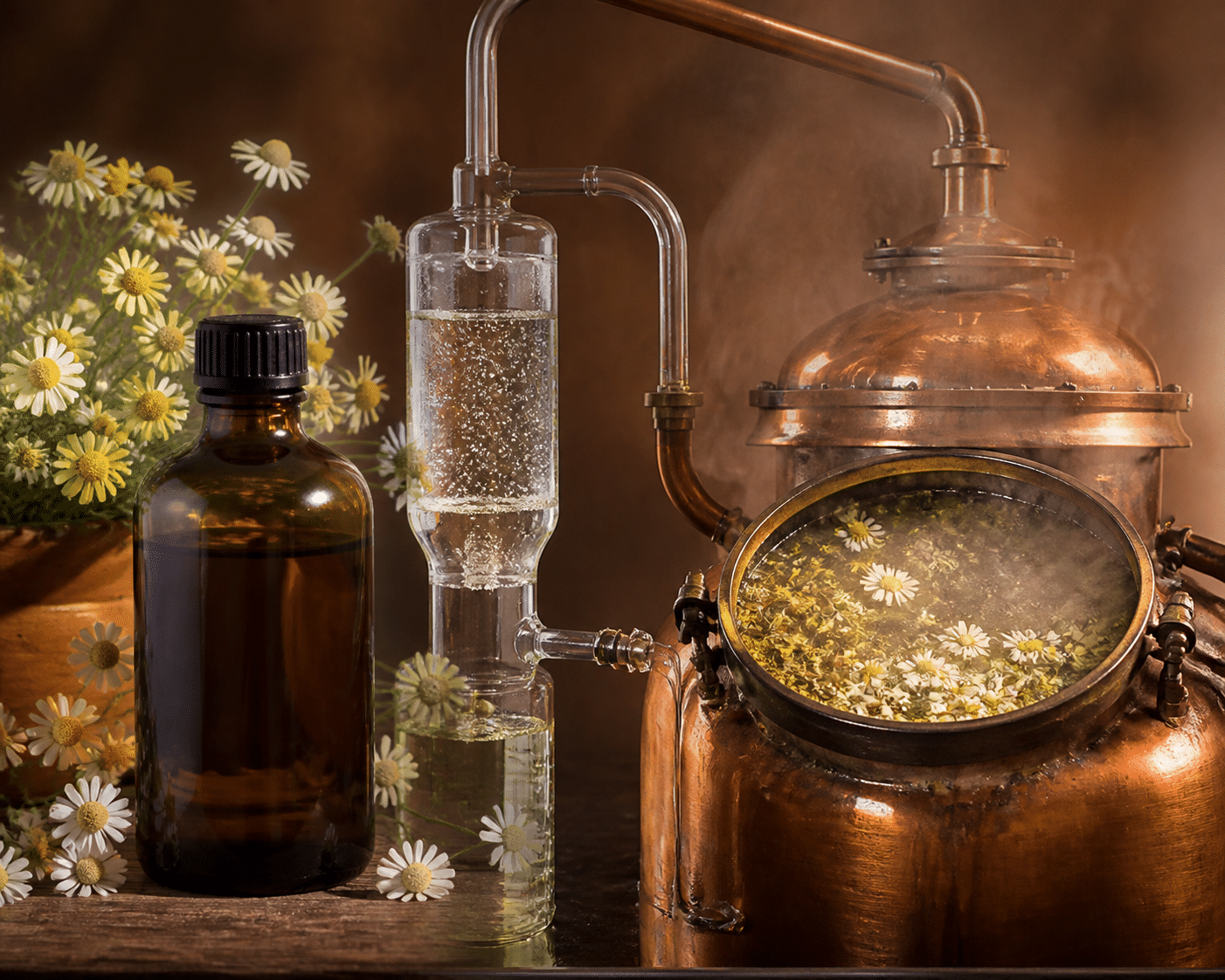
Chamomile water is a hydrosol. You make it by pushing steam through fresh or dried chamomile flowers. The steam carries tiny aromatic compounds into a condenser, and the cooled liquid gets collected. The oil layer, if there is one, gets skimmed off. What’s left is the aromatic water. It’s usually more than 99% water, with a very small amount of plant volatiles riding along.
Tea is different. That’s just flowers steeped in hot water. And a diluted essential oil is oil in water, which tends to separate and can bother sensitive skin.
| Chamomile hydrosol | Chamomile tea | Chamomile essential oil | |
|---|---|---|---|
| How it’s made | Steam distillation, water fraction collected | Flowers steeped in hot water | Steam distillation, oil fraction collected |
| What’s inside | Mostly water plus trace volatiles | Water-soluble plant material, some color | Highly concentrated oil-soluble compounds |
| Shelf stability | Needs a preservative system | Spoils fast, no standard spec | Very stable |
| Best cosmetic use | Mists, shampoos, conditioners, leave-ins | Home rinses, not a raw material | Tiny amounts in fragrance or active blends |
What’s Actually in the Bottle
Here’s where I’ll be honest with you. Chamomile flowers contain apigenin (a flavonoid) and bisabolol. Lab studies on chamomile extracts link both to calming, anti-inflammatory activity. But a hydrosol isn’t an extract. Apigenin doesn’t carry over into it very well, and you can’t guess a hydrosol’s makeup from the dried herb.
The species matters too. German chamomile (Matricaria recutita) hydrosol tends to show bisabolol oxides. Roman chamomile (Chamaemelum nobile) leans toward trans-pinocarveol and pinocarvone. A 2025 study on Roman chamomile hydrolate found those levels shifted depending on the extraction method. Same flower, different water.
So keep your claims soft and cosmetic. Think “soothing feel,” not “treats dandruff.”
Why True, Unadulterated Hydrosol Matters
The label “chamomile water” can hide a lot. Some products are thinned out, scented, or just a chamomile extract in water. That hurts stability and your brand story.
Ask every supplier for the basics:
- The correct Latin name and INCI name (for example, Matricaria recutita Flower Water)
- A batch-specific certificate of analysis with pH and microbial results
- Preservative details, production date and expiry date
- A GC report showing the real profile
A good example of what a proper spec looks like is Organic Herb Trading’s Roman chamomile hydrosol sheet. Suppliers like Aroma Monk build their pitch around lab testing and traceability for the same reason.
Next up, we’ll look at what the research says chamomile water can really do for hair and scalp.
Section 2: The Science-Backed Benefits of Using Chamomile Water for Hair & Scalp

Let’s be straight about something first. Chamomile has a long reputation, but the research on chamomile water is thin. Most studies look at extracts, skin cells or animals. So I’ll tell you what the science supports, and where it stops.
Calming a Cranky Scalp
This is the strongest benefit. A review of plants used for inflammatory skin problems found that chamomile’s bisabolol and apigenin slowed down COX and 5-LOX, two enzymes that help drive inflammation. Chamomile extracts also reduced skin swelling in animal tests.
A 2024 study in Frontiers in Pharmacology went further. Apigenin and bisabolol dialed down activated human T cells, which gives a believable immune-level reason for the soothing reputation. But here’s the catch. That same study showed the extraction method changed the chemistry and the activity. A water distillate isn’t an alcohol extract, so don’t assume it behaves the same way.
So what can a brand say? Something like “soothing feel” or “comfortable-feeling scalp.” What it can’t say is “treats dandruff.” No strong clinical evidence backs that up.
The Sun-Kissed Question
This one gets oversold. Many people assume apigenin bleaches hair. The evidence says otherwise. A 2026 review cites mouse research where topical apigenin actually boosted melanin in hair follicles. That’s the opposite of bleaching.
The more likely story is simple color deposit. Yellow-gold plant compounds may cling to the hair surface and make light hair look warmer. That’s closer to a tint than a lightener, and it’s my best read of the available info, not a proven fact.
User reports back this up. On a Long Hair Community thread, one person saw only a light golden stain, while another got a deep golden-brown tint after one rinse. Results swing with starting color, porosity and sun. And ash-blonde or gray hair might not love the warm cast.
Softness and Shine
Shoppers keep asking for this. Remember the survey from earlier: 56% complained about frizz or damage. A light, silicone-free mist that leaves hair soft is easy to picture.
The proof is mostly anecdotal, though. In a CurlyNikki forum discussion, one member said a chamomile and mint rinse gave shine and calmed a tender scalp. Nice. Not a lab result.
Why might it work? Hydrosols are mostly water, so they add light moisture without weight. Whether they truly smooth the cuticle hasn’t been measured, so keep claims to “soft-feeling” and “refreshed.” A supplier like Aroma Monk, which leans on lab testing, can help you back up what’s actually in your batch.
Benefits at a Glance
| Benefit | What supports it | How to word it |
|---|---|---|
| Scalp comfort | Lab and animal data on bisabolol and apigenin | “Soothing feel,” “comfortable-feeling scalp” |
| Subtle golden warmth | Forum reports, likely surface deposit | “May add a warm glow to light hair” |
| Soft feel | User reports, high water content | “Leaves hair soft” |
| Shine | User reports | “Adds natural-looking shine” |
| Gentle, plant-based story | 59% of shoppers want natural ingredients | “Made with chamomile water” |
That’s the honest picture. Next, let’s turn it into an actual formula.
Section 3: Formulation & Application: Incorporating Chamomile Water into Your Product Line

Good news first: chamomile water is easy to work with. The catch? Easy doesn’t mean foolproof. Here are three ways to use it, from simplest to most flexible.
Standalone Products: Start Simple
A short ingredient list is a great place to begin. Fewer parts means fewer surprises, and shoppers who read labels like what they see.
Take a soothing scalp tonic. Chamomile water leads the list, with a little glycerin for light moisture and a preservative to keep it safe. A brightening hair rinse works the same way, with chamomile water, glycerin and a pinch of citric acid to bring the pH down. Keep the claim modest, though. Think “a warm glow for light hair,” not “lightens hair.”
Preservation is where people slip. Hydrosols are water, and water grows things. Geogard ECT is a common natural-positioned pick, usually used at 0.6 to 1.0% and reported as stable between pH 3 and 8. Whatever you choose, run a challenge test on the finished product. No shortcuts here.
Swapping It In for Water
This is the move I like most. Instead of deionized water, use chamomile water for part of the water phase in your shampoo, conditioner or hair mask. Same process, new story on the label.
Proof it works: the Fragile Reborn Repairing Regenerating Hair Mask lists chamomile flower water third, right after water and cetearyl alcohol. That’s a normal conditioning-mask base. Nothing exotic.
How much should you use? Treat these as starting points, not rules:
- Shampoo: about 20 to 30% of the formula
- Conditioner: about 25 to 40%
- Hair mask: similar to conditioner, then adjust for feel
Then check viscosity, odor, pH and stability. More hydrosol means more water to protect, so your preservative system has to keep up. I’d start low and move up in small steps (my own habit, and it’s saved me some headaches).
Leave-In Products for Daily Use
Leave-ins are where chamomile water really shines. It’s light. It doesn’t feel greasy. And it suits the shopper who wants soft hair without buildup, which fits the 56% who told that survey they struggle with frizz or damage.
Think lightweight mists, detanglers and leave-in conditioners. A mist can use around 30 to 60% chamomile water, depending on how much scent and slip you want. One English chamomile hydrosol spec sheet from Madar Corporation lists shampoos, leave-on conditioners and hair sprays as intended uses. But it doesn’t set a finished-product inclusion rate, so your own testing still matters.
Because leave-ins sit on hair and scalp all day, packaging counts too. An airless pump or a tight-mouth spray bottle cuts contamination risk.
Formulation Inspiration
Here’s a quick cheat sheet to spark ideas. Adjust for your own base and test everything.
| Product Type | Key Ingredients | Target Benefit |
|---|---|---|
| Soothing scalp tonic | Chamomile water, aloe vera juice, panthenol, glycerin, preservative | Comfortable-feeling scalp |
| Brightening hair rinse | Chamomile water, glycerin, citric acid, preservative | Warm glow on light hair |
| Gentle shampoo | Chamomile water, mild surfactant blend, preservative | Light, refreshing cleanse |
| Conditioning hair mask | Chamomile water, cetearyl alcohol, conditioning agent | Soft-feeling hair |
| Detangling mist | Chamomile water, glycerin, light conditioning agent | Easy combing, no weight |
| Leave-in conditioner | Chamomile water, panthenol, light emulsifier | Daily softness and shine |
Once you know what you’re making, the next question is where the chamomile water comes from. That’s up next.
Get a quote from Aroma Monk.
Essential Oil Supplier – Bulk pricing • Samples • Fast response
Section 4: The Procurement Manager’s Guide: Sourcing Certified Bulk Chamomile Water

You can have a perfect formula and still stumble on day one. All it takes is a drum of “chamomile water” that isn’t what the label said. Hydrosols are easy to thin out and hard to judge by eye. So let’s talk about buying it right.
Quality Markers to Demand
Three checks aren’t up for negotiation.
First, a GC/MS report. This shows what’s really in the water. A Roman chamomile batch should lean toward pinocarveol compounds, while German chamomile should show bisabolol oxides. If the report doesn’t match the Latin name on the drum, walk away.
Second, a batch-specific certificate of analysis (COA). Not a generic sheet that says “100% pure.” You want pH, microbial results, production date and expiry date for the exact lot you’re buying.
Third, written confirmation of 100% natural origin. That means no synthetic fragrance, dyes or fillers. One catch: hydrosols still need a preservative, so ask exactly which one is in there and whether it fits your “natural” claim.
Your own eyes help a little, too. Cloudiness, floating bits or a sour smell are red flags. But they never replace lab testing.
| Supplier Vetting Checklist | What to ask for |
|---|---|
| Botanical identity | Latin and INCI name, plant part, country of origin |
| GC/MS report | Recent, batch-linked, matches the species |
| COA | pH, microbial counts, dates, storage conditions |
| Natural origin | Written statement: no synthetic additives |
| Preservative | Name, level and whether it suits your claims |
| Certifications | Cosmetic GMP, ISO 9001, organic if you’ll claim it |
| Traceability | Farm lot to distillation to filling records |
| Capacity | Lead times and volume commitments in writing |
On certifications, CBI notes that the EFfCI GMP scheme is built for cosmetic ingredients and rests on ISO 9001:2015 principles. Always check that a certificate covers the actual facility, not just a logo on a website.
Why Going Direct Beats Using a Broker
Brokers can feel simple. But every extra hand between the farm and your factory adds cost, delay and blind spots. When a lot gets blended along the way, you can’t say where it came from. And if something goes wrong, good luck tracing it.
That’s why many buyers prefer a direct manufacturer. NutraIngredients has covered how vertical integration can act as a shield against adulteration. A supplier like Aroma Monk, which manages the chain from sourcing raw materials to final delivery and leans on lab testing and traceability, gives you one team to call for volume, paperwork and answers.
Still, “integrated” can mean different things. Ask for a process map. Ask them to trace one past lot back to its source. A confident supplier won’t mind.
Cost vs. Value: Where the Math Really Lands
Cheap chamomile water looks great on a quote. Then the trouble starts. Batches smell different. Stability fails. And you can’t back up a single claim you wanted to put on the bottle.
Pure, certified water costs more up front. But it behaves the same from lot to lot, so you spend less time reworking formulas. It also lets you say things like “traceable chamomile” and mean it. Shoppers who read labels notice, and they tend to come back.
Once your supply is sorted, the next question is how to talk about it without overpromising.
Section 5: Marketing Your Chamomile Hair Products: Claims That Connect with Consumers
You’ve got a good formula and a clean supply. Now comes the part where many brands trip: the words on the bottle.
Here’s the deal. Shoppers want plant-based, but they’re also skeptical. Attest found that 56% of Gen Z beauty buyers look for natural claims. And Revieve reports that this group fact-checks what brands say. So make every line something you can prove.
Lead With Gentle and Soothing
This is your strongest angle, and it matches the science we covered earlier. Talk about a calmer-feeling scalp and soft-feeling hair. Skip anything that sounds like treatment.
Try lines like “A fine mist for a comfortable-feeling scalp.” Only add “dermatologist tested” if a real test was done on your finished product. No test, no badge. Simple.
Sell the Natural Glow
Benefit-driven copy works here, but keep it honest. Chamomile likely adds a warm tint, not bleach-like lightening. So “For sun-kissed, radiant hair” or “A warm glow for light hair” is fine. “Brightens blonde tones without chemicals” is risky, because results swing by hair color and sun. And “unleash your natural highlights” promises more than a mist can deliver. I’d test the wording on a few real customers first.
Tell the Clean and Sustainable Story
This is where chamomile water really helps. You can say it’s steam-distilled from flowers, which is true and easy to picture. Add “sulfate-free” and “silicone-free” only if your formula is. Then back it up with specifics: where the chamomile grew, what the bottle is made of, and the full ingredient list. A supplier like Aroma Monk can supply the traceability papers that make those lines believable.
Concept Ideas You Can Mock Up
Here are four label angles to test with your design team.
| Concept | Front-of-bottle line | Back-label support | Proof to keep on file |
|---|---|---|---|
| Scalp mist | “Calm, comfortable-feeling scalp” | Chamomile water, steam-distilled from flowers | Batch COA, preservative challenge test |
| Glow rinse | “A warm glow for light hair” | Use on damp hair, best with sunlight | User trials on different hair colors |
| Leave-in spray | “Soft, refreshed hair, no weight” | Silicone-free (if true) | Final ingredient list review |
| Clean-story mist | “Traceable chamomile, bottled with care” | Named region, packaging material | Origin records, supplier audit |
Once your message is set, there’s just one thing left to tie it all together.
Conclusion: Make Chamomile Water Your Brand’s Next Signature Ingredient
So, here’s where we land.
Chamomile water for hair isn’t magic. It won’t fix every scalp or bleach every strand. But it does have a real, honest story: a soft, plant-based hydrosol that fits scalp mists, shampoos, conditioners and leave-ins, backed by early lab data on calming activity and by shoppers who keep asking for gentler, more natural options. Keep your claims modest, like “soothing feel” and “soft hair,” and you’ve got a product line you can stand behind.
The formula is only half the job, though. The other half is what’s in the drum. Real hydrosol means the right Latin name, a batch-specific COA, a GC/MS report and clear preservative details. Skip those, and even a perfect recipe can wobble. A partner who controls the chain from sourcing to delivery makes all of that easier to prove.
That’s where Aroma Monk comes in. They supply bulk, lab-tested, traceable natural ingredients to cosmetic and personal care brands around the world, and they can talk through packaging and customization too. Ask for a sample. Ask for a spec sheet. Ask them to trace a lot back to its source (a good supplier won’t flinch).
Ready to put chamomile water in your next launch?
Get pure, certified, traceable hydrosol from a direct manufacturer, with documentation you can actually use.
Your shoppers are already reading the back of the bottle. Give them something worth reading.
Get a quote from Aroma Monk.
Essential Oil Supplier – Bulk pricing • Samples • Fast response