
Introduction: The Search for Multi-Functional, Natural Ingredients in Modern Skincare
Last month I watched a product developer toss a sample jar across a desk and say, “Everyone’s selling ‘natural.’ Nobody’s proving it.” Fair point. Funny enough, it sums up where the whole industry is right now.
Why “Natural” Alone Isn’t Enough Anymore
Buyers want more than a leaf on the label. Grand View Research valued the global natural cosmetic ingredients market at $10.6 billion in 2025 and expects it to hit $21.7 billion by 2033. Part of that growth comes from premium products that combine hydration, anti-aging and barrier support in one bottle. So the winning ingredient does more than one job, and it can back that up.
Irena James of Univar Solutions put it well in May 2025. She said buyers want ingredients that are ethically sourced, upcycled, biodegradable, and preferably supported by data. Not just “natural.”
The Headache for Developers and Procurement Teams
If you buy raw materials for a living, you know the drill. You need proven performance. You need a supply chain that won’t vanish mid-launch. And you need a story that makes a shopper pick your jar over the other forty on the shelf.
That’s a tall order. Add the risk of diluted or adulterated batches, and it gets stressful fast.
Where Sandalwood Water Fits
So here’s my take. Sandalwood water (also called chandan water, or sandalwood hydrosol for skin) deserves a closer look. It’s the aromatic water left behind when sandalwood is distilled. Most people file it under “nice hydrating mist.” I think that undersells it.
Done right, it can bring a calm, woody scent, gentle skin conditioning and a heritage story all at once. Done wrong, it’s scented water with a fancy name. Purity, proof and sourcing make the difference.
I’ll be honest too: the research on hydrosols is thinner than the marketing suggests, and we’ll stick to what’s actually supported. Let’s start with what sandalwood water really is.
1. What is Pure Sandalwood Water? A Look at Production and Quality Markers
Let’s clear up the biggest mix-up first. Sandalwood water is not sandalwood oil stirred into a bottle of tap water. Not even close.
A True Hydrosol, Not a Fragrance Water
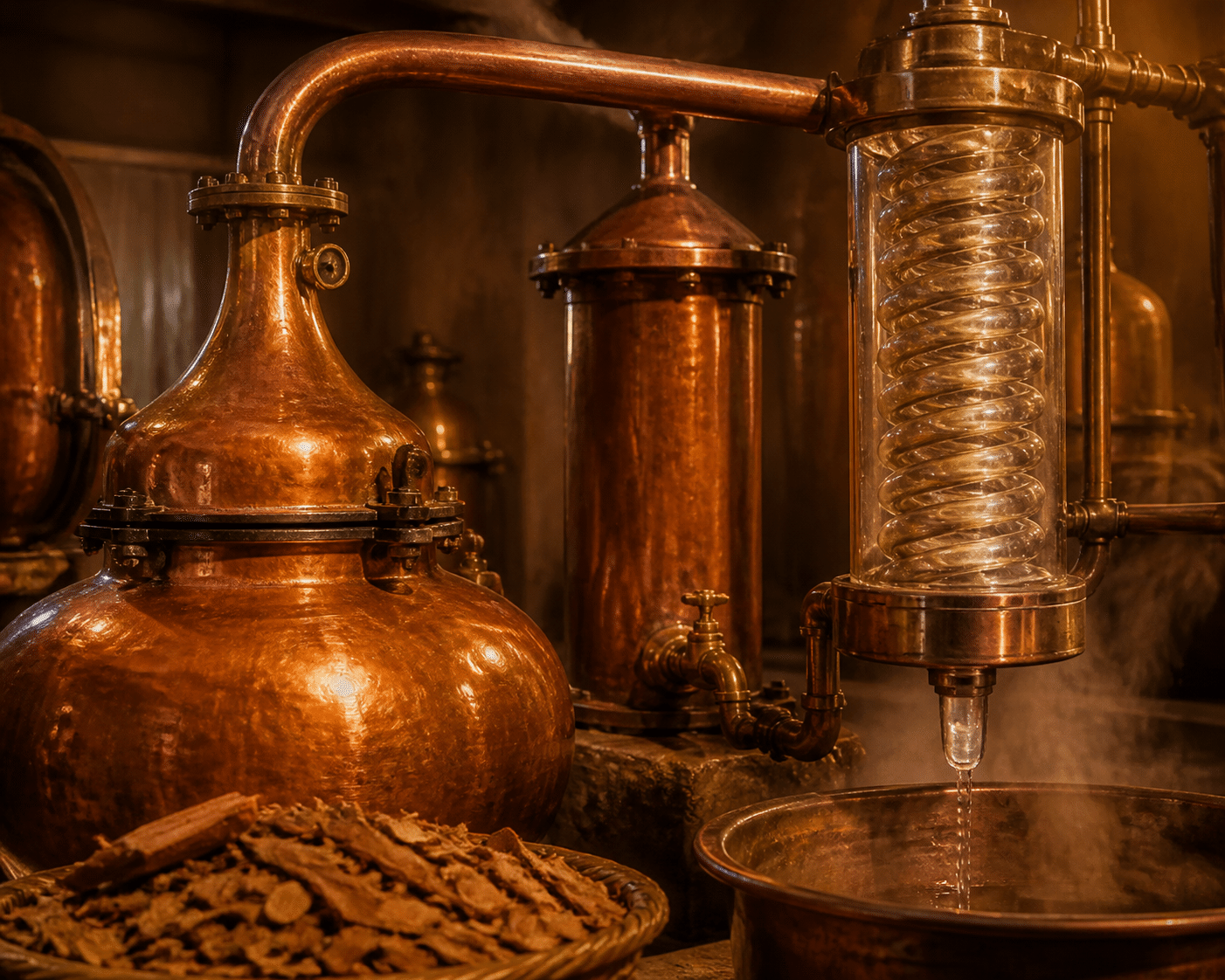
So, what is sandalwood water? It’s a hydrosol. When sandalwood heartwood is distilled, you get two things: a small amount of essential oil and a much larger amount of aromatic water. That water is the hydrosol, sometimes sold as chandan water or sandalwood distillate.
The two products don’t match. The oil holds the heavy santalols, which barely dissolve in water. The hydrosol carries only the water-soluble and water-dispersed bits that drift over with the steam. Think of it as a lighter, softer cousin. One supplier lists its sandalwood hydrosol as more than 99.85% water, which tells you why the scent is gentle.
And the fakes? A “sandalwood water” made by mixing oil, solubilizer and water isn’t a hydrosol. It’s a different thing with a nicer label.
How Steam Distillation Makes It
Here’s the process in plain steps. Each one affects what ends up in your drum.
| Stage | What happens | Why it matters to a buyer |
|---|---|---|
| 1. Wood | Chipped or powdered heartwood goes into the still | Species, age and origin set the starting quality |
| 2. Steam | Steam passes through the wood and picks up aromatic compounds | Pressure, heat and time shape the final profile |
| 3. Condenser | The steam cools back into liquid | Clean, inert equipment keeps contamination out |
| 4. Separation | Oil floats on top, hydrosol is drawn off underneath | Oil carryover should be controlled, not accidental |
I’ll be upfront: no one has published solid GC/MS data on sandalwood hydrosol itself. Most chemistry papers study the oil. So don’t assume an oil chromatogram describes the water.
Quality Markers Worth Asking About
There’s no dedicated international standard for sandalwood hydrosol. ISO 3518 covers the oil, so a claim that the water “meets ISO 3518” deserves a raised eyebrow. What you can check instead:
- Botanical source: Santalum album is the classic Indian sandalwood. Other species, like S. paniculatum or S. spicatum, smell and test differently, so the label should name the one you’re buying.
- Additives: Ask for a plain list of any preservatives, alcohol or solubilizers. Hydrosols spoil easily, so “no preservatives” is fine only if the shelf life is honest too.
- Freshness: Look for a distillation date and lot number. Small, recent batches are easier to trace.
- Paperwork: A batch-specific certificate of analysis, ideally with microbiology and a chemical fingerprint of the hydrosol.
Next up, we’ll look at what sandalwood water actually does for skin hydration, and where the evidence stops.
2. The Science of Deep Hydration: How Sandalwood Water Moisturizes and Balances Skin
Here’s where I have to bust a popular myth. Plenty of product pages call sandalwood water a natural humectant that pulls moisture out of the air and drives it deep into skin. I looked for proof of that. I didn’t find it.
What I did find is more useful for a formulator, so let’s walk through it.
So, Is It Really a Humectant?
Not on its own. Sandalwood water is almost all water, which is why it wets the skin surface fast and feels cooling. But true humectants like glycerin or hyaluronic acid grab water and hold onto it. A hydrosol doesn’t do that job.
The closest data point is a 2025 Taiwanese master’s thesis. Its record reports 56% surface hydration over 24 hours for sandalwood hydrosol, versus 58% for the essential oil. Interesting, sure. But it isn’t a standard corneometer trial, and the method details are thin. I’d call it a hint, not proof.
What About “Deep Penetration”?
The santalols are the stars of sandalwood oil, and they don’t dissolve well in water. So only small, variable amounts ride over into the hydrosol. That makes the “deep delivery of soothing compounds” story hard to back up.
Most anti-inflammatory and antioxidant research covers the oil or plant extracts, not the water. So the safest wording is “may help refresh and soothe skin.” Or “provides water-based skin conditioning.” Claims like “deeply moisturizes” need your own testing first.
pH and the Skin Barrier
Here’s the part that does hold up. Healthy facial skin is mildly acidic, usually around pH 4.5 to 5.5. Sandalwood water lands close to that range, which makes it a gentle fit for the acid mantle.
| Item | Typical pH | Note |
|---|---|---|
| Healthy facial skin | 4.5 to 5.5 | Mildly acidic |
| Sandalwood hydrosol (one reference table) | 5.9 to 6.0 | Slightly above skin |
| Sandalwood hydrosol (one supplier listing) | 4.0 to 5.5 | Shows batch variation |
| Hydrosols in general (per a broader review) | 3.5 to 6.5 | Depends on plant and process |
See the spread? “Pure” doesn’t mean every batch matches. So test pH on each lot, and remember the finished formula’s pH is what your customer’s skin actually meets.
Now, the barrier. A 2026 split-leg trial saw hydration rise 74.1% by day 28, while transepidermal water loss (TEWL) fell 13.5%. Big numbers. But the product was an emollient formula, not sandalwood water, so none of that credit belongs to the hydrosol.
The takeaway? Sandalwood water works best as a skin-friendly, pleasant-smelling water phase. Pair it with a real humectant and an emollient system to handle moisture and barrier support. Next, we’ll look at what else it can bring to a formula beyond water.
3. Beyond Moisture: Multi-Functional Sandalwood Water Benefits for Advanced Formulations
So hydration isn’t the headline. Fine. But that doesn’t mean sandalwood water has nothing else to offer.
Here’s the catch, and I’ll say it up front. Most of the research behind these benefits studied sandalwood oil or plant extracts, not the hydrosol. So think of what follows as a promising direction for your R&D bench, not a finished claim.
Calming Redness and Irritation
This is where sandalwood gets interesting for sensitive-skin lines. In one lab study, sandalwood oil reduced 20 of 26 inflammatory signals in human skin cells that had been deliberately irritated. The same work pointed to alpha- and beta-santalol as the main players.
Now, the hydrosol carries far less of those compounds, since santalols barely dissolve in water. So I wouldn’t promise “reduces rosacea redness” on a label. What you can reasonably explore is a cooling, gentle water phase for soothing serums, post-sun mists and after-treatment sprays. Then test it. Patch tests first, always.
Mild Astringent and Blemish Support
Sandalwood has long been used on combination and blemish-prone skin. A 2024 review reports that sandalwood oil slowed the growth of S. aureus, S. epidermidis and P. acnes in lab settings at concentrations of 0.06% or below.
That sounds great. But again, it’s oil. A typical hydrosol is over 99.85% water, so it probably won’t hit those levels on its own. I’d treat it as a gentle toner base that feels light and slightly tightening, and pair it with a proven active if you’re building a real acne-care product. Plenty of blemish lines do well with that “gentle” angle anyway.
Antioxidant Appeal for Anti-Aging Lines
Free radicals from sun, pollution and screen time are a big reason shoppers reach for preventative skincare. A 2026 study on an aqueous sandalwood extract found that at 10 mg/mL it cut malondialdehyde (MDA), a marker of lipid damage, in cell tests.
OK, but that was an extract, not a hydrosol. I also couldn’t find any head-to-head study against green tea or vitamin C, so don’t claim sandalwood water is “as strong as” either one. A fair line is “preliminary antioxidant activity seen in lab assays of sandalwood aqueous extracts.” Honest, and still a nice story.
Multi-Functional Benefits at a Glance
Here’s a quick cheat sheet for your development team. The “evidence” column is the part I’d keep taped to the wall.
| Benefit | Mechanism (what the research suggests) | Evidence level for hydrosol | Ideal product application |
|---|---|---|---|
| Anti-inflammatory | Santalols lowered cytokine signaling in skin-cell studies | Oil only, hydrosol unproven | Soothing serums, post-sun mist, after-treatment sprays |
| Mild astringent and antimicrobial | Sandalwood oil slowed acne-linked bacteria in the lab | Oil only, hydrosol unproven | Gentle toners, combination-skin mists, light blemish-care lines |
| Antioxidant | Aqueous extract lowered a lipid-damage marker in cells | Extract only, no hydrosol data | Anti-pollution mists, preventative day serums |
| Skin conditioning | Water-based phase with a soft woody scent | Reasonable, based on composition | Toners, essence waters, mask bases |
See the pattern? The one benefit you can lean on today is the sensory, skin-friendly water phase. The rest are leads worth testing in your own finished formulas.
Next, let’s talk about how to put sandalwood water into those formulas without wrecking stability.
4. Application in Cosmetics: How to Formulate with Sandalwood Water for Product Differentiation
OK, time to get practical. You’ve seen what sandalwood water can and can’t do. Now, where does it actually go in a formula?
Swapping Out the Deionized Water
The simplest move is also the most popular. Replace some or all of the deionized water with sandalwood water.
Deionized water is just a neutral base. Sandalwood water adds a soft woody scent, a skin-friendly feel and a story you can put on the label. Your INCI list gets more interesting too, since the botanical water shows up as the first ingredient (name the species, because Santalum album and Santalum spicatum aren’t the same thing).
But let’s be straight about one thing. A hydrosol isn’t automatically better than deionized water. It brings smell, color and batch-to-batch variation along with it. So the upgrade is mostly sensory and storytelling, plus whatever you can prove in your own testing.
Formulation Ideas Worth Testing
Here are some pairings I’d put on the bench first. They’re starting points, not published recipes.
- Hydration serum: Sandalwood water as the water phase, with hyaluronic acid doing the real moisture work.
- Purifying mask: Kaolin clay mixed with sandalwood water for a wet, light mask.
- Calming gel: Aloe vera gel built on a sandalwood water base for after-sun or sensitive skin lines.
For usage levels, one cosmetic-grade supplier suggests up to 100% of the water phase in toners and 30 to 50% in creams and lotions. I couldn’t find a published number for masks, so starting in the cream range is a sensible guess. Then adjust.
| Product type | Where sandalwood water fits | Suggested starting point |
|---|---|---|
| Toner | Whole water phase | Up to 100% of water phase |
| Serum | Water phase with a real humectant | Test from 30 to 50%, then raise |
| Mask jar | Mixed with kaolin or similar clay | About 30 to 50% of water phase (untested guess) |
| Spray mist | Main base, light and refreshing | Up to 100% of water phase |
| Cream or lotion | Part of the water phase | 30 to 50% of water phase |
Unique Formats That Set You Apart
This is where it gets fun. Because sandalwood water is thin and light, it suits formats that other ingredients make awkward.
- Facial mists: An easy on-the-go refresh. A Down Under Enterprises monograph lists toners, mists and facial masks as intended uses for Australian sandalwood hydrosol.
- Bi-phase cleansers: The water layer can carry the scent while the oil layer lifts makeup. Shake, use, done.
- Pressed powders: It can work as a mild wetting liquid in the binder step. I haven’t seen published data on this one, so trial it carefully.
Don’t Skip Preservation
Here’s the catch. A formula that’s mostly hydrosol is a very friendly home for bacteria and mold. One formulator guide suggests phenoxyethanol with ethylhexylglycerin at roughly 0.8 to 1.0%, a pH around 3.5 to 5.5, and dark packaging with a pump. It estimates about 12 months of shelf life when done right, versus just 2 to 4 weeks refrigerated for an unpreserved hydrosol. Your own challenge testing has the final say.
Next up: how to buy this stuff in bulk without getting burned.
5. Sourcing & Quality Control: A Procurement Manager’s Checklist for Bulk Sandalwood Hydrosol
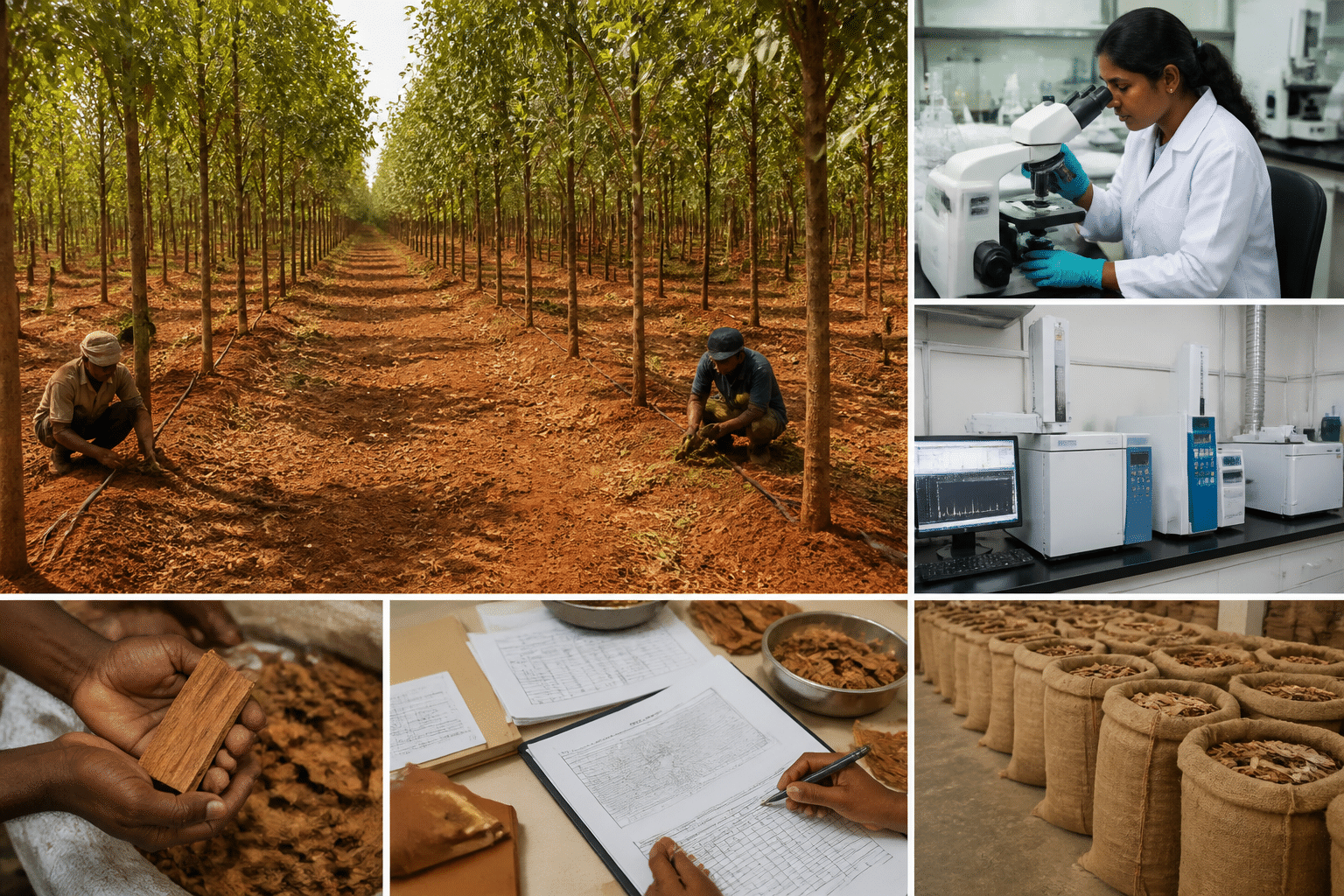
You’ve found a formula you love. Now comes the part that keeps procurement managers up at night: buying a few hundred liters of it that actually matches the sample. Let’s build a checklist you can use on your next call.
The Supplier Vetting Checklist
Start with paperwork. A good supplier won’t flinch when you ask for it.
- Traceability: Can they link the lot to a plantation or harvest region, a distillation date and a processor? CBI buyer guidance says certificates, lab tests and traceability maps build buyer trust. Vague answers are a red flag.
- Distillation date: Fresh, dated batches beat a drum with no history.
- CITES papers: Santalum album sits in CITES Appendix II, so international trade is controlled. Ask for export documents that match the shipping records.
- Sustainability proof: CITES paperwork alone doesn’t prove a plantation is well managed. Ask for forestry certificates (like FSC or PEFC) with a number, scope and expiry date. “Ethical” with no document behind it is just a word.
- Species and additives: The label should name the species and list any preservative, alcohol or solubilizer.
How to Read a CoA and GC/MS Report
A CoA is only useful if it’s specific. Insist on one that’s signed, lot-specific and lists test methods. A generic sheet with “100% pure” on it? Walk away.
Here’s a quick guide to what each section tells you.
| CoA section | What it tells you | What to watch for |
|---|---|---|
| Identity | Species, plant part, origin, lot and production date | Missing lot number or unnamed species |
| Organoleptic properties | Color, clarity and aroma | Sour, smoky or solvent-like notes, sediment |
| pH | Acidity at a stated temperature | Big jumps between lots |
| Specific gravity | Basic density check | One supplier listing-hydrosol-273) gives 0.940 to 1.040; investigate anything outside the validated range |
| Microbiological analysis | Total aerobic count, yeast and mold, pathogens like E. coli and Pseudomonas | No limits, no method, no sampling date |
| Preservative disclosure | Any added preservative, alcohol or solubilizer | Silence on this line |
| GC/MS fingerprint | The volatile compounds in the water | Oil data passed off as hydrosol data |
That last row trips people up. Most sandalwood chromatograms describe the oil, and santalols barely dissolve in water. So ask for a GC/MS run on the hydrosol itself. You’re looking for a believable natural pattern, not a clean spike of one aroma chemical, which can hint at added fragrance.
One more thing. Sandalwood water gets faked in plain ways: diluting it, mixing oil and solubilizer into water, swapping in cheaper species. A single test won’t catch all of that. Pair the chromatogram with microbiology, preservative checks and traceability. Independent lab verification is worth the money on your first order.
Why a Direct Manufacturer Cuts Risk
Here’s the deal with supply. Every middleman adds a handoff, and every handoff is a place for a batch to get diluted, delayed or mislabeled. Brokers can simplify sourcing, sure. But they also add cost and cloud who actually distilled your drum.
A direct manufacturer that controls the path from raw material to delivery gives you one throat to choke (sorry, one team to call). You get faster answers on lot history, steadier supply for production schedules and fewer surprises mid-launch. Aroma Monk, for example, manages sourcing through final delivery and tests its products in the lab, which is the kind of setup that makes documentation easier to get.
Still, ask for proof. Request a sample, the lot-specific CoA and the traceability file before you commit to volume.
Next, let’s look at what all this quality work can do for your brand and your margins.
6. The Commercial Advantage: Elevating Your Brand and ROI with Premium Sandalwood Water
Let’s talk money. You can have the prettiest hydrosol in the world, but if it doesn’t help you charge more or keep customers longer, your finance team will ask why you bothered.
Here’s my honest take. I couldn’t find an independent case study that puts a hard ROI number on sandalwood water. So I won’t invent one. What I can show you is why the pieces point in a good direction.
Proof Is What Supports a Higher Price
Shoppers will pay more when they believe something works. That’s the whole game.
| Mintel finding (February 2025) | Detail |
|---|---|
| 42% | of U.S. female skincare users aged 18 to 34 agreed it’s worth paying more for a product that works. Older shoppers (35 and up) were even more willing, according to Mintel’s findings reported by CosmeticsDesign. |
See the word “works”? Not “smells nice.” Not “is natural.” So a claim like “authenticated Indian sandalwood hydrosol, batch-tested for purity” carries more weight than a leaf icon. That’s the ‘clean-ical’ idea in plain terms: clean sourcing backed by lab paperwork. Keep your claims modest (“may help refresh and soothe skin”) and let the testing do the heavy lifting.
A Story With Three Layers
This is where sandalwood has a real edge. Most ingredients give you one story. Sandalwood gives you three.
- Tradition: Sandalwood has deep roots in Ayurveda and Indian perfumery. Shoppers already feel that heritage.
- Nature: A true hydrosol comes from steam distillation of heartwood. No fragrance cocktail. That’s a simple, believable purity story.
- Science: The lab data on santalols and sandalwood extracts is promising, as long as you describe it as early research rather than proof.
Brands like Forest Essentials and Kama Ayurveda have built identities around Ayurvedic ingredients and rituals, sandalwood included. They show that heritage sells when it feels consistent. Add honest evidence and you have something many competitors lack.
There’s a market tailwind too. Future Market Insights projects the global hydrosol market growing from $829.0 million in 2025 to about $1.46 billion by 2035, a 5.8% yearly rate. Steady, not explosive. But it’s a category moving the right way.
Trust Is the Real Return
Here’s the part people skip. Transparency isn’t a marketing add-on. It’s what keeps a customer coming back after the first jar.
When you can tell shoppers where the wood came from, who distilled it and which lab tested the batch, you’ve given them a reason to believe you. And belief turns into loyalty. Plus, a paper trail protects you if a retailer, regulator or reviewer ever asks hard questions.
The flip side stings. One adulterated lot or a vague “ethical” claim with nothing behind it can cost more than any ingredient savings ever earned. So the premium you pay for traceable, lab-verified sandalwood water is partly insurance.
Next, let’s pull everything together and look at what to do with it.
Conclusion: Integrate the Power of Sandalwood Water into Your Next Bestseller
So, where does that leave us? Sandalwood water won’t replace your humectants, and it won’t do miracle work on its own. But it’s a lovely, skin-friendly water phase with a soft woody scent, a gentle soothing angle (backed mostly by oil and extract research, so keep claims modest), and enough flexibility to land in toners, mists, masks and creams.
Here’s the thing, though. All of that only counts if the hydrosol in your drum is the real deal. Properly distilled, clearly labeled, lot-tested and traceable. Anything less is scented water with a fancy name.
So here’s your takeaway. Treat sandalwood water as a strategy, not just a swap for deionized water. Use it to tell a story shoppers can believe, and back that story with paperwork. That’s how you earn trust, meet what buyers now expect, and protect your margins when the next “natural” jar shows up on the shelf.
A supplier that manages the path from sourcing to delivery makes that much easier to pull off. Aroma Monk does exactly that, with lab testing and traceability built into the process.
Ready to test it in your own formula? Ensure your formulation’s success. Inquire about our lab-tested sandalwood hydrosol.