

The Untapped Potential of Chamomile Water in Modern Hair Care Formulations
Shoppers are reading labels like never before. The natural hair care market was worth about $10.17 billion in 2024 and is on track to reach $16.99 billion by 2030, a growth rate of 9.4% a year. That’s not a small niche anymore.
Here’s the thing, though. People aren’t only running from harsh sulfates and heavy fragrance. They want proof. A 2025 report summarized by GCI Magazine, citing McKinsey, found that about half of U.S. and U.K. consumers name clinical effectiveness as a top buying factor. Only around 20% named natural or clean ingredients. So “gentle” has to actually work.
Hair care is also borrowing from skin care (some folks call it “skinification”). The scalp gets treated like facial skin now: calm it, balance it, care for it. And a calm scalp is where healthy-looking hair starts.
That’s where chamomile water comes in. Also called chamomile hydrosol, it’s the water left behind when chamomile flowers are steam distilled. It’s light, familiar, and easy to work into mists, shampoos, and serums. Plus, chamomile compounds like apigenin have been studied for their skin-soothing activity.
I’ll be upfront, though. Proof that chamomile water directly grows hair is thin. So we’ll stick to what you can defend: a soothing, comfortable scalp environment.
This guide is for product developers and procurement managers. We’ll walk through the benefits, formulation strategies, and sourcing requirements, so you can decide if chamomile water for hair belongs in your next product line. First, let’s look at what the ingredient actually is.
Understanding the Ingredient: What is Chamomile Water and How Is It Produced?

Picture a pot of chamomile flowers with steam rising through them. That’s basically where chamomile water begins.
So, What Exactly Is a Hydrosol?
Chamomile water is the aromatic water that’s left over when chamomile flowers are steam distilled. Most suppliers call it a hydrosol or floral water. The flowers usually come from German chamomile (Matricaria recutita) or Roman chamomile (Chamaemelum nobile).
It’s mostly water, more than 99% in most cases. What’s left is a tiny amount of plant compounds that dissolve in water. That’s why it feels so light and gentle on the scalp.
Chamomile Hydrosol vs. Chamomile Essential Oil
People mix these two up all the time. They come from the same flowers, but they’re not the same thing. The oil carries the oil-loving compounds. The water carries the water-loving ones. So the hydrosol is softer, and it slips easily into water-based formulas like mists, shampoos and light serums.
| Feature | Chamomile Hydrosol | Chamomile Essential Oil |
|---|---|---|
| Main makeup | Mostly water with trace plant compounds | Concentrated oil-soluble compounds |
| Solubility | Mixes with water-based formulas | Needs an emulsifier or solubilizer |
| Potency | Mild and gentle | Very strong, used in tiny amounts |
| Typical cosmetic use | Mists, shampoos, conditioners, toners, serums | Fragrance or boosters in oils and creams |
One more thing, and it matters. A real hydrosol is not essential oil stirred into water. Oil doesn’t blend with water on its own, so those shortcuts separate or need extra additives. They also don’t carry the same water-soluble compounds. If a supplier’s “chamomile water” is really a fortified mix, your results (and your claims) can wobble.
Why the Distillation Process Matters
Here’s how it works. Steam passes through the flowers and picks up volatile compounds. The steam then cools in a condenser and turns back into liquid. That liquid splits into two parts: the hydrosol and a very small layer of essential oil. A Florentine separator pulls them apart. You can see the whole thing in this video on distilling hydrosols, and the copper still guide explains the equipment side.
Quality depends on small choices: how fresh the flowers are, how long the steam runs, and how it’s stored. Those choices change what ends up in the bottle.
So how do you actually use this stuff? That’s next.
The Science-Backed Benefits of Chamomile Water for Hair and Scalp

Let’s be honest about one thing first. Nobody has proven that chamomile water grows hair. What it can do is help make a scalp feel calm. And that matters more than you’d think.
Calming Irritation, Redness and Itch
Chamomile is known for apigenin, a flavonoid that shows up in German chamomile hydrosol profiles. It’s studied for soothing skin. A 2024 review on topical apigenin reported that it eased inflammation in lab and animal skin models, including irritant contact dermatitis. Creams with about 0.1% apigenin also improved hydration in those models.
But here’s the catch. That was skin, not scalp, and it wasn’t chamomile water. A hydrosol usually holds only trace amounts of apigenin, and chamazulene is mostly oil-soluble, so don’t count on much of it. So the safe wording is “supports a soothing scalp environment.” Not “treats inflammation.”
Why a Calm Scalp Helps Hair Grow
Think of the scalp as soil. If it’s irritated, flaky or stressed, the hair coming out of it isn’t happy either. A 2021 review in the International Journal of Cosmetic Science links oxidative stress and poor scalp condition to a worse environment for the follicle. Dandruff and seborrheic dermatitis both show up in that research.
To be fair, scalp inflammation isn’t the only cause of shedding. Fevers, stress, diet and hormones play a part too. Still, a well-hydrated, comfortable scalp gives follicles a better place to work. That makes chamomile water a smart base for “scalp health” lines. If you want “hair growth” language, you’ll need your own finished-product testing.
The Smaller Perks: Sebum, Shine and Brightening
Chamomile water is mild, so it can lightly freshen the scalp and help balance a bit of oiliness without stripping. Many formulators also like the shine it gives hair when used in a mist or rinse. One science explainer on chamomile for hair covers this shine angle in plain terms.
Brightening is trickier. Chamomile rinses are a classic trick for warming up blonde hair. But I couldn’t find a solid study measuring hair lightening from chamomile hydrosol. So treat it as a nice, subtle touch over time, and don’t make it a headline claim.
Here’s a quick way to picture the whole story:
| Benefit | What it means for the scalp or hair | Claim strength |
|---|---|---|
| Reduces irritation | Calms redness and itch feelings | Supported by preclinical data, wording must stay soft |
| Hydrates the scalp | Water-rich base adds comfort | Easy to test in the finished formula |
| Balances sebum | Light, mild astringent feel | Moderate, test it yourself |
| Boosts shine | Smoother, glossier hair | Mostly sensory feedback |
So that’s the benefit side. Next up: how to get chamomile water into a formula without it falling flat.
Formulation Strategies: Incorporating Chamomile Water into Hair Care Products

Here’s the fun part. Chamomile water doesn’t need a fancy new process. You mostly just swap it in for some of the water you were already using.
Swapping It In for Deionized Water
In most formulas, chamomile water can replace part or all of the aqueous phase. How much depends on the product. These are starting points from a hydrosol formulation guide, not hard rules:
| Product type | Typical share of the water phase |
|---|---|
| Shampoo | 20 to 40% |
| Conditioner or mask | 30 to 50% |
| Scalp serum | 20 to 80% |
| Leave-in spray or mist | 50 to 100% |
Why go partial in shampoo? Hydrosols run acidic, and that can mess with foam, thickeners and emulsifiers. Start low, then work upward. Mists are the easy win since there’s less going on in the bottle.
Pairings That Play Nice
Chamomile water is gentle, so it likes company. Three partners come up again and again:
- Aloe vera: adds slip and extra water-binding comfort.
- Panthenol (Pro-Vitamin B5): a classic hair-feel and moisture helper, often used around 0.5 to 2%.
- Rosemary oil: a popular scalp-care pick. Keep it tiny and solubilize it, since oil won’t mix into a water base by itself. Also, I’d skip “boosts circulation” on the label unless you’ve tested it.
Here’s a sample “Soothing Scalp Tonic” to show how it fits together. Treat the numbers as a draft, not a final spec.
| Ingredient | Role | Sample use level |
|---|---|---|
| Chamomile hydrosol (preserved) | Soothing water base | 65 to 75% |
| Aloe vera liquid | Hydration | 10% |
| Glycerin | Humectant | 2% |
| Panthenol | Hair feel, moisture | 1% |
| Rosemary oil + solubilizer | Aroma, scalp-care story | 0.1 to 0.3% |
| Preservative system | Microbial protection | Per supplier range |
| Citric acid or sodium hydroxide | pH adjustment | As needed |
Preservation, pH and Stability: The Tricky Bits
Look, I’ll say it plainly. Hydrosols are basically snacks for bacteria. Don’t assume chamomile water protects itself.
Check what preservative is already in your hydrosol before adding more. Formula Botanica’s hydrosol guide recommends buying preserved hydrosols and asking for the safety data sheet and certificate of analysis. Doubling up can cause odor, clouding or regulatory headaches. A commercial example, La Saponaria’s organic chamomile hydrosol, lists benzyl alcohol, sodium benzoate and potassium sorbate after the flower water. That’s one approach that’s already on shelves.
Nature-identical blends are another option, and Ashland’s preservative guide covers choices for both rinse-off and leave-on products. Whatever you pick, run a preservative challenge test on the finished formula. An ingredient list alone proves nothing.
Formulator’s Tip: pH
Chamomile hydrosol is mildly acidic, and many natural preservatives work best in that same zone. A target around pH 4.5 to 5.5 is often practical for scalp products. But your surfactants, polymers and preservative all have a say, so check each supplier’s allowed range. Then test viscosity, color, odor and freeze-thaw stability at that pH.
Emulsions need extra care. Swapping in a lot of acidic hydrosol can thin a lotion or split a conditioner base. If that happens, cut the hydrosol share, adjust the thickener, or add it in the cool-down phase.
Once the formula holds together, the next question is how to make it stand out on a crowded shelf.
Get a quote from Aroma Monk.
Essential Oil Supplier – Bulk pricing • Samples • Fast response
Market Differentiation: Positioning Your Brand with Chamomile-Infused Hair Products
You’ve got a good ingredient. Now you need a reason for shoppers to pick your bottle over the twelve next to it.
The good news? Scalp care is hot. The New York Times, citing Spate, reported that “scalp serum” pulled more than 910,000 searches, views and posts from September 2024 through August 2025, up 77% from the year before. People are searching by symptom (“itchy scalp,” “scalp redness”) more than by brand. Chamomile water fits right into that.
Four Product Lines Worth Building
Here are four ideas that match what chamomile water does best. Each one leans on comfort, not big medical promises.
- Sensitive Scalp Care: Mists, gentle shampoos and light serums. Keep them fragrance-free if you can, since the whole formula matters for sensitive skin, not just one botanical.
- Post-Sun Hair Recovery: A cooling leave-in mist or rinse for beach days and summer trips. Think fresh, soft and comfortable.
- Gentle Baby & Kids Hair Care: Mild, tear-friendly washes and detangling sprays. Parents read labels like detectives, so this one rewards short, clear ingredient lists. (Do your own safety testing here. Kids’ products need extra care.)
- Natural Blonde Hair Enhancer: A rinse or spray that nods to the classic chamomile tradition. Frame it as a subtle, golden-toned touch. Skip hard lightening numbers unless you run colorimetry tests of your own.
See how it all branches out from one ingredient:
| Central ingredient | Product line | Best formats | Safe claim angle |
|---|---|---|---|
| Chamomile water | Sensitive Scalp Care | Mist, shampoo, serum | Soothes the feel of an irritated scalp |
| Chamomile water | Post-Sun Hair Recovery | Leave-in spray, rinse | Refreshes and comforts after sun |
| Chamomile water | Baby & Kids Hair Care | Mild wash, detangler | Gentle, soft-feeling care |
| Chamomile water | Natural Blonde Enhancer | Rinse, spray | Adds a warm, golden look over time |
Marketing Language That Holds Up
Here’s where brands trip. Words like “soothing” and “calming” are usually fine for cosmetics. Words like “treats,” “heals” or “stimulates hair growth” can push you into drug territory. In the U.S., claims that imply treating disease or promoting hair growth can move a product into drug territory, and the EU asks for the same honesty and evidence.
So stick with phrases like these:
- “Soothes the feel of an irritated scalp”
- “Helps calm the look of redness”
- “Supports a healthy environment for hair”
- “Gentle chamomile water for a comfortable scalp”
Notice what’s missing. No “regrows hair.” No “stops shedding.” Keep a claim file with your exact wording, ingredient papers and finished-formula test results. Your claims need to be backed by your product, not just by what’s published about chamomile.
Turning Purity Into Trust
Remember, only about 20% of shoppers named natural or clean ingredients as a top factor, so “natural” alone won’t carry you. Trust comes from proof.
A premium, certified-pure chamomile water gives you real things to show. Name the species. Share the origin. Explain the steam distillation. Point to batch testing and the preservative system. A simple “from flower to formula” panel on your website can do more than ten vague buzzwords. Suppliers like Aroma Monk, which promotes lab-tested, traceable, certified-pure ingredients, make that story much easier to tell honestly.
The health-conscious shopper notices when brands are specific. Be specific.
Of course, a great story falls apart if the raw material doesn’t match it. So next, let’s look at how to buy chamomile water the smart way.
Sourcing and Quality Control: A Procurement Manager’s Checklist for Bulk Chamomile Water
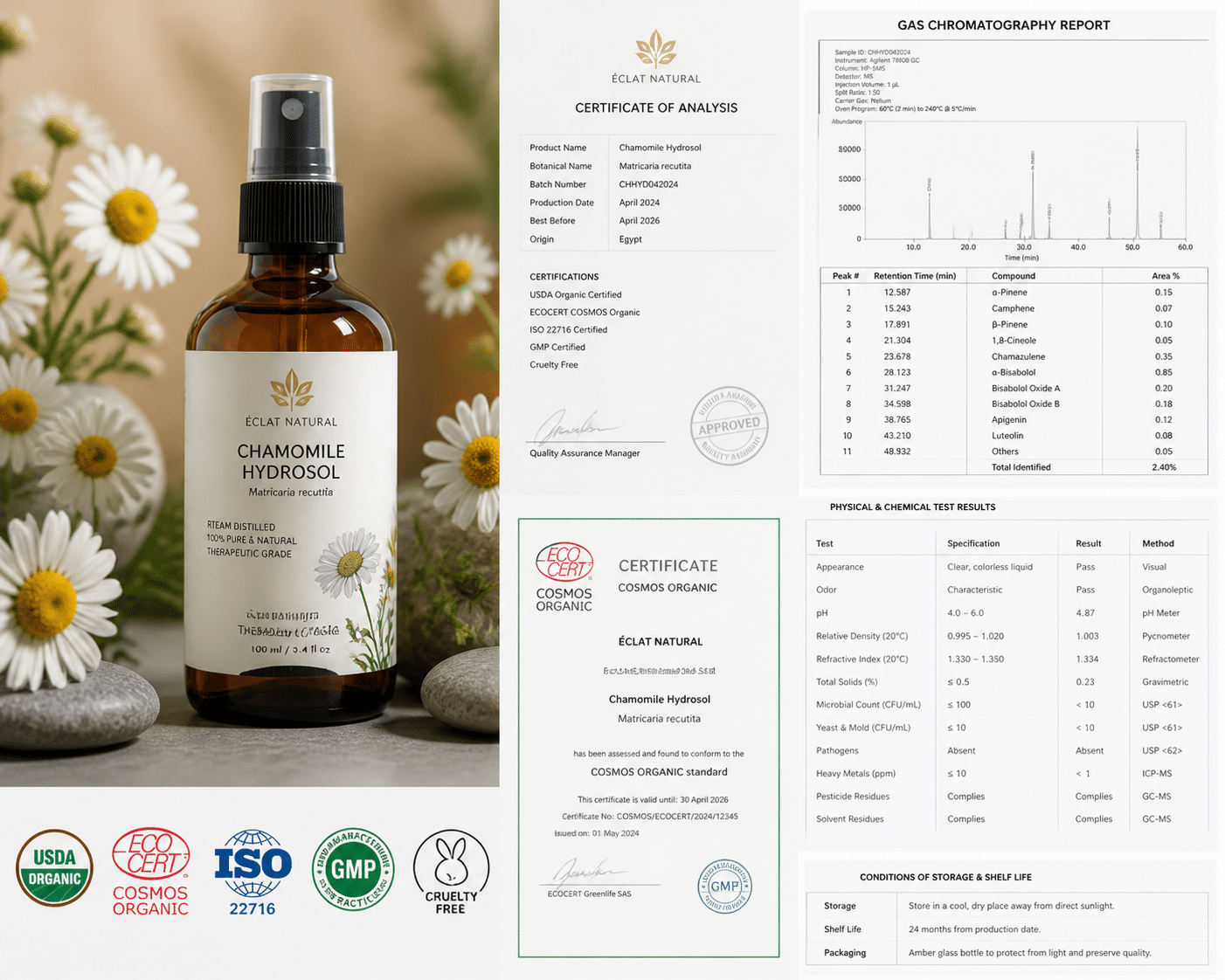
Here’s a nightmare scenario. You approve a pallet of chamomile water, the batch arrives, and it smells a little too perfect. Too strong, too sweet. Turns out someone stirred in fragrance to hide a weak product. Not fun.
Let’s make sure that never lands on your desk.
Paperwork First: COA and GC-MS Reports
Start with the Certificate of Analysis (COA). Ask for one for every batch, not a sample PDF from two years ago. It should list pH, specific gravity, microbial counts and the preservative system.
Then ask for the GC-MS report. This is a chemical fingerprint of what’s in the bottle. And you want the full chromatogram and peak table, not a line saying “GC tested.” One technical source on chamomile materials reports that German chamomile hydrosol holds only about 20 to 80 ppm of alpha-bisabolol. So if a report shows essential-oil-level numbers, something’s off. The water may have been boosted.
Also look for odd peaks. Linalool, limonene, geraniol or synthetic musks that don’t fit the species are red flags. And ask the supplier to confirm, in writing, that there are no synthetic fragrances or solubilizers in the water.
Know Where Your Flowers Come From
Paperwork only tells part of the story. You also want to know how the water was made.
Ask which species it is (German or Roman, they aren’t interchangeable). Ask where the flowers grew, how they were distilled, and how the finished water was stored. A supplier that manages the whole chain, from raw material to final delivery, can answer these fast. Aroma Monk, for example, backs its ingredients with lab testing and traceability, which is the kind of openness you should expect from any partner. A hydrosol supplier article makes the same point: without batch GC-MS/FID analysis, you can’t really confirm purity.
If they dodge the farm question? That’s an answer too.
Supplier Vetting Checklist
- Can you send a batch-specific COA and a full GC-MS chromatogram, not just a summary?
- Which botanical species is this (Matricaria recutita or Chamaemelum nobile), and how do you verify it?
- Is this a true steam-distilled hydrosol, with no added essential oil, synthetic fragrance or solubilizers?
- What preservative system is already in the water, at what level, and is it listed on the safety data sheet?
- Can you trace each lot back to the farm and the still?
- How do you test for microbes, and how often?
- Can I get a sample first, plus details on MOQ, lead time and shelf life?
What Cheap Hydrosol Really Costs
A low price per liter looks great until a batch goes cloudy in the warehouse. Then you’re paying for recalled stock, repeat stability testing and delayed launches.
The reputation hit is worse. Shoppers with sensitive scalps are the exact people who react to hidden fragrance or a bad preservative. One bad review thread can undo months of careful positioning.
So the cheapest quote is rarely the cheapest result. A transparent bulk partner saves you money by being boringly consistent.
Solid sourcing sets you up well. Next, let’s wrap up what this means for your next formula.
Embrace Gentle Efficacy: Make Chamomile Water Your Next Hero Ingredient
So where does that leave us? Chamomile water for hair isn’t a magic growth potion. But it’s a smart, gentle ingredient that does what shoppers actually want: it helps a scalp feel calm and comfortable. It mixes easily into mists, shampoos and serums. It gives you honest, defensible claims. And it fits a market that keeps asking for scalp care that works.
The formula only goes as far as the raw material allows, though. A beautiful concept can still fall flat if the water inside is weak, boosted with fragrance, or poorly preserved. Batch-level paperwork, a clear species, and a traceable source are what turn a nice idea into a product you can stand behind.
So start small. Test a sample in your own base. Check the pH, the smell, the stability. Then build your story on what you can prove.
That’s the whole recipe, really. Good ingredient, honest claims, a supplier who shows their work.
Ready to elevate your hair care line with certified pure chamomile water?
Contact Aroma Monk to request a sample, specification sheet, and bulk pricing.
Tell them your product format and target market. You’ll get lab-tested, traceable material and the technical documents your team needs to move forward.
Get a quote from Aroma Monk.
Essential Oil Supplier – Bulk pricing • Samples • Fast response