
Introduction: Crafting Your Signature Scent, Naturally
“A fragrance is like a signature,” says designer Aerin Lauder. It tells people who you are before you even say a word.
But lately? That signature scent often comes with a list of unpronounceable ingredients. If you have ever walked through a department store perfume aisle and instantly felt a headache coming on, you know exactly what I mean.
We are all getting a bit smarter about what we put on our skin. Actually, the shift is huge. The natural fragrance market is growing fast and is projected to reach over $7.2 billion by 2034. Why? Because people want clean beauty without the mystery chemicals.
But here is the tricky part.
Making your own essential oil perfume roller can feel… distinctively scary. You hear words like “top notes,” “fixatives,” and “ratios,” and suddenly it feels like a chemistry final you didn’t study for. Maybe you tried a DIY perfume roller before and ended up smelling like a household cleaner. It happens.
Don’t worry.
This guide is going to fix that. We are going to demystify the process and make scent blending simple. No complex math, just easy steps to create a natural fragrance roller that is safe, balanced, and 100% unique to you.
Let’s get mixing.
1. The Anatomy of a Perfume Roller: Understanding the Core Components
You don’t need a chemistry degree or a lab coat to make a natural fragrance roller. You actually only need three main things. It is simpler than baking a cake.
Let’s break down the parts so you know exactly what to buy.

1. Essential Oils
This is the star of the show. These are the super-concentrated plant extracts that give your blend its scent. And when I say concentrated, I mean it. A single drop packs a huge punch.
Because these oils go right onto your skin, quality is a big deal. You want pure oils without any weird synthetic fillers. This is where sourcing matters—companies like Aroma Monk are great because they test their oils in a lab to make sure they are 100% pure. If you start with bad ingredients, you will end up with a bad perfume.
2. Carrier Oils
Here is a secret. You can’t just put essential oils straight onto your skin. They are too strong and can cause itching or burning. You need to dilute them first.
That is where the carrier oil for perfume roller blends comes in. It acts as a base to dilute the potent oils and helps the scent stick to your skin longer.
Here are the top choices:
- Jojoba Oil: This is my personal favorite. It is actually a liquid wax that feels just like your skin’s natural oils. It has a long shelf life and doesn’t smell like anything.
- Fractionated Coconut Oil: This is coconut oil that stays liquid. It is very light, clear, and absorbs fast so you don’t feel greasy.
- Sweet Almond Oil: This is a classic option that is very moisturizing. Just skip it if you possess a nut allergy.
3. The Roller Bottle
You might be tempted to buy those clear, pretty glass bottles you see on Pinterest.
Don’t do it.
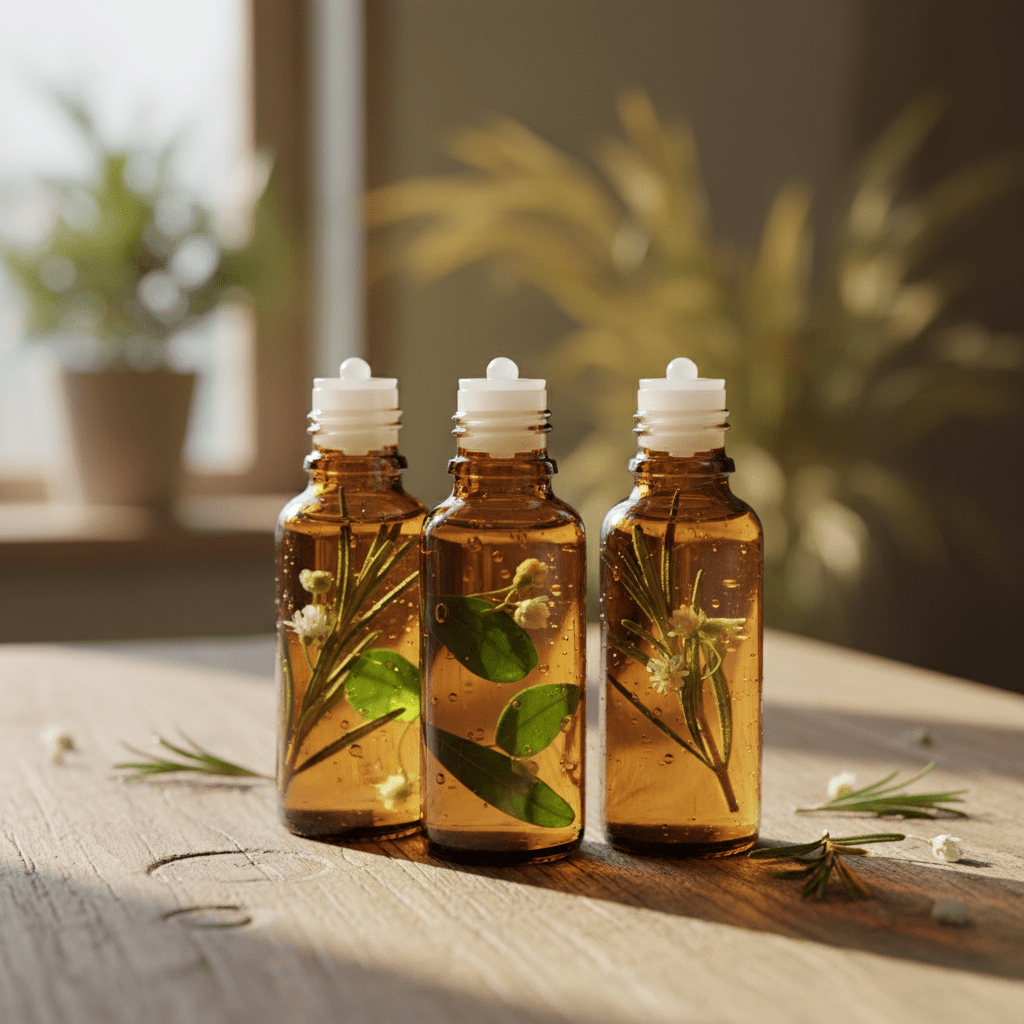
Light is the enemy of essential oils. Sunlight breaks down the scent and ruins the therapeutic properties. You need a perfume roller bottle made of dark glass—usually amber (brown) or cobalt blue. This dark glass acts like sunglasses for your oil, protecting it from UV rays and UV degradation.
Also, pay attention to the roller ball itself. Look for stainless steel balls instead of plastic ones. The plastic ones tend to get stuck or leak, while the metal ones roll smoothly and feel nice and cool on your wrists.
So, you have your oils and your bottles. Now, we need to figure out which scents actually go together.
2. The Art of Scent: Decoding Top, Middle, and Base Perfume Notes
Have you ever sprayed a perfume, loved it immediately, but hated it an hour later?
Or maybe the opposite happened. You weren’t sure at first, but by the end of the day, you couldn’t stop sniffing your wrist.
That isn’t an accident. It happens because a good essential oil perfume roller isn’t just one smell. It is a story that changes over time.
Perfumers call these changes “notes.”
Think of it like a musical chord. You need different notes playing at the same time to make a beautiful song. In perfume, we group these into three layers: Top, Middle, and Base.
Understanding this is the secret to scent blending techniques that actually work. If you just throw random oils together, you get a muddy mess. But if you balance them right? You get magic.
Let’s break down the layers.
Top Notes: The First Impression
This is the “Hello!” of your perfume.
Top notes are the first thing you smell when you open the bottle or roll it on your skin. They are fresh, sharp, and grab your attention immediately.
But here is the catch. They don’t stick around.
Top notes are made of tiny, light molecules that evaporate very quickly—usually within 30 minutes to maybe 3 hours. Their job is to hook you in and introduce the scent.
- Common Scents: Lemon, Grapefruit, Peppermint, Bergamot, Eucalyptus.
- Vibe: Energizing, happy, clean.
Middle Notes: The Heart
Once the top notes wave goodbye, the middle notes show up.
We call this “the heart” of the fragrance because it makes up the main body of your blend. It is usually softer and more rounded than the sharp top notes. These scents are the ones you smell for most of the day, hanging around for about 2 to 4 hours.
If you are making a floral natural fragrance roller, this is where those flowers usually live.
- Common Scents: Lavender, Geranium, Chamomile, Rosemary, Black Pepper.
- Vibe: Balancing, warm, floral.
Base Notes: The Soul
Finally, we have the base notes.
These are the heavy lifters. Literally. The molecules in these oils are heavy and thick, which means they take a long time to evaporate. They can last on your skin for 12 to 48 hours depending on the oil.
Base notes add depth and richness. But they have another cool job, too. They act as a “fixative.” This means they grab onto the lighter top and middle notes and help hold them to your skin, making your whole perfume last longer.
Without base notes, your scent would vanish before lunch.
- Common Scents: Cedarwood, Patchouli, Frankincense, Vetiver, Vanilla (often as Benzoin).
- Vibe: Grounding, deep, mysterious.
The Golden Ratio: 30-50-20
So, how do you mix them? You can’t just use equal parts of everything.
If you put in too much peppermint (top note), you will never smell the sandalwood (base note). If you use too much patchouli, you might smell like a basement.
Beginners should start with this classic formula:
- 30% Top Notes
- 50% Middle Notes
- 20% Base Notes
This balance gives you a nice opening, a strong heart, and a lasting finish.
Here is a quick cheat sheet to help you sort your oils:
| Note Type | Evaporation Time | Role | Popular Examples |
|---|---|---|---|
| Top | 0.5 – 3 Hours | The First Impression | Citrus (Lemon, Orange), Mint, Basil |
| Middle | 2 – 4 Hours | The Main Body | Flowers (Rose, Ylang Ylang), Spices |
| Base | 12 – 48+ Hours | The Foundation | Woods (Cedar), Resins, Roots |
When you buy oils from places like Aroma Monk, they often list the note type on the site. This helps a ton when you are planning your blend.
Now that you speak the language of notes, we need to pick the specific oils that fit your mood.
3. The Perfumer’s Palette: Grouping Oils by Scent Family
Okay, so you understand the notes now. You know that top notes fade fast and base notes hang around until tomorrow.
But you might be looking at a table full of dark amber bottles and wondering, “Does this wood smell actually go with this flower smell?”
It is a valid question.
Actually, it is the biggest hurdle for most beginners. You don’t want to waste expensive drops on a blend that ends up smelling like a weird science experiment.

Here is the cheat code: Scent Families.
Just like colors on a wheel, scents have groups. When you understand these families, blending becomes intuitive rather than a guessing game. It is one of the most practical scent blending techniques you will ever learn.
Most essential oils fit into one of these main buckets:
- Citrus: Fresh, fruity, and happy. Think Lemon, Orange, or Bergamot.
- Floral: Sweet, romantic, and flowery. Like Lavender, Rose, or Jasmine.
- Woody: Warm, dry, and grounding. Cedarwood, Sandalwood, and Pine live here.
- Earthy: Rich, soil-like, and deep. Vetiver and Patchouli are the heavy hitters.
- Herbal: Green, sharp, and clean. Rosemary, Basil, and Peppermint.
- Spicy: Hot, exotic, and intense. Ginger, Clove, and Cinnamon.
Complementary Blending
Now for the fun part. How do we mix them without making a mess?
The easiest way to start is by picking just two families that balance each other out.
Think about cooking. You wouldn’t just eat a bowl of hot sauce, right? You mix it with something mild to balance it. Aromatherapy roller blends work the same way. Unlikely pairs often make the best team.
Here are three combinations that almost never fail.
1. Citrus + Floral (The Happy Blend)
This is a classic for a reason. The bright zest of the fruit lifts up the heavy sweetness of the flower. It feels like walking through a sunny garden.
- Try this: Sweet Orange (Citrus) + Lavender (Floral).
2. Woody + Spicy (The Cozy Blend)
This is perfect for darker, colder months or when you just want to feel grounded. It is warm, comforting, and smells very sophisticated.
- Try this: Cedarwood (Woody) + a tiny bit of Ginger (Spicy).
3. Herbal + Citrus (The Focus Blend)
If you need to wake up your brain before a meeting, this is it. The sharp herbs cut through the fruity sweetness for a really clean, crisp smell.
- Try this: Rosemary (Herbal) + Lemon (Citrus).
A quick pro tip: Not all families fight fair. Spicy and Earthy oils are bullies. They are incredibly strong. If you blend a drop of Cinnamon with a drop of Lemon, you will only smell the Cinnamon. When using those strong families, use a very light hand.
Also, purity changes everything here.
A synthetic lavender might smell like soap, but a pure essential oil captures the whole plant’s complexity. That is why getting lab-tested oils from places like Aroma Monk makes your DIY project smell expensive rather than cheap. You need the real deal to get the families to sing together.
“Your fragrance should be as unique as you are,” says master perfumer Marian Bendeth celebrating individuality in scent.
By mixing these families, you aren’t just following a dull recipe. You are crafting something personal.
So, you have your oils picked out. Now, let’s get to the actual mixing.
4. Essential Scent Blending Techniques for Harmonious Perfumes
Ready to mix?
Wait. Put the bottle down.
The specific mistake most beginners make is mixing everything directly in the roller bottle immediately. If you mess up the ratio there, there goes your whole batch. You have to dump it out.
Money down the drain regarding your expensive ingredients.
Instead, we are going to play scientist for a minute. Don’t worry, it’s the fun kind. To save your oils (and your sanity), try these three testing methods first.
1. The ‘By the Drop’ Method
This is the safest way to start. It is basically the “taste test” of perfumery.
Grab a cotton pad or a few paper testing strips. You don’t need fancy equipment; a chopped-up index card works too.
Here is how to do it:
- Start with the Base: Put one drop of your base oil (like Cedarwood) on the cotton.
- Add the Heart: Add one drop of your middle note (like Rose).
- Top it Off: Add one drop of your top note (like Bergamot).
Now, wave it under your nose. Do you like it? Does the Rose take over everything? If it’s too flowery, add another drop of Cedarwood.
Keep adding one drop at a time until you think, “Yes, that is the one.” Write down exactly how many drops you used. That is your recipe.
2. The ‘By the Note’ Method
If guessing feels too chaotic for you, use a formula.
Remember that 30-50-20 rule we talked about? Let’s turn that into actual drops for a test blend. This is great for structure.
Try this mix on your testing strip:
- 3 drops Top Note
- 5 drops Middle Note
- 2 drops Base Note
This gives you a total of 10 drops. It is a perfect micro-batch. If you love it, you can easily scale it up for your full DIY perfume roller bottle later.
Just keep in mind, this is a starting point. Your nose is the final boss. If you feel like it needs more zing, add more top notes. Trust your gut.
3. The ‘By Family’ Method
Sometimes you don’t care about the math. You just want a specific vibe.
This method is about picking a theme.
Want to feel like you are walking in the woods? Focus on the Woody and Earthy families. Pick 2-3 oils that fit that description—maybe Pine, Vetiver, and a tiny bit of Lemon to represent the sun filtering through the trees pairing aromatic notes.
A Fix for ‘Nose Fatigue’
Here is a weird thing that happens.
After smelling three or four blends, your nose will quit. Everything starts smelling the same. We call this “olfactory fatigue.”
If you can’t tell the difference between Jasmine and Ginger anymore, stop.
Sniff some coffee beans. The strong smell resets your palate. If you don’t have coffee, sniff your own elbow (seriously, the unscented skin helps reset your nose).
Take your time with this part. The best scent blending techniques require a little patience. Once you have your winning ratio written down, you are finally ready to bottle it up.
5. Your First DIY Perfume Roller: 3 Fail-Proof Recipes
Okay, you have done the sniff test. You survived the “nose fatigue.” You have a winning combo written on a scrap of paper somewhere.
Now, let’s make it official.
Building your first DIY perfume roller is surprisingly fast. Actually, the whole process takes about five minutes once you have your supplies. We are going to use a standard 10ml roller bottle for these recipes. This size is perfect for tossing in your bag or pocket.
Here is exactly how to make roll on perfume with essential oils without making a mess.
The Step-by-Step Process
- Add the Scents: Take the cap off your empty glass bottle. Carefully drop in your essential oils first. It is way easier to count the drops when the bottle is empty.
- The Swirl: Before adding the carrier oil, give the essential oils a gentle swirl at the bottom. This helps them marry together.
- Top It Off: Grab your carrier oil for perfume roller blends (Jojoba or Fractionated Coconut Oil). Use a small funnel or a pipette to fill the bottle. Stop just below the neck—you need to leave room for the roller ball insert.
- Snap It Shut: Push the roller ball insert into the opening. You usually need to push down hard until you hear a satisfying click.
- Label It: Don’t trust your memory. You think you will remember that this one is “Relaxation” and that one is “Energy,” but in two weeks, they will just look like two identical amber bottles. Get creative with stickers or washi tape, customizing your labels.
3 Recipes to Get You Started
If you aren’t ready to experiment with your own blends yet, don’t worry. I have got you covered.
These essential oil blend recipes for rollers use the safe dilution ratio we talked about earlier (about 10 drops per 10ml bottle). This is roughly a 3-5% dilution, which is generally safe for adult skin.

1. Uplifting Sunshine (The Energy Boost)
This is my go-to for Monday mornings. It is bright, happy, and wakes up your brain instantly.
- 5 Drops Sweet Orange
- 3 Drops Grapefruit
- 2 Drops Peppermint
Heads up: Since this uses citrus oils, be careful in direct sun! Citrus loves UV rays a little too much and can cause sunburn avoid sun exposure.
2. Serene Garden (The De-Stresser)
Feeling frazzled? This floral and woodsy blend feels like a deep breath. It is grounding without being too heavy.
- 5 Drops Lavender
- 4 Drops Cedarwood
- 1 Drop Ylang Ylang
3. Deep Focus (The work Horse)
When you need to power through a to-do list, skip the third coffee and try this. The herbs and earthiness help clear the fog.
- 3 Drops Bergamot
- 5 Drops Lemongrass
- 2 Drops Patchouli
Give the bottle a good shake before you roll it on your wrists or behind your ears. The warmth of your skin will do the rest.
6. Safety First: Dilution Guidelines and Best Practices
This is the part most people want to skip.
It is not as fun as mixing scents. But honestly? It is the only thing standing between you and a nasty skin rash.
Essential oils are powerful. Really powerful. A lot of beginners think, “If I want a stronger smell, I will just add more oil.”
Please do not do that.
Using essential oils “neat” (which means undiluted, straight from the bottle) can burn your skin or cause an allergic reaction that lasts for weeks. I learned this the hard way with some Cinnamon Bark oil a few years ago. It was not pretty.
The Magic Number: 2-3%
To keep your natural fragrance roller safe, you need to stick to a specific ratio.
For a daily-wear perfume on an adult, a 2-3% dilution is usually perfect. It is strong enough to smell great but safe enough to use every day.
Here is a simple chart for a standard 10ml roller bottle so you do not have to do the math:
| Bottle Size | Dilution Strength | Drops of Essential Oil | Carrier Oil Amount |
|---|---|---|---|
| 10ml Roller | 1% (Subtle) | 3 Drops | Fill the rest |
| 10ml Roller | 2% (Standard) | 6 Drops | Fill the rest |
| 10ml Roller | 3% (Strong) | 9 Drops | Fill the rest |
Stick to 6-9 drops total. That includes your top, middle, and base notes combined.
Watch Out for the Sun
Did you know some oils can basically give you a sunburn in a bottle?
It sounds crazy, but it is true. Certain citrus oils are “phototoxic.” This means if you put them on your skin and then go out in the sun, they can cause severe blistering or discoloration.
The main culprits are cold-pressed Lemon, Lime, Grapefruit, and especially Bergamot.
If you want to use these in a summer blend, look for “steam-distilled” versions instead. The steam process removes the chemical that reacts with UV light. If you must use the cold-pressed kind, just make sure you apply it somewhere the sun will not shine, like behind your ears or under your shirt.
The 24-Hour Patch Test
Before you roll that new creation all over your neck, do a quick test run.
- Put a small amount of your diluted blend on the inside of your elbow.
- Wait 24 hours.
- Look at it.
If there is no redness or itching, you are good to go.
It takes an extra day, but it is better than finding out you are allergic to Ylang Ylang five minutes before a big date.
Conclusion: Embrace Your Inner Perfumer
You made it. High five.
We have covered a ton of ground here. You know your top notes from your base notes. You understand why dark glass matters. You even know how to avoid turning your arm red with the wrong citrus oil.
But here is the most important thing to take away from this entire guide.
There is no “wrong” way to create art.
Sure, we have rules for safety and ratios for balance. But once those are safe, the rest is just play. Albert Einstein once said, “Creativity is intelligence having fun,” and that is exactly what this should be: intelligence having fun.
Don’t be afraid to make a weird blend.
Maybe you mix Basil and Ylang Ylang and it smells terrible. That isn’t a failure. That is just data. You learned something. But maybe, just maybe, you mix two oils that “shouldn’t” go together, and it ends up being the best thing you have ever smelled.
That is the joy of an essential oil perfume roller. It is 100% yours.
So go ahead. Grab your oils, trust your nose, and start mixing.
And hey, if you stumble upon a magical combination that smells amazing? Don’t keep it a secret. We want to see what you made! Tag us @AromaMonk on social media or drop your recipe in the comments below so we can try it too.
Happy blending.