

The Rising Demand for Natural Dandruff Solutions and the Role of Chamomile Water
Picture a shopper standing in the hair care aisle, flipping a dandruff shampoo bottle around. She squints at the ingredient list. Then she puts it back. Sound familiar?
That small moment is happening everywhere. People want a calmer scalp, but they don’t want a harsh, medicinal-smelling wash to get it. Innova Market Insights reports that 60% of consumers globally seek natural ingredients, and the shift is hitting scalp care hard.
Market snapshot: Mordor Intelligence estimates the global natural hair care market at $24.05 billion in 2025, rising to $33.78 billion by 2031 (about 5.9% growth per year).
So where does chamomile water for hair fit in? It’s a gentle, soothing botanical water with a long track record in skin and scalp care. It’s also an easy story to tell on a label. One honest note, though: the science supports chamomile for soothing, not for treating dandruff on its own. We’ll keep that line clear.
This guide is for product developers, procurement managers and brand owners. We’ll cover what chamomile hydrosol for scalp care really is, how it behaves in a formula, how to position it, and how to source it in bulk.
What is Chamomile Water? A Deep Dive for Cosmetic Formulation

Let’s clear up a name mix-up first. “Chamomile water” shows up on supplier sheets for a few very different things. Some are real. Some aren’t. Knowing which is which saves you a lot of headaches later.
Chamomile Water Is a Hydrosol
Think of a pot with a lid. Steam rises, hits the cool lid, and drips back down as water. Steam distillation works the same way, just on a bigger scale. Fresh chamomile flowers sit in a still, steam passes through them, and the vapor is cooled. The Formulator’s Guide to Hydrosols explains that this cooled condensate splits in two: a tiny layer of essential oil and a much bigger layer of water. That water is the hydrosol.
So a true chamomile hydrosol is the aromatic co-product of the distillation. It isn’t essential oil stirred into water with a solubilizer. That second type does exist, and it’s sold under the same name. Formula Botanica’s guide to spotting fake hydrosols says these look-alikes often contain about 1% or less essential oil. Always ask how it was made.
Hydrosol vs. Essential Oil vs. Tea
Here’s a quick side-by-side.
| Chamomile hydrosol | Chamomile essential oil | Chamomile tea | |
|---|---|---|---|
| How it’s made | Steam distillation, the water part | Steam distillation, the oil part | Flowers steeped in hot water |
| Mixes with | Water | Oils (not water) | Water |
| Strength | Gentle, light | Very concentrated | Weak, varies a lot |
| Key compounds | Water-soluble and trace volatile compounds | Bisabolol oxides, chamazulene and other oil-soluble compounds | Plant pigments and flavonoids, no distillation |
| Best cosmetic use | Scalp mists, toners, water phase of shampoos and conditioners | Tiny amounts in oil phases, with care | Home use, not a reliable raw material |
One trap to avoid: a hydrosol isn’t just a diluted essential oil. The chemistry is different. In a 2025 analysis of 22 chamomile oils, α-bisabolol oxide A ranged from 12.31% to 45.66%. Hydrosols carry only trace-to-low levels of these compounds. So don’t copy oil numbers onto a hydrosol spec sheet. Ask for a batch-specific certificate of analysis instead.
German or Roman: Which Fits Your Formula?
Two plants get the “chamomile” label, and they aren’t twins.
- German chamomile (Matricaria recutita): Known for chamazulene, the compound that turns the oil blue. It’s the usual pick for anti-inflammatory scalp ingredients and soothing claims.
- Roman chamomile (Chamaemelum nobile): Softer, sweeter, a bit apple-like in scent. It’s a good fit when you want a mild fragrance story.
The pH differs too. Bioflore’s organic Roman chamomile hydrosol averages 3.2, while Avena Lab’s German blue chamomile hydrosol is specified at 4.5 to 7.0. Hmm, that’s a wide gap.
My take: for scalp care, start with German chamomile. Just confirm the species on the label and the paperwork. Next, let’s look at what the science really says about it.
The Science: Why Chamomile Water Effectively Combats Dandruff and Scalp Irritation

Here’s the honest version, because your customers (and regulators) will test it. Chamomile water is great at calming an irritated scalp. It isn’t a proven dandruff killer. Once you see where it helps in the dandruff cycle, the claim you can make gets clearer.
The Soothing Side: Bisabolol and Chamazulene
Dandruff isn’t only flakes. It’s usually flakes plus itch plus redness, and that itch-scratch loop keeps things going.
This is where chamomile’s best-known compounds come in. Bisabolol and chamazulene are both linked to anti-inflammatory scalp ingredients and soothing claims. A 2022 review in Nutrients described a double-blind study where a cream with 0.3 g of α-bisabolol per 100 g, used twice a day for eight weeks, was tied to less itching and inflammation. A separate trial of 278 people found that a heparin and levomenol blend (levomenol is another name for bisabolol) eased itching better than either ingredient alone.
Now the fine print. Those studies were on eczema-type skin, and the creams held other actives. Lab and mouse work also shows bisabolol cutting TNF-α and IL-6 inflammation signals, but that’s not proof for a human scalp. And remember the earlier point: a hydrosol holds only trace amounts of these compounds. So think “gentle soothing support,” not “strong dose.”
What the research supports: Formulas with bisabolol have clinical backing for easing some itching and redness. Evidence for chamomile hydrosol itself, and for dandruff caused by Malassezia globosa, is still thin.
What About the Fungus?
Malassezia is the yeast most tied to dandruff. So does chamomile water fight it?
I looked hard, and I couldn’t find a reliable paper that tests chamomile hydrosol against Malassezia globosa. Some chamomile oils and extracts show antifungal action in the lab against other fungi. But oils and extracts are far stronger than a hydrosol. You can’t borrow their results. So don’t promise microbiome balance or fungus control on your label unless your finished product has its own test data.
Hydration Without the Stripping
Here’s the practical win. Harsh anti-dandruff washes can leave a scalp tight, dry and itchy, which feeds the cycle all over again. A water-based, mild botanical like chamomile hydrosol gives you a gentler base. It adds moisture and a calm feel instead of a medicated sting.
What I can’t tell you is that it regulates sebum. No solid data backs that for chamomile water. What you can say is that it suits both dry-flake and oily-feel scalps as a comfort-focused ingredient, since it doesn’t strip.
The Dandruff-Irritation Cycle at a Glance
| Stage of the cycle | What’s happening | Where chamomile water may help | Evidence level |
|---|---|---|---|
| 1. Yeast overgrowth | Malassezia feeds on scalp oils and leaves irritating by-products | Nothing proven for hydrosol | Not established |
| 2. Redness and itch | The scalp reacts with inflammation | Bisabolol and chamazulene support soothing | Moderate, mostly from bisabolol formulas |
| 3. Scratching and flaking | The scalp barrier gets damaged, flakes show up | Water-rich base adds moisture and comfort | Reasonable, as a gentle base |
| 4. Over-washing | Strong cleansers dry out the scalp, and the cycle restarts | Milder formula that doesn’t strip | Reasonable, depends on the full formula |
See the pattern? Chamomile water works best at stages 2 to 4. That’s a solid, honest story. Next, let’s look at how to build it into a real formula.
A Product Developer’s Guide to Formulating with Chamomile Water
Get a quote from Aroma Monk.
Essential Oil Supplier – Bulk pricing • Samples • Fast response
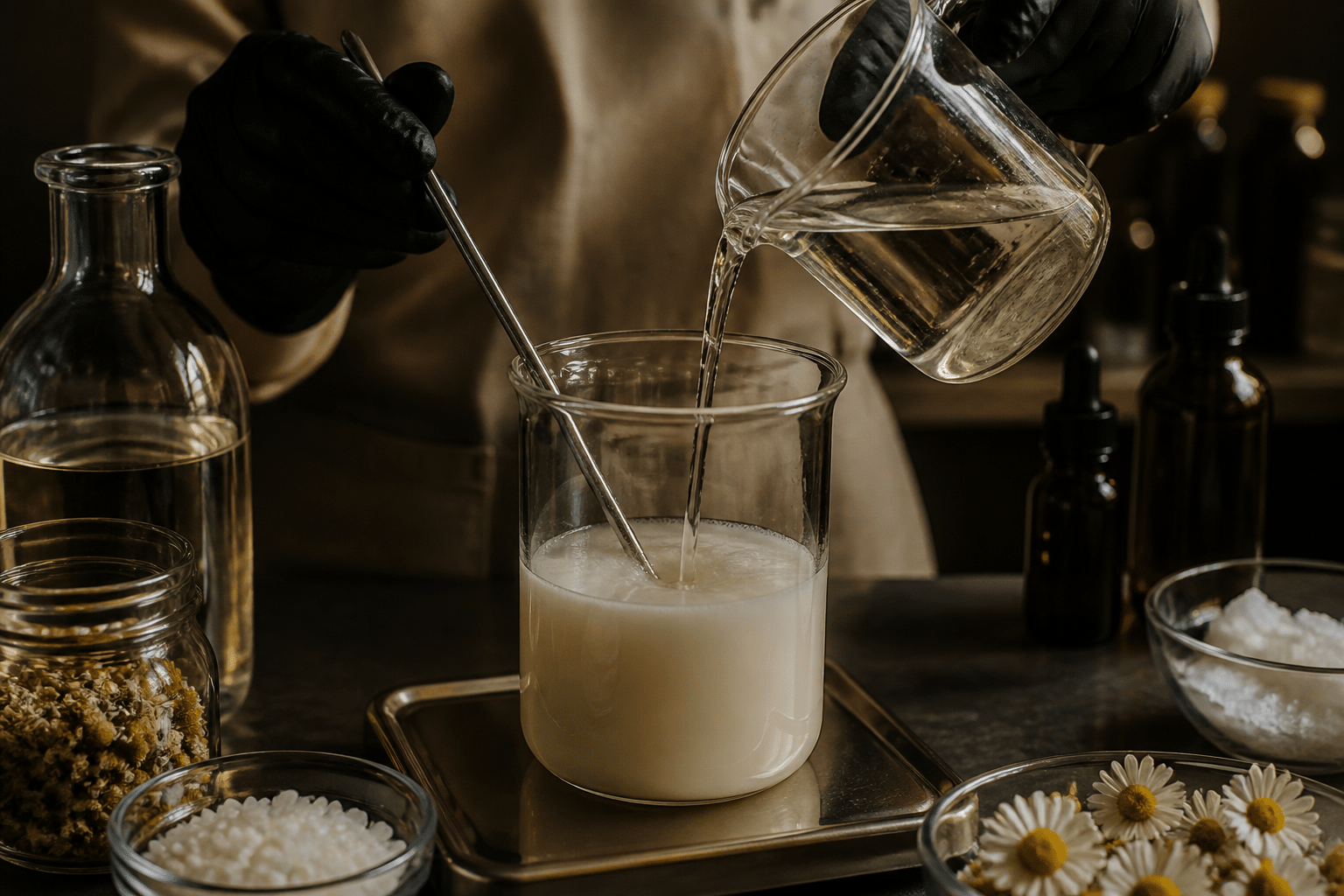
Good news first: chamomile water is easy to work with. It’s mostly water, so it slides into a lot of formulas without a fuss. The tricky parts are pH, preservation and setting honest expectations. Let’s walk through it.
Swapping It In for Deionized Water
The simplest move is to replace some of the plain water in a shampoo, conditioner or hair mask. Most teams start with a partial swap, usually 10% to 30% of the total formula. That’s enough to put “made with chamomile water” on the label and keep costs in check.
Can you go all the way and replace every drop of water? Sure. But think about the price, the pH shift and the extra preservation work first. I’d test a partial swap before going bigger.
One handling tip: add the hydrosol during the cool-down phase, below about 40°C (104°F). Heat can flatten the soft floral scent. And remember, the chamomile compounds in a hydrosol are trace amounts. This is a comfort ingredient, not a heavy hitter.
Making It the Star of Targeted Treatments
Here’s where chamomile water gets to shine. In scalp serums, soothing tonics and pre-shampoo treatments, it can make up the biggest part of the formula, often 30% to 50% or more. These products are light, leave-on and water-based, so the hydrosol does real work in the base.
A few pairings worth testing:
- Aloe vera: adds slip and a cool, calm feel.
- Tea tree hydrosol: gives a fresh, clean scent story (but don’t promise antifungal results without your own data).
- Salicylic acid: helps lift visible flakes. Careful, though. In the US, adding it for dandruff can turn your product into a drug claim.
- Panthenol or glycerin: keep the scalp feeling soft and hydrated.
Chamomile Water Formulation Matrix
| Product Type | Recommended % | Key Benefit | Synergistic Ingredients |
|---|---|---|---|
| Shampoo | 10% to 30% (partial water swap) | Gentle, calm-feel cleansing | Aloe vera, panthenol, mild surfactants |
| Conditioner | 10% to 30% | Softness and light moisture | Glycerin, panthenol, hydrolyzed oat protein |
| Hair mask | 10% to 25% | Soothing comfort, hydration | Aloe vera, plant oils, humectants |
| Pre-shampoo treatment | 20% to 50% | Preps a dry, tight scalp before washing | Aloe vera, tea tree hydrosol |
| Scalp serum | 30% to 50% | Comfort for itchy-feeling scalps | Panthenol, glycerin, low-level salicylic acid (check claims rules) |
| Soothing tonic or mist | 40% to 50%+ | Fresh, leave-on calm | Tea tree hydrosol, aloe vera, glycerin |
These are starting points, not rules. Your surfactants, thickeners and preservative can all change how a formula behaves, so run your own bench tests.
pH, Preservation and Stability
Pick your pH plan early. Supplier numbers swing a lot. Avid Sensory Wellness lists its chamomile hydrosol at pH 3.0 to 3.3, while the German blue spec we looked at earlier runs much higher. So treat the hydrosol’s pH as an input, not the finish line. Teravella’s dosage guide makes the same point: the final pH depends on the whole formula. Most hair products land around pH 4.5 to 5.5. Adjust slowly, then recheck after 24 to 48 hours.
Now, preservation. It’s the part people skip, and it bites back. An acidic hydrosol isn’t self-preserving, and freshly distilled hydrosols often sit around pH 4.5 to 5.0, which isn’t enough on its own. One formulation guide lists phenoxyethanol with ethylhexylglycerin at roughly 0.8% to 1.0% for pH 4.5 to 6.0 as a common starting point.
Pro-Tip: Want a more natural-leaning system? Look at benzyl alcohol with dehydroacetic acid (works around pH 4.0 to 6.0), or sodium benzoate with potassium sorbate for acidic toners (around pH 4.0 to 5.0). “Natural” doesn’t mean “no preservative.” Always confirm the choice with a preservative challenge test like ISO 11930 on the finished formula, in its final packaging.
Also check viscosity, color, smell and pH drift through freeze-thaw cycles. A batch that looks perfect on day one can surprise you on day thirty.
Once the formula holds up, the next question is how to tell the story on the shelf.
The Market Advantage: Positioning Your Brand with Chamomile-Based Hair Care
Walk down any dandruff aisle and you’ll notice the same thing. Clinical bottles. Bold “treatment” words. A lot of sameness. Chamomile gives your brand a different lane to stand in.
The Story Conventional Actives Struggle to Tell
Let’s be fair first. Zinc pyrithione works for plenty of people. But shoppers don’t always trust what they can’t pronounce. A Consumer Council test of 25 anti-dandruff shampoos found fragrance allergens in more than 90% of them, and zinc pyrithione in four products, even though the EU Cosmetics Regulation prohibits it. That’s the kind of headline that makes people squint at labels.
Dryness is the other sore spot. A 2025 scalp-care survey found 45% of women reported an itchy scalp and 41% a dry one in the past six months. So a gentle, water-based, calming-feel story lands right on a real frustration.
| Factor | Chamomile water | Conventional actives (like zinc pyrithione) |
|---|---|---|
| Efficacy | Soothing support, no proven dandruff action | Proven flake control (as an OTC drug in the US) |
| Gentleness | Mild, water-rich, doesn’t strip | Can feel drying or irritating for some |
| Consumer perception | Familiar, calming, plant-based | Medicinal, “chemical” |
| Formulation versatility | Fits shampoos, mists, serums, masks | Mostly rinse-off medicated washes |
| Marketing story | Comfort, freshness, gentle daily care | Strength, treatment, fast results |
See the trade? Chamomile won’t out-muscle a drug active. It wins on comfort and trust.
Clean Beauty Needs Proof
Educated shoppers read the back of the bottle. Market.us reports that 65% of consumers prefer clear ingredient lists and 74% value organic ingredients. Pretty telling.
The money side looks promising too. One scalp-care market estimate says clean scalp products reached about 12% of category sales, with 22% to 28% price premiums. (It’s a commercial report with no public method, so treat it as a direction, not a promise.)
So back up the story. Use a true, certified hydrosol. List the full INCI name. Keep batch certificates handy. A supplier like Aroma Monk, which stresses lab testing and traceability, makes that paper trail easier to build.
One Ingredient, Several Honest Claims
Chamomile water can support a few benefits at once: a soothed feel, gentle cleansing without stripping, and a light floral freshness with no medicinal smell. That’s a strong, believable bundle.
But skip the word “anti-dandruff.” The FDA says an anti-dandruff shampoo is both a cosmetic and a drug, because it’s meant to treat dandruff. Chamomile water alone can’t carry that claim.
Try wording like this instead:
- “Helps the scalp feel calm and comfortable”
- “Gentle daily cleansing”
- “Made with real chamomile water”
Smaller claims, yes. Also claims you can defend, which is the real edge. Next, let’s talk about how to buy the stuff without getting burned.
A Procurement Manager’s Checklist for Sourcing Bulk Chamomile Water

You’ve got the formula. You’ve got the story. Now comes the part where a bad batch can quietly wreck everything. A hydrosol that smells fine on a sample can still be watered down, mislabeled or just plain fake.
So here’s a simple checklist. Print it, tweak it, argue with it.
Start With a Current GC-MS Report
Ask for a gas chromatography-mass spectrometry (GC-MS) report on the exact lot you’re buying. Not a “typical” one from last year. And don’t settle for a line that says “passed.” Ask for the full chromatogram, the method used and the library matches.
Why so picky? Because hydrosols are mostly water, and the compounds you’re hunting for show up in tiny amounts. A report can look busy and still tell you nothing. Here’s what should make you pause:
- One or two fragrance-type compounds (like linalool) dominating, with no wider chamomile pattern around them
- Peaks that look identical across batches from different harvests (copy and paste, basically)
- Compounds that don’t belong in a steam distillate, like solvents
- No clear link to the species on the label
Species matters more than you’d think. Look-alike plants such as Anthemis and Tanacetum have been reported as chamomile adulterants in botanical products. Also cross-check the GC-MS against pH, microbial results and batch records. One document alone can’t prove authenticity.
The 10-Question Supplier Vetting Checklist
Send these in writing and ask for records, not promises. A 2026 B2B hydrosol buying guide also stresses checking botanical identity, pH, microbial purity, packaging and shelf life, so these fit right in.
| # | Ask this | A good answer looks like |
|---|---|---|
| 1 | Is it a true steam or hydro-distilled hydrosol? | Stated on the spec sheet, with distillation records |
| 2 | Which species, plant part and country of origin? | Latin name, region, cultivated or wild |
| 3 | Is it a primary distillate or diluted? | A clear yes or no, plus a full INCI list |
| 4 | Can I see three recent CoAs? | Lot numbers, dates, pH, microbial limits |
| 5 | When is harvest and distillation season? | Real months, with stock commitments |
| 6 | What happens in a poor crop year? | Written approval needed for any change |
| 7 | How is incoming plant material checked? | Botanical inspection, pesticide testing |
| 8 | Which preservative, and how much? | Named and documented, plus shelf life data |
| 9 | Which certifications cover the raw material? | Current certificates you can verify |
| 10 | Will you send a sample from the exact lot? | Yes, before the commercial order ships |
On certifications, ask whether the ingredient is certified, not just the brand. COSMOS and NATRUE are two names buyers trust, and both involve third-party checks. ISO 22716 is good for manufacturing quality, but it doesn’t make an ingredient natural or organic. Verify certificates with the certifier. Don’t just trust a PDF.
Why Buying Direct From the Manufacturer Helps
Brokers can be handy. But every layer between you and the still adds cost and hides information. When something looks off in a batch, you want to ask the person who actually ran the distillation.
Going direct usually gets you three things:
- Steadier supply. You can plan around harvest windows and agree on rolling forecasts.
- Better bulk pricing. No middleman margin stacked on top.
- Custom specs. Packaging sizes, pH ranges or preservation systems that suit your formula, which generic suppliers rarely offer.
That’s the model Aroma Monk follows, handling sourcing through to export delivery with lab testing and traceability built in. Whoever you choose, hold them to the checklist above.
Next, let’s wrap up what this all means for your product line.
Innovate Your Hair Care Line with the Power of Pure Chamomile Water
So, where does all this leave you?
Chamomile water is gentle, familiar and easy to work with. Shoppers already trust it, and it fits into shampoos, serums and mists without a fuss. It won’t replace a drug active, and we’ve said that plainly. But for a brand that wants a calm, honest scalp story, it’s a smart place to start. Pure chamomile water for hair can carry a believable promise: comfort, freshness and a scalp that doesn’t feel stripped.
The brands that win here usually do one thing well. They keep the claims small and the proof solid.
Your Action Plan for Launching a Chamomile-Based Product
Ready to move? Here’s a simple order of work.
- Step 1: Vet suppliers and ask for samples. Choose certified bulk suppliers, request recent CoAs and test a sample from the exact lot before you commit.
- Step 2: Task R&D with a pilot scalp serum. A serum is the easiest place to let the hydrosol lead. Test pH, preservation and stability early.
- Step 3: Build a marketing story around purity. Talk about real distillation, batch records and comfort. Skip the word “anti-dandruff.”
- Step 4: Run your own tests. Check irritation, compatibility and shelf life on the finished product, in its final packaging.
Need a partner for the sourcing part? Aroma Monk supplies natural ingredients in bulk, with lab testing and traceability, straight from the manufacturer. You can reach out to Aroma Monk to ask about samples and custom specs.
Where Scalp Care Is Heading
Here’s my honest read. Shoppers are done with harsh, one-note products. They want scalp care that feels good, works with the skin and tells the truth on the label. Multifunctional botanicals, backed by clean sourcing and careful testing, fit that shift well.
Chamomile water won’t be the whole answer. But as a calm, plant-based foundation for the next wave of scalp care, it’s a very good bet.
Get a quote from Aroma Monk.
Essential Oil Supplier – Bulk pricing • Samples • Fast response