
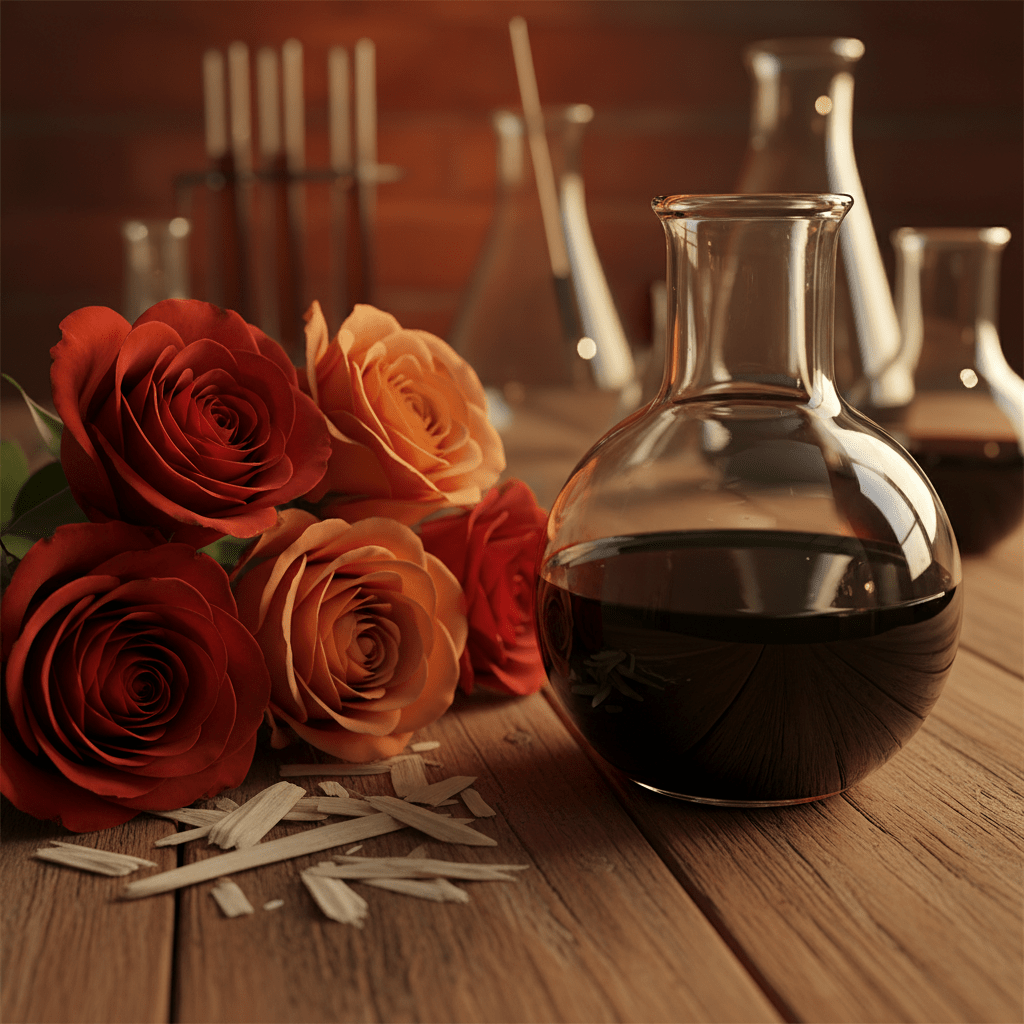
Beyond the Bottle: Discovering the Pure, Potent World of Essential Oil Perfume
Ever walked through the perfume aisle at a department store and felt an instant headache coming on? Or maybe you hugged a friend and spent the next hour sneezing?
You aren’t the only one.
Actually, it turns out that fragrance sensitivity affects approximately 30-32% of people. That means nearly one in three people you meet might feel sick around traditional perfumes.
So, why does something designed to smell “pretty” make us feel so awful?
The answer is hidden in the fine print.
For years, the beauty industry has used a little loophole. If they write “fragrance” or “parfum” on the label, they don’t have to list the actual ingredients. It’s like a secret recipe, but not the good kind. This umbrella term can hide dozens of chemicals. Even scarier? Studies confirm that up to 4% of these hidden fragrance chemicals are linked to serious health concerns.
But here’s the good news. You don’t have to give up smelling amazing.
This is where essential oil perfume changes the game.
Unlike those mystery bottles, natural perfume is transparent. It’s made from real plants, flowers, and woods. When you wear a plant-based fragrance, you aren’t just masking odors. You are wearing a scent that naturally works with your body, not against it.
Whether you are a creator looking to source pure ingredients for your own clean beauty fragrance line, or just someone who wants a chemical-free scent, the shift to botanical ingredients is the ultimate upgrade. It’s sophisticated, it’s safe, and honesty? It smells better too.
1. Deconstructing Conventional Perfume: What’s Hiding in a Synthetic Fragrance?
Ever try to read the back of a perfume box? It feels like you need a chemistry degree just to understand what you are putting on your skin.
But here is the real kicker.
Even if you read every single word, you still won’t see the full picture. That is because of the “fragrance loophole.”
Basically, regulations allow companies to list hundreds of different chemicals under a single word: “fragrance” or “parfum.” It’s designed to protect trade secrets (so nobody steals a signature scent), but it leaves the rest of us guessing.
It’s kind of wild when you think about it. You wouldn’t eat a candy bar that just listed “flavor” as the only ingredient, right? But we do it with perfume every day.
And we might be stuck guessing for a while. In the US, the FDA has actually delayed mandatory allergen labeling until May 2026, meaning brands don’t have to spill the beans on exactly what is in that bottle just yet.
Studies indicate that these regulations represent a significant shift in the industry.
The “Nasty” List
So, if they aren’t telling us what’s in there, what are we usually spraying on ourselves?
When we look at the battle of synthetic vs natural fragrance, the hidden ingredients are the biggest difference. Here are a few common guests at the synthetic party:
- Phthalates: Say that three times fast. These are often used as fixatives. They act like glue to make the scent stick to your skin for hours. The problem? They are known endocrine disruptors, which is just a fancy way of saying they can mess with your hormones.
- Synthetic Musks: These are cheap replacements for natural musk. But unlike the real deal, some of these compounds don’t break down easily. They can accumulate in the environment—and in our bodies.
Doctors are definitely paying attention. In fact, medical groups have formally noted that these hidden fragrance chemicals can cause debilitating side effects in sensitive people.
From Crude Oil to Eau de Toilette
Here is the part that usually surprises people.
Most clean beauty fragrance lovers assume that if a perfume smells like a rose, it started as a rose.
But for synthetic scents, the starting point is usually petroleum.
Yep. Crude oil.
The same stuff that fuels your car is processed in a lab to mimic the smell of vanilla, jasmine, or sandalwood. It’s chemistry, sure. But it’s not nature.

This is exactly why so many creators and brands are pivoting to non-toxic perfume. When you source authentic ingredients—like the pure oils and attars we handle every day at Aroma Monk—you aren’t just getting a better smell. You are getting a legitimate plant extract.
You skip the petroleum. You skip the phthalates. And you finally know exactly what you are wearing.
2. The Essence of Nature: What is an Essential Oil Perfume?
So, what exactly is an essential oil perfume?
It sounds fancy, but it is actually pretty simple.
At its heart, a true natural perfume is just two things: pure aromatic extracts from plants and a natural carrier to hold them. That’s it. No hidden preservatives, no colorants, and definitely no secret chemicals.
The carrier is usually something gentle like jojoba oil or organic sugarcane alcohol. It acts as the vehicle that delivers the scent to your skin.
But the real magic is in the extraction.
How We Catch the Scent
You can’t just squeeze a rose and expect perfume to come out. Well, actually, with citrus fruits like lemons or oranges, you can cold press the peels. It smells incredible.
But for delicate flowers or woods, we usually use steam distillation.
Ideally, we pass steam through the plant material. The steam picks up the volatile oils—the plant’s “soul,” if you want to get poetic about it—and then cools down to turn back into liquid. The oil floats on top, and boom. You have essential oil.

This method is the gold standard because it doesn’t leave behind nasty residues. On the other hand, some commercial methods use chemical solvents like hexane to strip the scent out. While that gets you more oil, it makes the final product less natural according to holistic standards.
The “Fragrance Oil” Trap
Here is where it gets tricky.
You might see bottles labeled “Blueberry Muffin Fragrance Oil” or “Ocean Breeze Scent.”
Don’t be fooled.
Unless blueberries suddenly started growing oil glands, that is a synthetic lab creation. These “fragrance oils” might smell okay, but they are lifeless. They are flat. They don’t have the complex chemical structure of a plant.
Real essential oils are complex. They are made of hundreds of natural compounds that actually interact with your body.
For example, lavender oil contains a compound called Linalool. It doesn’t just smell nice; it actually communicates with your brain. Research shows that Linalool interacts with your system to meaningful reduce anxiety.
That is the difference between an aromatherapy perfume and just smelling like a candle.
One is a chemical soup. The other is a functional tool that can shift your mood.
This is why sourcing matters so much. At Aroma Monk, we see this constantly—brands trying to cut corners with “nature-identical” oils. But if you want the benefits of botanical perfume, you need the real thing. It’s not just about smelling good; it’s about feeling good, too.
Get a quote from Aroma Monk.
Essential Oil Supplier – Bulk pricing • Samples • Fast response
3. The Health & Wellness Advantage: Breathe Easy with Natural Perfumes
You know how we talked about that instant headache earlier?
When you switch to an essential oil perfume, that typically disappears.
It’s like walking out of a crowded, stuffy room into fresh, open air.
But why does this happen?
It pretty much comes down to what your body recognizes. Your biological system has evolved alongside plants for thousands of years. It knows what a rose is. It knows what cedarwood is.
It definitely has no idea what diethyl phthalate is (and honestly, neither do I half the time).
Your Skin Will Thank You
One of the biggest complaints we hear at Aroma Monk isn’t even about the smell. It’s about the itch.
Contact dermatitis is a real problem. And it’s frustrating.
Because traditional perfumes hide so many ingredients behind that “fragrance” label, you never know which chemical is making your skin red and angry. It’s a guessing game you usually lose.
But things are changing.
New rules are starting to force the industry’s hand. In fact, regulators in places like the EU are now updating mandates to disclose over 80 specific allergens that were previously flying under the radar. That is a huge list of potential irritants hiding in your fancy bottle.
Regulations are finally catching up to what our bodies already know.
When you choose a non-toxic perfume, you eliminate the mystery. If you are allergic to roses, you just don’t wear the rose blend. Simple. No hidden triggers.
More Than Just a Pretty Smell
Here is the coolest part. Useing a plant-based fragrance actually does something to your brain.
Since these scents are made from living plants, they carry the plant’s therapeutic properties. This is what separates a standard scent from a true aromatherapy perfume.
Take citrus oils, for example.
Smelling a lemon, orange, or bergamot peel doesn’t just make you think of summer. It changes your brain chemistry.

Citrus oils are generally high in a natural compound called Limonene. It’s a powerhouse for your mood.
Actually, clinical tests show that Limonene has anxiety-reducing effects comparable to some prescription meds.
Wild, right?
So when you dab on a bergamot-based scent, you aren’t just smelling nice for your date. You are literally chilling yourself out. You typically won’t get that from a synthetic musk created in a vat of petroleum.
Comparing the Impact
If you’re still on the fence about synthetic vs natural fragrance, seeing the breakdown helps. Here is what’s really happening when you spray:
| Feature | Synthetic Fragrance | Natural Essential Oil Perfume |
|---|---|---|
| Source | Petroleum byproducts | Flowers, woods, resins, fruits |
| Complexity | Single, flat molecules | Hundreds of complex compounds |
| Body Reaction | Often triggers headaches/allergies | Can lower stress & boost mood |
| Transparency | “Trade Secret” (Hidden) | Fully transparent ingredients |
The Clean Beauty Standard
If you are in the business of making scents or sourcing ingredients, this matters big time.
Customers are smarter than they used to be. They are flipping boxes over. They are reading labels. They actively want chemical-free scents.
Whether you are blending a custom line for a boutique or just buying for yourself, the benefits of botanical perfume go way beyond vanity.
It’s health care. It’s mood management.
And for us, it’s the only way that makes sense. We supply these raw ingredients—pure attars, absolutes, and oils—because we believe you should know exactly what you’re inhaling.
Plus, nature just smells better.
4. An Ethical & Environmental Choice: The Sustainable Side of Botanical Fragrance
Think about this for a second.
When you hop in the shower at the end of a long day and scrub that expensive scent off your wrists, where does it go?
It swirls down the drain, enters the water system, and eventually flows out into rivers or oceans.
If you are wearing a natural perfume, this isn’t a huge deal. It’s plant material. It came from the earth, and it returns to the earth. It breaks down (biodegrades) pretty quickly and becomes food for bacteria.
Nature knows how to recycle it.
But if you are wearing synthetic fragrance? That is a whole different story.
The “Zombie” Chemicals in Your Water
Many synthetic perfumes rely heavily on synthetic musks to make the smell last longer.
And here is the scary part. Some of these chemicals are built to be indestructible. They don’t break down easily. Instead, they hang around in the water supply for years.
Scientists call this “bioaccumulation.”
It means that tiny amounts of these chemicals build up in the fatty tissues of fish and other aquatic life. And since we are at the top of the food chain, guess where they end up eventually?
It’s a cycle we really don’t want to be part of.
While the industry is slowly trying to create safer options, research confirms that certain synthetic musks are linked to serious environmental concerns, including disrupting the hormonal systems of wildlife.
So, choosing chemical-free scents isn’t just better for your headache. It’s basically an act of kindness for the planet.
Respecting the Source
There is also a human side to this.
Since essential oil perfume comes from real farming, it connects us to the land.
We aren’t just mixing powders in a lab. We are dealing with harvest seasons, rainfall, and soil health. This forces us to respect the process.
At Aroma Monk, we have to act carefully. If we over-farm a crop, like Sandalwood, it disappears.
That means legitimate suppliers of plant-based fragrance ingredients have to champion sustainable farming. We look for ethical partners who pay fair wages and harvest responsibly. We want those roses to bloom again next year, and we want the farmers to thrive.
Support the Artisans
When you buy a clean beauty fragrance, act like you are casting a vote.
You can vote for a giant factory pumping out gallons of petrochemicals.
Or, you can vote for small farmers, distillers, and artisans who actually care about the soil.
Switching to botanical ingredients is the ultimate upgrade because it aligns your beauty routine with your values. It feels good to know your signature scent didn’t hurt a fish or underpay a worker to get to your vanity.
It’s guilt-free luxury. And honestly? That is the best kind.
5. Making the Switch: How to Choose and Wear Your First Natural Perfume
Here is the thing about switching to essential oil perfume.
It takes a minute to get used to.
If you are used to spraying a department store brand at 8 AM and still smelling it across the room at 8 PM, natural scents might shock you. They behave differently. They don’t have those synthetic fixatives that lock the smell in place like hairspray.
Instead, they evolve. They live on your skin.
But once you understand how they work, you probably won’t want to go back to the static, unmoving cloud of synthetic fragrance. It becomes a ritual.
Understanding the Scent Pyramid
Natural perfumes are built like a pyramid. They unfold in layers because different oils evaporate at different speeds.
Think of it like a conversation.
- Top Notes (The Greeting): This is the first thing you smell. It’s usually bright, fresh citrus like lemon or bergamot. It grabs your attention, says hello, and then—poof. It fades pretty fast, usually within 5 to 15 minutes.
- Middle Notes (The Conversation): Once the citrus calms down, the “heart” of the perfume comes out. These are your florals and herbs, like lavender, rose, or geranium. They stick around for a few hours and define the character of the scent.
- Base Notes (The Goodbye): These vary the most. Thick, heavy oils like sandalwood, vetiver, or patchouli hang on tight. They act as anchors.
Because natural oils are volatile (they want to fly away), perfumers have to balance these carefully.
Experts typically recommend a blending ratio of top, middle, and base notes to ensure the scent doesn’t just disappear. For example, a common ratio is 30% top notes, 50% middle notes, and 20% base notes to keep the fragrance grounded.
Application: Don’t Do the “Wrist Rub”
Okay, we have all done this.
You spray the perfume on one wrist, then furiously rub your wrists together.
Stop!
When you rub your skin together, you create heat. That heat breaks down the delicate top note molecules way faster than nature intended. You are basically fast-forwarding the perfume’s life cycle.
Instead, just dab it on your pulse points—wrists, neck, inside the elbows—and let it air dry.

These spots radiate heat naturally, which helps diffuse the scent gently throughout the day.
The Moisture Hack
Here is a pro tip that changes everything.
Natural perfume loves oil. It hates dry skin.
If your skin is dry, it will drink up the essential oils, and the scent will vanish. To make your aromatherapy perfume last longer, apply an unscented lotion or a carrier oil (like jojoba) first. This gives the scent something to hold onto.
In fact, major natural brands suggest applying scents to moisturized skin or even clothing to significantly extend how long the fragrance lingers.
Finding Your Signature Scent
Buying a clean beauty fragrance online can be tricky since you can’t smell it through the screen.
I always recommend starting with a sample set, or “discovery kit.”
Look for families that you already know you like:
- Citrus: Energetic and happy (Great for mornings)
- Floral: Romantic and classic (My personal favorite for daily wear)
- Woody: Grounding and earthy (Perfect for stress relief)
- Spicy: Warm and exotic (Think date night)
At Aroma Monk, we see a lot of customers moving toward pure Attars—these are traditional, concentrated oils that are incredibly potent. A tiny drop of a real Rose Attar is an entirely different experience than a rose-scented body spray. It’s deeper. Richer.
Safety First
Just because it’s natural doesn’t mean it’s foolproof.
Before you slather a new plant-based fragrance all over your neck, do a patch test. Put a tiny bit on your inner arm and wait 24 hours.
Since these contain real botanical ingredients, you want to make sure your skin agrees with the plant before you commit.
Embrace Your Natural Scent: A Fragrance That’s Truly You
So, where does this leave us?
We have taken a hard look at the “mystery mix” inside those fancy bottles. And when you compare synthetic vs natural fragrance, the winner feels pretty obvious.
Making the switch to essential oil perfume is about more than just a new smell. It is about ditching the headaches. It is about walking away from hidden ingredients that you can’t even pronounce.
It’s a lifestyle shift.
You are choosing transparency. You are choosing a plant-based fragrance that actually works with your body chemistry, not against it.
And sure, it might feel different at first. A clean beauty fragrance doesn’t punch you in the nose from five feet away. It’s subtle. It invites people in. But that is the beauty of it. It’s not static; it’s alive.
Plus, the industry is shifting. With new regulations finally catching up to the demand for transparency, we aren’t the only ones asking for better standards anymore.
Whether you are a creator sourcing pure oils for a new line, or just someone looking for a safer, non-toxic perfume, the standard is the same. You want ingredients that are real. That is why we are so obsessed with purity at Aroma Monk—because you can’t fake quality.
So, take the leap.
Find a scent that doesn’t just mask odors, but actually lifts your mood. Explore chemical-free scents that change and evolve on your skin.
Nature has already done the hard work. You just have to wear it.
Get a quote from Aroma Monk.
Essential Oil Supplier – Bulk pricing • Samples • Fast response